Top Non-USA Performers in FIBA Women’s World Cup
The FIBA Women’s World Cup has hit the sharp end, and while Team USA marches on with its galaxy of stars, the real intrigue is how the rest of the world is answering back.
Six nations are already through to the quarterfinals — USA, Hungary, France, Belgium, Spain, and Germany — and a handful of non-American standouts are dragging their countries into genuine medal conversations. Others are already out, but left a mark that will linger long after the final buzzer.
Here are the top non-USA performers so far — not hype, just production.
1. Emma Meesseman, Belgium
The best player outside of Team USA might be wearing Belgian colors.
Emma Meesseman has looked every inch the WNBA Finals MVP she once was. She’s running this tournament like it’s her own: 18.3 points per game on 50% shooting, 8 rebounds, 6.3 assists. Those aren’t just big numbers. That’s all-court control.
Belgium went 3-0 in Group Play and didn’t fluke their way there. They handled a star-studded Australia, and whenever the game tightened, Meesseman became the calm in the chaos — facilitating, scoring, organizing. She’s the axis around which Belgium’s entire campaign spins.
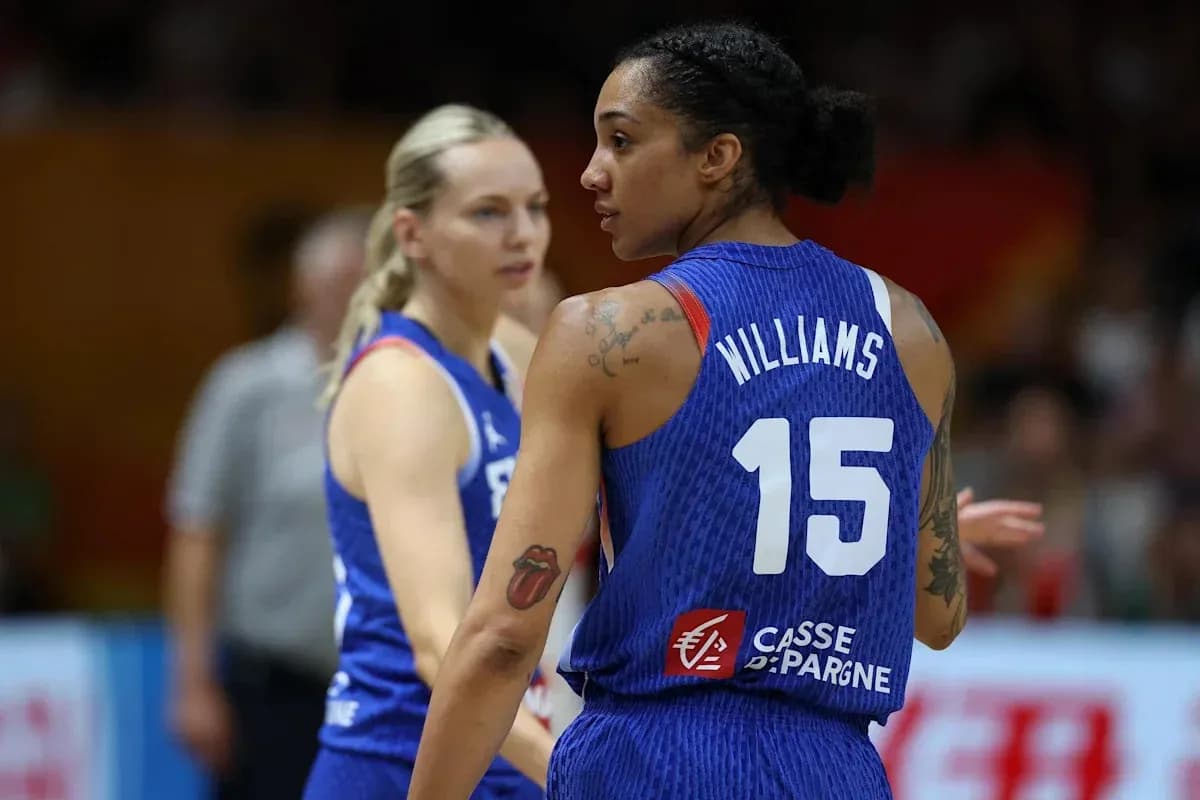
2. Gabby Williams, France
France has swagger again, and Gabby Williams is driving it.
She’s doing a bit of everything, and a lot of it at an elite level: 18.7 points per game, 58.8% from the field, and a scorching 55% from three. She’s also adding 4.7 rebounds and 3.3 assists. No one in the tournament is scoring more points per game.
Williams isn’t just padding the box score. She’s dictating tempo, punishing mismatches, and giving France a go-to option when possessions stall. With France waiting for the winner of Puerto Rico vs. China in the quarterfinals, her form turns them from contenders into a real threat for gold.
3. Iyana Martin, Spain
At 20 years old, Iyana Martin is not supposed to look this poised on the World Cup stage. She does anyway.
The Portland Fire guard has become Spain’s spark and stabilizer in one. She’s averaging 17.3 points on ruthless efficiency — 56.2% from the field and 43.8% from deep — while chipping in 3 assists a night.
History is already in her pocket: she’s the first under-21 player this century to score at least 20 points in back-to-back World Cup games. For a program used to veteran leadership, Spain suddenly has a new face of the future, and she’s already delivering in the present.
4. Julie Vanloo, Belgium
Every star needs a co-star. Meesseman has Julie Vanloo.
Vanloo has been Belgium’s second pillar, and at times, their flamethrower. She’s putting up 16.3 points per game on 51.4% shooting, including 44.8% from three, while also handing out 4 assists.
Belgium’s perfect 3-0 record owes plenty to the Meesseman–Vanloo tandem. When defenses load up on the big, Vanloo punishes them from the perimeter. When the ball needs moving, she turns from scorer to creator without a hitch. It’s a partnership that can carry Belgium deep.
5. Marine Johannes, France
When Marine Johannes gets hot, it feels like the floor tilts.
The New York Liberty guard is France’s second-leading scorer, averaging 17 points per game and hitting an outrageous 52% from three. She stretches defenses to breaking point, then steps back another foot and hits again.
Johannes brings experience and nerve to a French team eyeing gold. She doesn’t need high volume to change games; a three-minute burst from her can flip a quarter, a half, a tournament. As the knockout rounds loom, her shooting becomes a weapon no opponent can ignore.
6. Ezi Magbegor, Australia
Australia’s path has already taken a hit with Alanna Smith ruled out for the tournament with a lower-leg injury. That only sharpens the spotlight on Ezi Magbegor.
The Seattle Storm standout is captain, anchor, and leading scorer. Through three games, she’s averaging 15.7 points on 59.5% shooting, hitting 42.9% from three and pulling down 6.3 rebounds per game.
Magbegor’s versatility is carrying the Opals. She can stretch the floor, protect the rim, and bully smaller defenders inside. With Smith sidelined, Australia’s hopes lean even harder on her shoulders. She looks ready for that weight.
7. Dorka Juhász, Hungary
Dorka Juhász might be battling inconsistency with the Minnesota Lynx, but the moment she pulls on a Hungary jersey, everything clicks.
Through four games, she’s averaging 15.3 points on 50% shooting and absolutely owning the glass with 11 rebounds per game. That double-double presence has powered Hungary into the quarterfinals.
Her impact goes beyond the numbers. Juhász gives Hungary a physical edge, a reliable target in the paint, and second chances on the boards. For a nation not often mentioned among the powerhouses, her dominance has changed the conversation.
8. Xu Han, China
China’s fate hangs on a single game against Puerto Rico, but Xu Han has already stamped her authority on this World Cup.
The New York Liberty center is averaging 17.3 points, 11.3 rebounds, and 2.7 assists per game, shooting 52% from the field and a stunning 54.5% from three. A 6-foot-plus center spacing the floor like that is a tactical nightmare.
If China gets past Puerto Rico, a quarterfinal date with France awaits. That matchup will put Xu directly up against Williams and Johannes. On current form, she won’t shrink from it.
9. Sevgi Uzun, Turkey
Turkey’s 0-3 record doesn’t tell the whole story. Sevgi Uzun does.
The former WNBA guard lit up the tournament, leading all players in assists with 8.3 per game while also scoring 17.7 points a night. She shot 53% from the field and 45% from three — elite numbers on a team that struggled to keep pace.
Uzun was Turkey’s lifeline, creator, and scorer rolled into one. The wins didn’t come, but her performances made sure Turkey never went quietly.
10. Djeneba N’Diaye, Mali
Mali is out, but no one will forget what they did here — or who led them.
Djeneba N’Diaye averaged 17 points per game on 50% shooting, including 45% from beyond the arc, across three games. Her signature moment came in the shock of the group stage: 19 points in an 82-73 upset of Spain, just Mali’s second-ever World Cup win and their first since an overtime thriller in 2010.
For a program still fighting for respect on the global stage, N’Diaye delivered a statement. Mali may be done in this tournament, but with performances like hers, they won’t be overlooked the next time they arrive.