USA Secures Fifth Straight World Cup Title Against France
The USA are still on top of the world. Just don’t call them untouchable anymore.
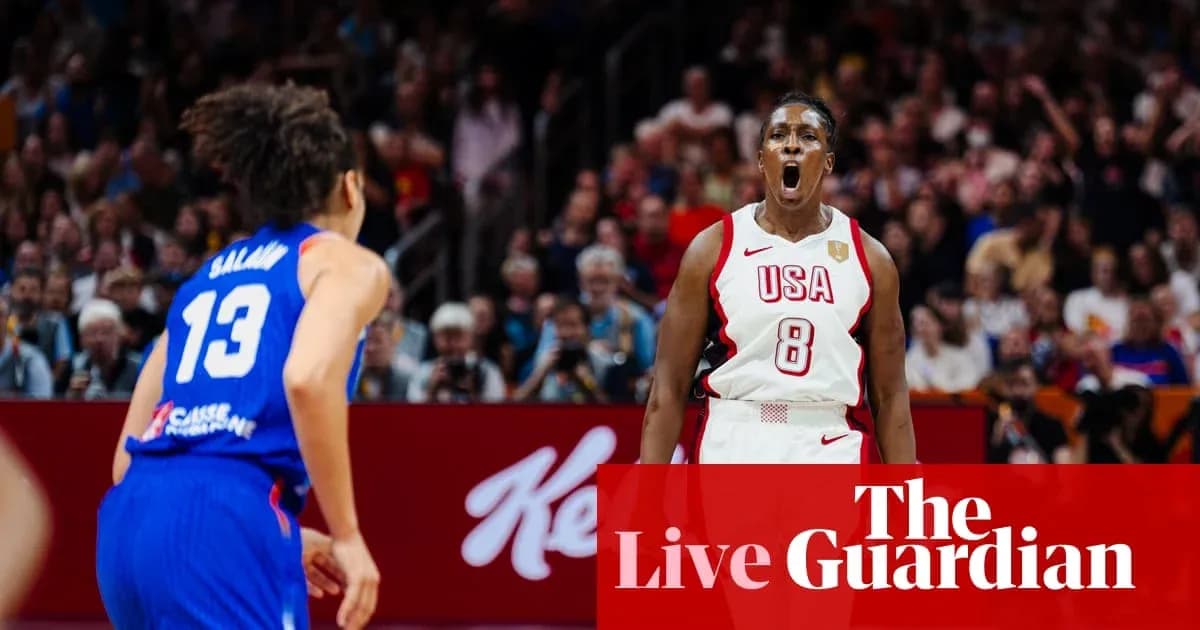
In Berlin, in a World Cup final that briefly threatened to rewrite the sport’s hierarchy, the Americans absorbed France’s best punch, steadied themselves and then walked away with a fifth straight title, 97-79. It was ruthless without being spectacular, clinical without ever feeling calm. The dynasty endures, but the gap has closed.
France fly, then fall
For a quarter and a half, this looked like the night the script would finally flip.
France, still nursing the scar of that Olympic final two years ago when Gabby Williams’ would‑be game‑tying three turned out to be a long two, came out firing. Layups, threes, crisp ball movement. At 31-17 early in the second quarter, the USA were rattled, their offense rushed, their defense a step slow. Marine Fauthoux wasn’t here, but France had Williams carving them up again, Dominique Malonga pounding the paint and the shooters spaced perfectly around them.
Kara Lawson burned a timeout with her team down double digits. It didn’t immediately fix much. Ayayi splashed a three, Leite hit a jumper, and Williams drilled from deep to stretch the lead to 14 at 22-36. The Americans were forcing drives, missing open looks, and looking, for once, human.
Then the veterans went to work.
Jackie Young finally stemmed the bleeding with a three, then turned a broken play into a five‑point possession when Breanna Stewart was fouled off the ball and hit both free throws. Boston started to make her presence felt inside, deflecting a Johannes three and scoring in transition. Gray, already humming, threaded a no‑look pass through traffic to Young in the corner, then kept hitting the sort of off‑balance, late‑clock jumpers that break a defense’s spirit.
The game began to tilt.
Clark’s flash, Gray and Stewart’s control
France still held the upper hand late in the second quarter. Williams was up to 16 points by halftime, Janelle Salaun had shaken free for key buckets, and the USA were still chasing at 39-45 inside the final minute.
Then Caitlin Clark finally arrived.
Her first real look – a corner three on the halftime buzzer – dropped cleanly to cut the deficit to two at 43-45. It was only her second shot of the game, but it felt bigger than that. The US bench erupted, the French lead was suddenly fragile, and a tense, beautiful final had truly begun.
Clark’s overall line was tidy and telling: 12 points in just over 10 minutes, 4-of-5 from the field, 2-of-3 from deep, four turnovers and a technical foul for arguing a call in the fourth. She wasn’t the engine – that belonged to the veterans – but she changed the temperature when she came on, especially in the second half when she strung together a drive, a three and a pair of free throws to help blow the game open.
The real backbone, though, was familiar. Stewart, Young and Chelsea Gray read the game like a trio who have been here before – because they have.
Stewart finished with 22 points and nine rebounds, just missing a double-double and passing Cheryl Miller early on to become the fifth‑leading scorer in US history. Young added 18 points and five assists, and Gray, the ever-reliable metronome at point guard, posted 12 points and five assists of her own. Each time France threatened to find a foothold, one of those three made the right decision: the extra pass, the pull‑up jumper, the calm reset.
By the break, France’s shooting numbers were sparkling – 52% from the field, 8-of-14 from three – but the USA had quietly clawed back on the glass and in the paint. Stewart already had six rebounds; the Americans led 15-12 on the boards. Those were the first signs of the tide turning.
Third-quarter chokehold
The third quarter was where the final really changed shape.
Stewart tied the game on the first possession of the half. Collier, quiet but typically solid, muscled through a scramble to give the USA their first lead “in eons,” as it felt. France still had moments – a slick back‑and‑forth between Williams and Malonga, a tough scoop from Ayayi – but their rhythm began to fray.
The USA’s defense tightened a notch. Johannes, so often France’s chaos merchant, went cold. Williams stopped getting clean touches. Malonga had to work for everything.
At 52-47, Young splashed a jumper and Lawson’s side suddenly had a bit of air. Copper, who had been grinding on both ends, drilled a three after Collier kept a broken possession alive. Then came the sequence that effectively snapped France’s composure.
With under a minute left in the quarter, Copper glided past Johannes and took a heavy whack. Officials went to the monitor to review it as a potential “act of violence” and upgraded it, giving the USA four free throws and the ball. Copper hit three of four, the Americans scored again on the ensuing possession, and France’s wheels finally started to come off.
Toure briefly threw them a lifeline with a three, but Clark answered with a calm fadeaway at the horn. From 45-40 down late in the first half, the USA had outscored France 33-12 in a devastating stretch. The scoreboard read 73-57 after three. The team in blue had just lived through a nightmare quarter.
Malonga’s stand, USA’s depth
France refused to fold. Pride and talent wouldn’t let them.
Malonga, the 20‑year‑old center from Seattle, kept swinging. She hit a corner three, then bullied her way to the rim on consecutive trips. She finished with 21 points and a series of fearless drives, including a three‑point play after banging into Collier. At one stage in the fourth, she practically authored a 13-2 run by herself.
But the hole was simply too deep.
The Americans had built a 27‑point lead early in the fourth at 86-59. They were dominant on the glass – 36-27 overall – and every French mistake seemed to turn into an American layup or free throws. Williams, brilliant in the first half, endured a miserable second. Her final line – 20 points and seven assists – still spoke to her influence, but the turnovers and missed chances late underlined how the US defense had adjusted.
Copper kept pushing, adding 15 points and a couple of dagger buckets in the final minutes. Collier chipped in timely scores. Boston battled inside. Angel Reese, who had come in during the first quarter and missed two early free throws, settled into her role, blocking shots, finishing a late Stewart feed and making Malonga work at both ends.
Clark’s cameo in the closing stretch was pure theater: the foul and technical that gave the game a WNBA edge, the quick‑release three, the drives through contact. Her plus/minus may have dipped as Lawson left the starters out longer than many expected, but she showed why this coaching staff trusts her in spurts even when the shot hasn’t always been there this tournament.
With the result secure, Lawson finally emptied the bench. Sonia Citron and Kiki Iriafen checked in, alongside Clark, as Stewart, Gray and Young exited to well‑earned ovations. It was a small but telling snapshot: the present walking off, the future stepping on.
A dynasty under pressure
When the buzzer went, the numbers told a familiar story. USA 97, France 79. Another gold medal. Another unbeaten run through a major tournament. Another reminder that, when it matters most, the US still find answers.
But this World Cup also underscored something else: the rest of the world is catching up, fast.
Italy pushed them to the brink in the group stage, clawing back from 15 down before the US defense bailed out a sputtering offense in a 55-52 grind. Spain had them tied at 58 after three quarters in the semifinal. France led this final by 14 and looked, for a long stretch, like the sharper, more inventive side.
The Americans are no longer a prohibitive favorite simply by showing up. They are still the standard, but no longer the only team capable of playing at this level.
That might be the best news women’s basketball could ask for.
The next cycle will bring its own questions. Can this core – Stewart, Young, Gray, Copper, Collier – hold off a wave of European challengers for one more Olympics, one more World Cup? How quickly will the next generation – Clark, Reese, Boston, Bueckers, plus Citron and Iriafen – turn promise into dominance on this stage?
For now, the record books will show another American coronation. Five straight World Cups. A 71‑1 mark at the sport’s highest level since 1994. A glass case full of medals that barely leaves room for doubt.
But France, and the rest of Europe, walked out of Berlin with something just as important as silver.
They left knowing the giant can bleed.