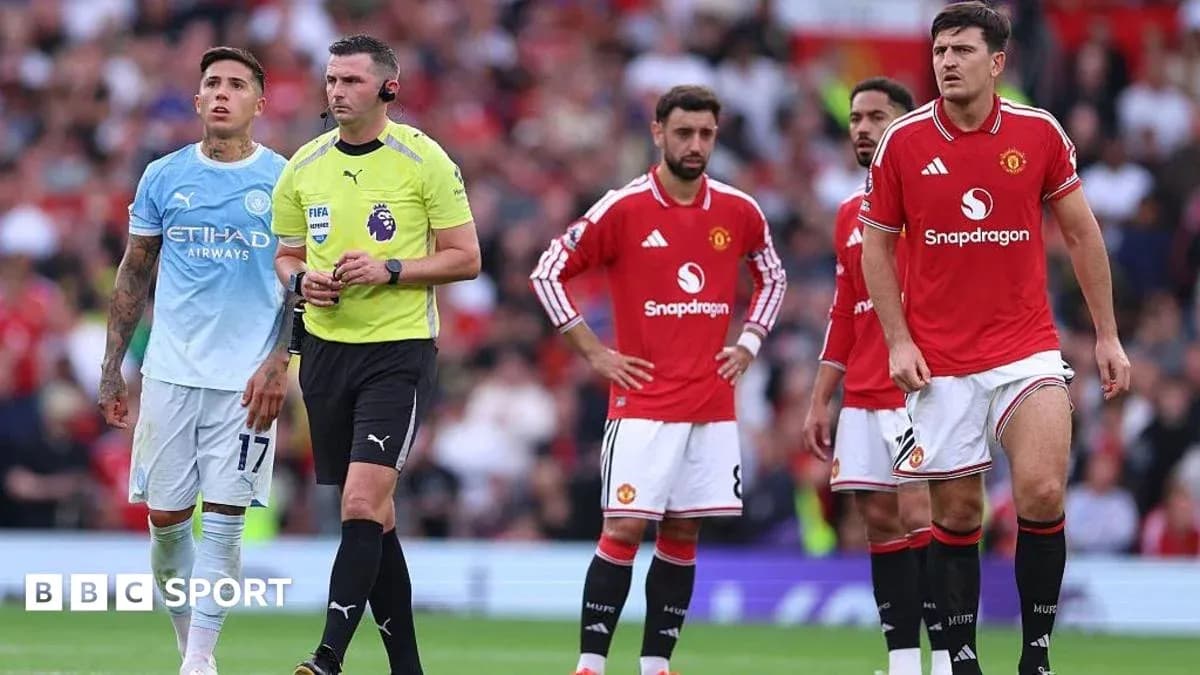
“Quick, quick, quick, quick! Go, go, go, go, go!”
In the heat of a Manchester derby, those words from video assistant referee Matt Donohue were meant to signal efficiency. Instead, they became the soundtrack to one of the most glaring VAR failures the Premier League has witnessed.
Seconds later, Erling Haaland’s winning goal stood. Manchester City 1, Manchester United 0. And Enzo Fernandez, three yards offside in the buildup, somehow invisible to the officials with every camera angle at their disposal.
Speed over sense
Refereeing has always been a goldfish bowl. VAR turned it into a microscope. Every decision replayed, dissected, slowed down, frozen. Every mistake amplified.
This season, the Premier League doubled down on a new mantra: VAR must be quicker. Shorter delays. Slicker checks. Less dead time. The league even formalised it as one of its football “principles” – a more efficient application of VAR to reduce delays.
The pressure seeped into the booth.
“Let’s go, let’s go, let’s go, let’s go!”
Donohue’s voice on the audio is hurried, anxious. The exchange with the replay operator sounds frantic, not forensic. Rushed, not rigorous. Everything a video official is told not to be.
Fans complain that VAR takes too long. Managers grumble. Pundits hammer home the point. The Premier League stakeholders’ survey – canvassing managers, coaches and supporters – identified one clear priority for improvement: speed.
That background noise matters. But it cannot excuse what unfolded on Sunday.
The moment it went wrong
The key error did not come when Donohue began to race through the attacking phase. It came just before.
On the first replay, as Josko Gvardiol shapes to cross, Donohue asks the replay operator to freeze the frame at the moment of contact. From there, he jumps straight into the semi-automated offside technology.
Process broken. Steps skipped.
The VAR team should first have watched the entire sequence – from Gvardiol’s cross to Haaland’s header – to understand every position and every action in the box. That wider picture would have made Fernandez’s offside position and involvement impossible to miss.
Instead, they locked in on a single question far too early: did Fernandez touch the ball? In their minds, that became the hinge point. If he got a touch, it would start a new phase and put Haaland offside. If he didn’t, Haaland was fine.
They never truly reassessed the chaos in the area. They never properly reset.
The offside line went down. The check hurtled towards its conclusion. Fernandez, standing three yards beyond the last defender when the ball came in, simply vanished from the decision.
A missing safety net
Donohue has carried most of the blame, but the role of assistant VAR Blake Antrobus is just as significant.
The AVAR exists as the safety net – the second set of eyes, the one who spots what the VAR has missed, who slows the process down if something feels wrong.
On this review, Antrobus’ only contribution was a brief, uncertain “no, yeah” on whether Fernandez had made contact with the ball. One second later, Donohue delivered the verdict: “final decision is goal, check complete”.
No challenge. No pause. No insistence on a wider look inside the penalty area. The checks and balances collapsed in a single, hurried exchange.
The context is uncomfortable. The only truly long VAR delay in the league this season came in Brentford v Sunderland, when a Dan Ballard goal was ruled out for a subjective offside against Kevin Danso. That review took more than four minutes. Antrobus was AVAR that day too and faced heavy criticism in some quarters for the length of the check.
Did that experience push him towards speed at all costs on Sunday? Only he will know. The irony is brutal: in that Brentford game, Antrobus helped guide VAR Tim Wood to the correct offside decision against Danso.
There was another potential safeguard. In the operations room at Stockley Park sits a support VAR, whose job includes stepping in on protocol. That official could see the review hurtling towards a conclusion. No intervention came.
Even after the goal was given, there was still a window – the gap between the ball hitting the net and the restart from kick-off – when the decision could have been rescued. It wasn’t.
A system built for this – and still failing
Pro Ref has poured time, money and training into VAR. Workshops, simulations, specialist coaching. The aim: make decisions both accurate and efficient.
Yet when a mistake of this scale happens, the investment feels hollow.
Calls to appoint “VAR specialists” have grown louder, but in Premier League terms, that is exactly what Donohue is. Three seasons ago, Pro Ref invited officials to apply for a dedicated video role. Candidates went through aptitude tests; around 15 reached the final stages of training. Ten of them have since worked Premier League matches as VARs.
Donohue is one of that group. Sunday was his 65th game as the video official. His progress has been such that he is now on the international list and worked Uefa club competition qualifying ties over the summer.
He has made mistakes – they all have – which underlines the difficulty of the job. Across the last two seasons, only two VARs, Nick Hopton and Neil Davies, have a clear record with no key errors, and both came through the same accelerated pathway.
The romantic idea is simple: take experienced referees, remove the physical and mental strain of the pitch, and turn them into full-time VARs. Reality has been harsher. Lee Mason and Mike Dean, the only two full-time VARs appointed after retirement, were both dismissed by Howard Webb just months into his tenure, their spells marred by high-profile errors.
Spain offers another cautionary tale. La Liga and its second division operate with a full team of officials who only work in the VAR booth, never on the pitch. Yet controversy there is as fierce and frequent as in England. At the start of last season, the VAR in Spain completely missed that a goalscorer was offside when the ball was played. Different country, same outrage.
Specialists, then, are no magic fix.
The numbers and the trade-off
On the surface, the Premier League can point to progress. VAR delays, including the time it takes for the referee to announce the decision to the crowd, have dropped from an average of 46 seconds per game to 36 seconds compared with last season.
The league can also argue that only one other clear VAR error has blotted this campaign – the failure to award Arsenal a penalty at Aston Villa – and that, again, arguably came because the incident was cleared too quickly.
The pattern is hard to ignore.
When West Ham’s stoppage-time equaliser against Arsenal was ruled out last season, the review dragged on for more than four minutes. Nobody enjoyed the wait. But the decision was right.
On Sunday at the Etihad, the opposite happened. The review was slick, sharp, television-friendly – and wrong.
Human cost, football problem
City manager Enzo Maresca, the main beneficiary of the blunder, offered a measured response when asked on Wednesday.
“To make a decision in 10, 20 seconds is not easy for them,” he said. “Sometimes they make mistakes. I make mistakes, players make mistakes. It’s part of our job.”
It is a generous view, and a fair one. Donohue and Antrobus did not set out to botch the biggest call of the derby. They are working in a climate where every second of delay is treated as an affront to the spectacle. The message from almost every stakeholder has been clear: be faster.
Yet this is where the sport now finds itself. An obsession with speed that threatens to undermine the very credibility VAR was brought in to protect.
Pro Ref will have to explain how a VAR, in one of the marquee fixtures of the season, ended up rushing through a review with such obvious gaps in process. Why the AVAR did not pull the handbrake. Why the support VAR stayed silent. Why a system built on layers of protection still allowed a three-yard offside to slip straight through.
The technology has not changed. The cameras have not moved. The angles are the same.
The question for the Premier League is whether it still wants the truth from VAR, or just a quicker version of the same old arguments.