
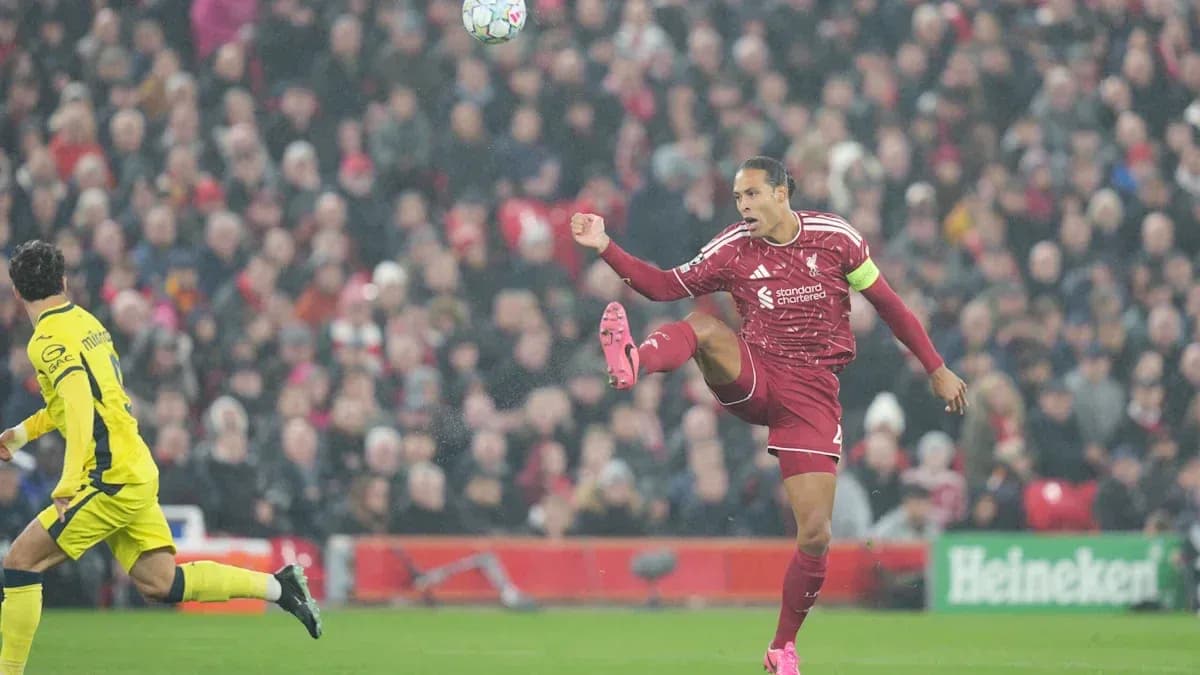
Virgil van Dijk is walking into the most delicate spell of his Liverpool career with the same unhurried authority he shows when a long ball drops out of the sky at Anfield. The clock is ticking on his contract. He is not flinching.
The Liverpool captain’s deal runs out at the end of June, a hard deadline for a club already juggling major decisions at the back. Yet there is no pledge, no ultimatum, and certainly no panic from the 35-year-old.
Speaking after Liverpool’s win over Crystal Palace, in comments reported by Gregg Evans for The Athletic, Van Dijk made one thing absolutely clear: he is not done.
“I want to keep playing and continue what I’m doing so let’s see what the season brings,” he said. “I’ve had an amazing time already so far. If that will be extended, that's the case. If not, then I will go somewhere else. There's nothing to report at the moment but that doesn't mean that there's any stress or anything.”
It was classic Van Dijk. Cool. Measured. Door open both ways.
No promise to stay. No hint he has chosen to leave. Just a centre-back who knows his worth, comfortable enough to let the situation breathe while he focuses on the next game, not the next contract.
“I feel good but it's not about me at the moment. I'm not in any panic whatsoever,” he added.
For supporters, that ambiguity fuels unease. For Van Dijk, it is simply the reality of a late-career negotiation at a club still shaping its next defensive era.
Ever-present and still central
If Liverpool needed evidence to support a new deal, they barely have to look beyond the team sheet. Van Dijk has played every minute of their Premier League campaign so far, anchoring a back line in transition and guiding Jeremy Jacquet through his early steps in English football.
This is not a veteran coasting on reputation. His presence remains structural. He organises, he cajoles, he absorbs pressure, and he still sets the tone for those around him.
His influence stretches beyond what he did in title races gone by. Under Andoni Iraola, he remains embedded in the team’s evolution, not just its memory. Every week he offers a live, current argument for continuity.
Yet Liverpool cannot afford to be sentimental. Extending a 35-year-old defender is never just about today’s level. It is about tomorrow’s risk.
Age is a factor. It always is at this stage. But it is not a verdict on its own. The club must weigh his durability, his leadership and his continued ability to play at the highest level against the length and structure of any new agreement.
Playing through a “niggle”
There is another layer to the discussion: his body.
Van Dijk admitted he has been managing a minor physical issue in recent weeks.
“Mentally I'm in a good place, physically I've been struggling with a little niggle the last couple of weeks but I do everything in my power to be out there,” he said.
That commitment is familiar. He has withdrawn from the Netherlands squad for the upcoming international break, a decision that buys him rest and Liverpool some breathing space.
The nature of the problem has not been disclosed, and there is no suggestion yet of a long-term absence. It would be a stretch to label it a major concern on the information available. Still, for a club assessing a new deal for a 35-year-old who plays every minute, even a “little niggle” matters.
Managing his workload will be part of any plan. He wants to play. He always does. The challenge for Liverpool is to preserve what makes him so valuable without pushing him to the point where that value erodes.
A defence in flux
Van Dijk’s future does not exist in isolation. Liverpool’s entire defensive picture is unsettled.
Joe Gomez is also out of contract in June, another key figure whose status needs resolving. Giovanni Leoni, meanwhile, remains sidelined with an anterior cruciate ligament injury, removing one more option from the immediate depth chart.
Those factors strengthen the case for keeping the captain. Continuity at the heart of the defence suddenly looks more like a necessity than a luxury. But nothing is guaranteed. Sentiment cannot write contracts, and Liverpool’s hierarchy will judge each case on its own merits.
There is a reminder in the recent past. Van Dijk last extended his deal in April 2025, signing a two-year contract not long before his previous one was due to expire. The stand-off then did not lead to a parting of ways. It may not this time either.
Still, the stakes feel different now. He is older. The squad is being reshaped. The club must balance performance, availability and the broader make-up of the back line before committing to another chapter together.
Van Dijk has already laid out his stance. He wants to keep playing. He treasures what he has experienced at Anfield. He is prepared for either outcome.
The decision now sits with Liverpool: do they build the next version of their defence around him once more, or accept that the era of Virgil van Dijk at the heart of Anfield is edging towards its final whistle?





