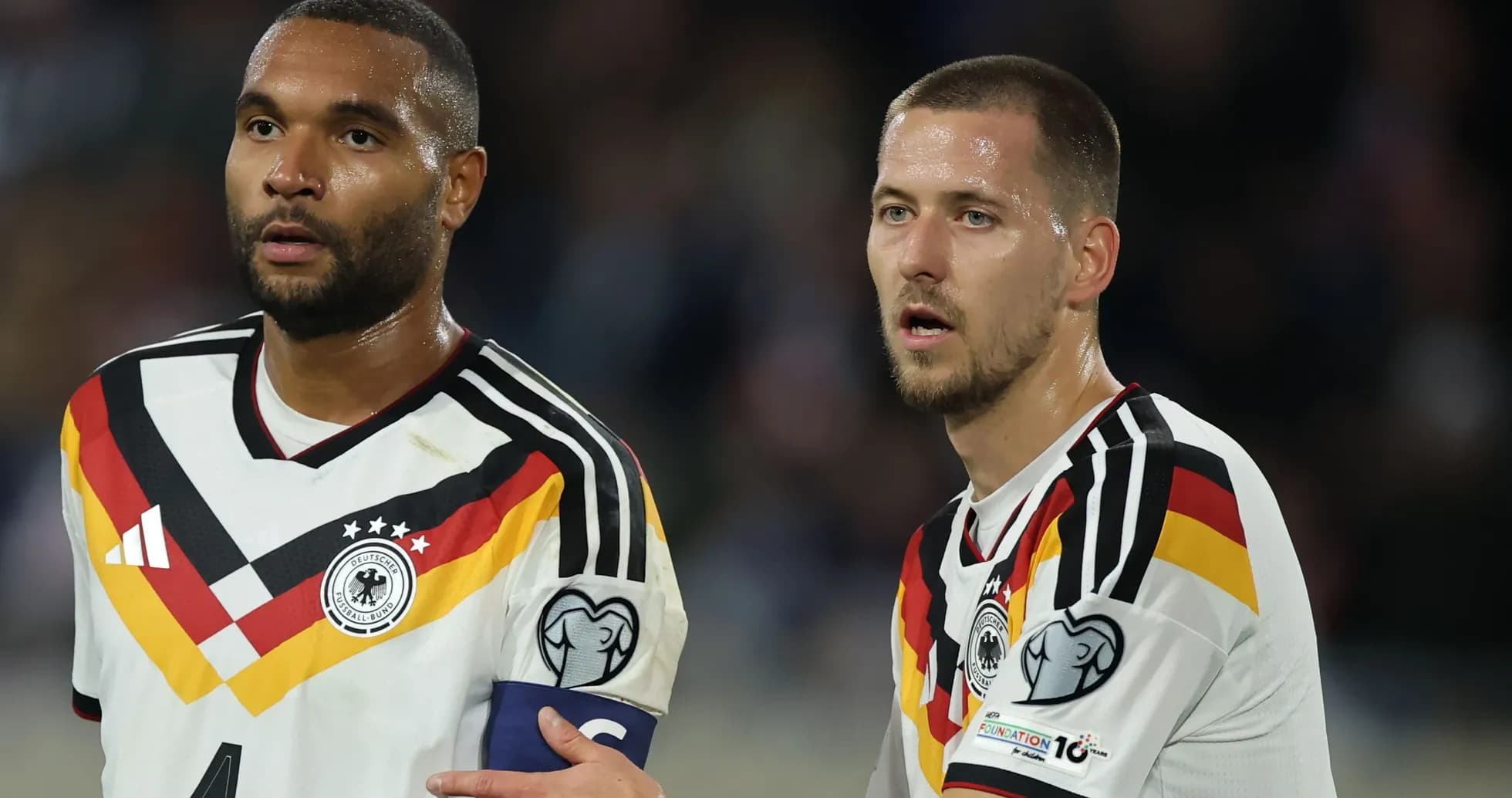
Waldemar Anton does not shout often. When he does, Serhou Guirassy usually hears it first.
"It actually happens in every game that we shout at each other once," Anton admitted recently. Old friends, old habits. They have known each other for so long that the words can be blunt, even harsh, without leaving a scar. On the pitch, honesty comes before niceties.
On Saturday night in Stuttgart, Anton had every excuse to raise his voice again.
A flash of anger, a wall of calm
Borussia Dortmund were grinding their way through a tight, nervy 1-0 win against VfB Stuttgart when Guirassy ambled off in the 74th minute. Too slowly. Under the new rules, that hesitation cost BVB a full minute with ten men as Fabio Silva waited out his 60-second delay on the touchline.
Niko Kovac’s reaction left no doubt about his opinion of the striker’s stroll. The coach bristled on the sideline, furious at the unnecessary risk in a game decided by inches.
Anton, though, had no time to dwell on it. Back at his former club, in a stadium where every touch still draws loud boos two years after his abrupt move to Dortmund, the 30-year-old had other battles to fight. The noise rained down, but it did not break him. It rarely does.
Once again, neither he nor his team were beaten.
The backbone of Kovac’s Dortmund
Since Kovac took over, defending has stopped being a weakness and turned into Dortmund’s defining trait. Last season they already finished with the best defensive record in the league, conceding just 34 goals. Four matchdays into the new campaign, they have tightened the screws even more: three clean sheets, only two goals conceded, level with Bayern Munich at the top of that table.
At the heart of that transformation stands Anton.
His first year at BVB was anything but smooth. Two muscle fibre tears in quick succession sidelined him for the longest spell of his career, disrupted rhythm, and raised questions. Those questions have long since vanished. Over the past year he has become what Kovac once called a “total constant” in Dortmund’s back line.
Kovac rarely misses a chance to underline it. Before the Champions League opener against Villarreal, the coach summed up his defender in a way that sounded less like flattery and more like a job description: a leader, someone who lives football around the clock, supports his teammates, never gives up, gives everything for the team. A role model.
On the pitch, the evidence is hard to argue with.
Ironman in black and yellow
Last season Anton quietly put together one of the most complete campaigns of any defender in Germany. He looked more secure than his partner Nico Schlotterbeck, who also missed time through injury at the start of the year, and he did it without drama. No fuss, no theatrics, just relentless, repeatable work.
The numbers tell the story. Of 47 competitive matches in 2025/26, he was unavailable for only three. In league and cup, he started 35 times and finished every single one of those games. No early substitutions, no managed minutes. Just 90 after 90.
Kovac dubbed him “Ironman” for a reason.
Even the World Cup could not knock him off course. While others eased back into club life after a draining tournament, Anton returned late and simply carried on. Fifteen caps for Germany on his back, barely any preparation time in his legs, and yet he slipped straight into the new season in the same outstanding form.
Availability alone does not make a defender indispensable. In Anton’s case, it is just the foundation.
Front-foot defending, old-school mentality
What truly elevates him is the way he leads. Not with gestures for the cameras, but with discipline, resilience and a refusal to switch off. He plays without decoration, defends with an edge, and treats every duel as if it matters more than the last.
His anticipation has become one of the most striking aspects of his game. Since Mats Hummels, no centre-back at BVB has defended on the front foot with such intelligence and timing. He steps in early, reads danger before it blooms, and turns potentially chaotic situations into routine clearances.
The data backs the eye test. Anton ranks among the league’s best in duel success rate, aerial duels won, interceptions and clearances. When Dortmund look solid, he is usually in the middle of it, sweeping, blocking, barking instructions, dragging the line a few metres higher or deeper as needed.
In a team that has rebuilt its identity around defensive stability, he has become one of the defining faces of the Kovac era. Right now, on current form, there is no German centre-back playing better.
Klopp’s blueprint and the Germany question
That form inevitably leads to the national team. Jürgen Klopp wants to restart Germany with a style anchored in a rock-solid defence. For that, he needs more than just talent. He needs certainty.
Anton offers exactly that. Experience, sharp match fitness, a clear voice at the back, and a natural instinct to guide younger players through difficult phases. In short, almost everything Klopp would draw up on his whiteboard for the future DFB team.
There is competition, of course. Long term, Schlotterbeck’s strong left foot and his diagonal passing might give him an edge in certain game plans. Bayern Munich’s Jonathan Tah remains the established number one in the heart of defence. Those hierarchies do not change overnight.
But form demands attention. And Anton’s form is impossible to ignore.
No ego, no doubts at Dortmund
The man himself will not shout about it. Kovac has described him as very calm, very modest, very humble, someone who pushes his ego to the side and the team to the front. It fits the way he plays, and it fits the way he carries himself off the pitch.
Time will decide how the battle for places in Germany’s defence unfolds and whether Anton becomes a permanent pillar of Klopp’s rebuild or a trusted rotation piece.
At Dortmund, there is no such debate. In a team sitting atop the table and priding itself on its defensive steel, Waldemar Anton’s name is written in ink, not pencil.