
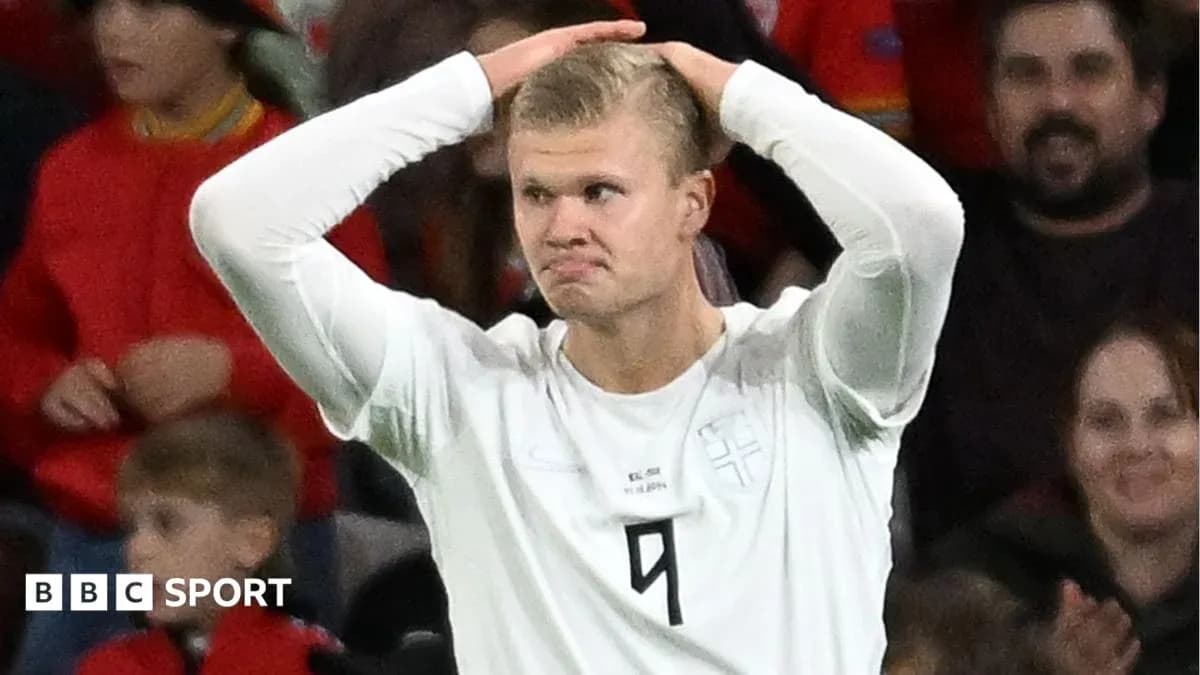
Erling Haaland is the problem modern defenders cannot solve. Wales, improbably, have at least found a working theory.
On Saturday in Oslo, Craig Bellamy’s side walk back into the storm. Norway at home. Nations League points on the line. Haaland in his own backyard, with 65 goals in 59 caps and a Manchester City highlight reel that has shredded some of the best back lines in Europe.
And yet, a month ago in Cardiff, Wales made him look almost ordinary.
Bellamy’s Gamble
Bellamy knew the numbers. He knew the reputation. He also knew that waiting for Haaland is usually the beginning of the end.
"You're talking about trying to deal with one of the best players in his position in the world," the Wales head coach said. "He’s different to what you would normally have to deal with."
So he went against instinct.
Most teams, spooked by Haaland’s pace and power, sink back. They crowd the box, drop 10 yards, try to close off the penalty area. The logic is obvious: protect the space where he does the most damage.
It usually backfires. Sit deep and you give him exactly what he craves – time to pick his runs, time for his team-mates to pick him out.
Others try to fight fire with fire. Go physical. Wrestle with a 6ft 5in centre-forward who thrives on contact and relishes the chaos. That rarely ends well either.
Bellamy chose door number three. He pushed the line up and told his players to live with the risk.
"Drive up and don't let him dictate," he explained. He knew the question that would follow: why on earth play a high line against Haaland? "Trust me you don't want to, but you can't have him dictating the game."
The idea was simple, the execution anything but. Press the ball. Crush the supply. Turn the game into a grind for Norway’s stars rather than a showcase.
"A good player can look like a top player if you give him time," Bellamy said. "A top player can look world-class if you give him time. A world-class player might then have a chance of looking like an ordinary or good player, if you don't allow him time."
On that night in Cardiff, the theory held.
Star Striker, Starved of Service
Haaland finished with 24 touches. For him, that in itself is not shocking; he has built a career on doing little for long stretches, then everything in a heartbeat. The telling detail lay elsewhere.
Two shots. One on target. A routine header straight at Danny Ward.
Wales didn’t just mark Haaland. They unplugged him.
They cut off the lines from deep, the slide-rule passes, the clipped balls into the box. That is no small achievement when the man trying to feed him is Martin Odegaard, the Arsenal captain who drove his club to the Premier League title last season and one of the division’s most inventive playmakers.
So the job description stretched well beyond the back four. Ethan Ampadu and the Wales midfield had to stand in the passing lanes, close down Odegaard, and disrupt the rhythm of Norway’s creators. Behind them, defenders had to track Haaland and his supporting cast – Oscar Bobb of Fulham and Benfica’s Andreas Schjelderup – without leaving the middle of the pitch gaping.
"You have to consider the distance between Ethan and Haaland," Bellamy said. "You can't open up the middle too much because balls are going to come into his feet. You have to get your distances right, be side-on and make sure you're aware of his runs."
Then came the other half of the plan: make Haaland work without the ball.
"It's also important how we use the ball," Bellamy added. "If we use it well, develop our possession and move up the pitch, he has to work. He has to run and get back."
Since Bellamy took charge in the summer of 2024, Wales have tried to evolve into a team that keeps the ball rather than simply survives without it. Their average share of possession has surged. Against Norway, Portugal and Denmark in this Nations League run, that control has been harder to find, and the manager has not hidden his belief that they must improve.
But on that night in Cardiff, when it mattered, they used the ball just enough to keep Norway honest and their star striker chasing shadows.
Distances, Discipline and Dan James
The detail that pleased the players most was not a flash of brilliance in attack. It was the shape without the ball.
Dan James, scorer of Wales’ first goal in the 2-1 win, spoke like a man who knew the margin for error had been thin.
"Our distances [between players] were really good," he said. "Odegaard is a unique player. He'll get the ball anywhere so it's hard as a defence. They want you to jump out and I think they showed that with their goal with the ball for Oscar Bobb and he's finished it well."
Norway still found moments. Odegaard still threaded passes. Bobb still punished one lapse. But Wales bent and did not break.
"We showed our resilience and it was about limiting their chances and I thought we did that," James said. "Odegaard played some great balls in behind but, to the very last minute, we defended really well, not just the defenders but the whole unit, from the forwards back."
The phrase “whole unit” is not a cliché here. Against Haaland, it is a necessity.
"I thought we defended really well on the day," James added, "and we've got to be great again on Saturday."
New Night, New Problems
Oslo will not be Cardiff. The stands will be full of Norway shirts, the pitch familiar to the home side, the mood leaning heavily towards revenge.
Wales also arrive with a reshuffled defence. Ben Cabango, excellent in the first meeting and the man who left with Haaland’s shirt, is suspended. That forces at least one change in the back line.
There is, however, a significant boost. Joe Rodon, the first-choice centre-back who missed the Cardiff game through injury, is back after returning for Leeds United last weekend. His presence restores authority and experience to the heart of the defence.
Bellamy knows, though, that no centre-back pairing wins this battle on its own.
"Ben Cabango and Ben Davies have both done really well against him [Haaland], but the work has to be done in front of them," he said. "If it isn't, you expose the defenders.
"Against this type of player, it doesn't matter how good an individual defender is. We've seen over the last four or five years how difficult it becomes for one player to cope with what Haaland brings."
So the message is clear. Press the ball. Stay compact. Keep the distances tight. Use possession as a weapon, not a luxury.
Bellamy has already promised Wales will go "all out" for victory in Oslo. That is not bravado; it is part of the defensive plan. The more Norway have to defend, the less Haaland can lurk in the spaces where he is lethal.
Stopping the Unstoppable – Together
Haaland will not change. He will still hunt the space behind a high line. He will still bully centre-backs, still explode into the box with those long, loping strides. One lapse, one mistimed press, and the game can tilt in a second.
Wales know that. They saw the danger up close and survived it once.
They also know something else now: if they move as one, if they suffocate the supply and make Norway’s superstar chase the game rather than control it, the myth of the unstoppable striker can be punctured, if only for 90 minutes.
On Saturday in Oslo, they will find out if that blueprint was a one-off – or the start of a new way to live with football’s most ruthless finisher.





