
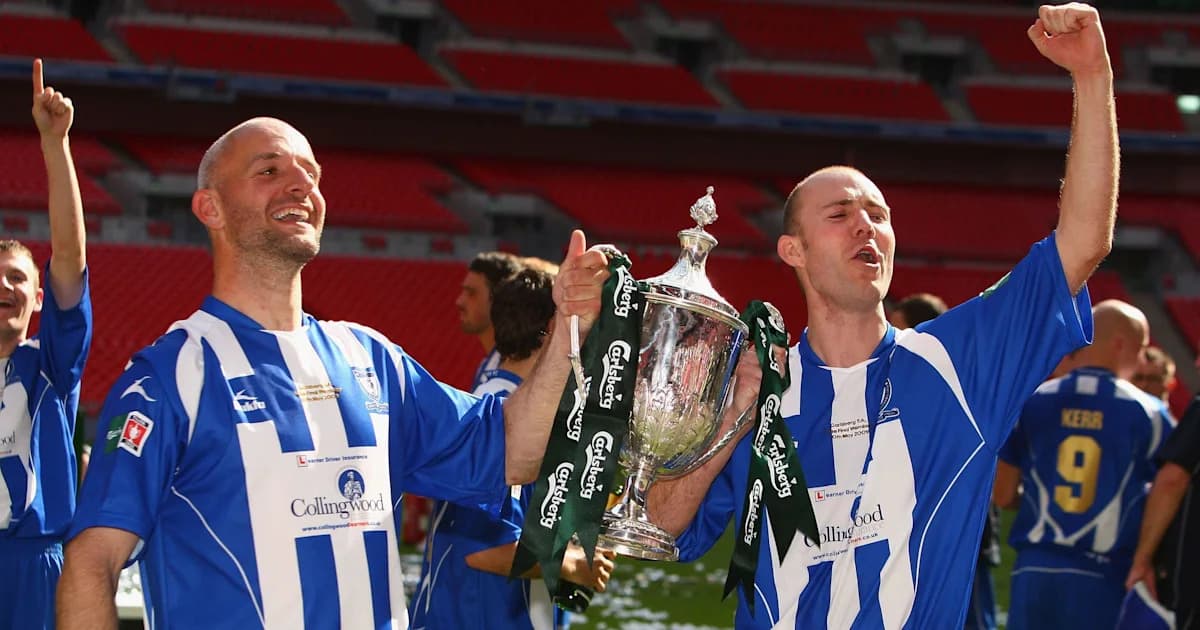
You might recall Pep Guardiola's Manchester City winning four consecutive League Cups from 2018 to 2021, but a lesser-known team achieved a hat-trick of silverware before them. Whitley Bay, competing in the ninth-tier Northern Football League, claimed three consecutive FA Vase finals at Wembley between 2009 and 2011—a remarkable milestone in non-league football.
A Unique Record in Amateur Football
The FA Vase, created in 1974 for amateur sides, has only seen The Seahorses win it four times, including their historic three-peat. This success unfolded under Ian Chandler, a modest IT manager from Sunderland who balanced daily work with planning cup triumphs.
Chandler, having played for Whitley Bay in three spells, took charge as manager in 2004 and stayed for a decade. His role demanded more than strategy; he juggled scouting reports and hotel bookings rather than traditional managerial duties.
Building Resilience Through Setbacks
The team’s drive was fueled by disappointment after missing out on Wembley in 2007-08. Despite a 3-0 early lead in the second leg of the FA Vase semi-finals against Lowestoft Town, they couldn't overturn a 4-0 first-leg deficit. This loss led Chandler to avoid pre-match interviews, believing it brought bad luck.
"It’s the hardest thing to keep a team together—as soon as players get noticed, they move up," Chandler told BBC Sport. "But after reaching the Vase semis, players wanted to stay and prove themselves. Then the lads wanted to do it again. And again."
Chandler, a Sunderland fan, modeled his style on Kevin Keegan's Newcastle United, prioritizing entertaining football over just winning. He joked about defensive formations, saying, "Two or three at the back? One time we chased a game with two at the back."
From Player to Managerial Success
Before managing, Chandler was already a club hero, scoring the winner in the 2002 FA Vase final. Though new to management at 35, he assembled a team that dazzled non-league football across England.
Chairman Paul McIlduff said, "We played good football. We had pace on the wing, fantastic midfielders, and deadly strikers. When we signed players, it was about fitting the dressing room’s psychology—no one thought they were better than anyone else."
Key Players and Off-Pitch Support
One standout was Paul Robinson, dubbed the "Whitley Bay Maradona." Having come through Newcastle United’s academy, he played for various north-east clubs before joining Whitley Bay from 2007 to 2013. Robinson also worked with Chandler at software company Sage, where Chandler was his manager.
Robinson shared, "I was sick of him as a manager at work and football, but it helped getting time off for matches. I often pictured scoring goals and hoped the opposition was poor so we could stroll through."
Robinson’s memorable moment came in the 2010 FA Vase semi-final second leg when his last-minute diving header sealed a 6-5 aggregate win over Barwell, triggering a pitch invasion.
With crowds of 2,000 to 3,000 attending home games, Robinson recalls, "You felt like a real player. Those memories remind me of the ’90s FA Cup—something you never expect in non-league." Whitley Bay even reached the FA Cup third round once, beating Preston 2-0 in 1989-90.
Intimidating Presence in Non-League Circles
The team became feared among non-league sides. Robinson remembered a quarter-final against Biggleswade in 2009 where their opponents arrived in suits, treating it like their cup final, but Whitley Bay won 5-2 easily. "By the end, teams showed up afraid of us," Robinson added.
Community Spirit Fuels the Club
Whitley Bay’s achievements stirred pride in this working-class north-east town, once a Victorian holiday hotspot. Volunteers rallied support by canvassing local shops in Tynemouth, North Shields, and Whitley Bay, promoting the blue and white striped team.
Jenn Robinson, a volunteer, recalled, "Every shop had things in the windows. I still prepare buffets for players and fans; the community loved it."
Local partners like Newcastle United helped with ticket sales, and North Tyneside Council provided security for packed matches at Hillheads Park.
Not all plans went smoothly; a train arranged for fans to Wembley once ended at Kings Cross, forcing last-minute taxi rides. Yet, the fans persisted, making the journey three times, sometimes even experiencing royal treatment in the stadium’s royal box.
Wembley Nights and Lasting Memories
Chandler’s son Benjamin acted as mascot for all three finals. The first final was an overwhelming experience; the bus driver even scraped the vehicle entering the ground. By the third final, the team focused solely on securing the historic three-peat.
- 2009: Whitley Bay defeated Glossop North End 2-0 in front of 12,200 fans.
- 2010: A dominant 6-1 win over Wroxham, including a goal by Paul Chow just 21 seconds in—the fastest Wembley final goal until surpassed in 2023.
- 2011: A tense 3-2 victory against Coalville Town, with Chow scoring the late winner.
Nearly 30,000 supporters watched across these three finals. Post-match celebrations evolved from quiet pub visits to large events with families and fans sharing the joy.
Robinson described the 2010 run: "We spent 10 days together—preparing and then five nights in Marbella. Best 10 days of my life!"
The 2010 trophy lift carried special emotion, with former teammate Mark Taylor joining despite battling motor neurone disease. Chandler remembered Taylor as "the core of our second and third year."
Life After Glory
Success brought media attention and encounters with legendary managers. Chandler attended sports awards alongside names like Sven Goran Eriksson and Sir Alex Ferguson, even witnessing a cheeky greeting to his wife from Sven himself.
Robinson found returning to IT work after Wembley bittersweet. "One year I got a standing ovation entering the office, but then it was back to normal," he said, joking about colleagues tiring of hearing about Wembley.
Whitley Bay’s golden era ended with Chandler leaving in 2014 after a dip in form. The club hasn't won major honors since 2011 and still competes in the ninth tier. Yet, their legacy remains strong in the football-loving north-east.
Chandler laughed recalling a recent encounter: "A guy asked if I was Ian Chandler, then started talking about that team. Everyone here follows football—that memory is lovely."





