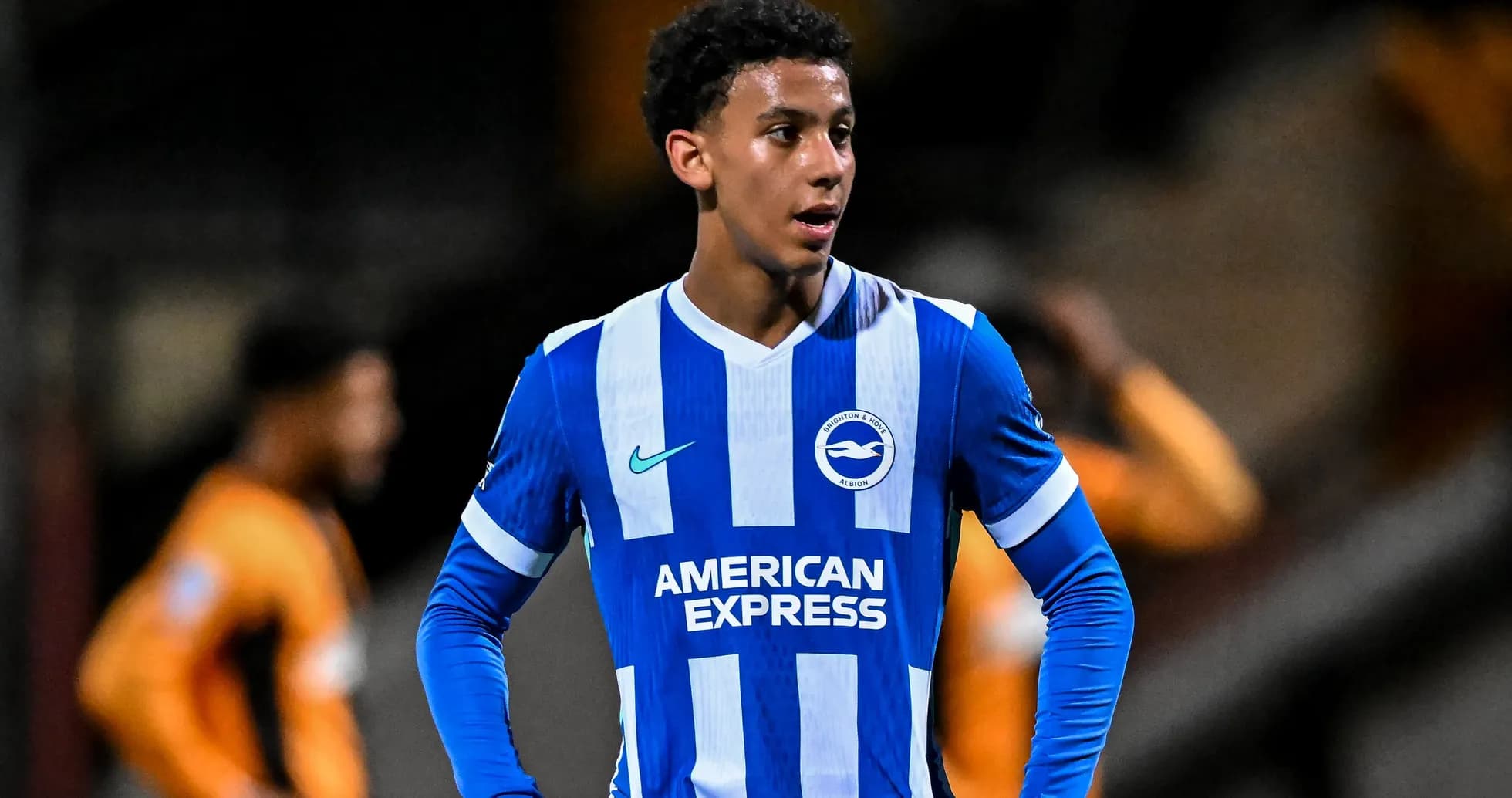
Last Sunday did not feel like youth football anymore for Younes Ibrahim.
Less than 48 hours after lighting up the under-21s with a superb goal, his phone rang with the kind of message every academy player dreams of and few actually hear: you’re with the first team tomorrow.
No ceremonial pat on the head. No token seat on the bus. When Fabian Hürzeler and his staff pull a teenager into the Brighton squad, it carries weight. This is the club that calmly sold Moisés Caicedo for £115 million, moved on Alexis Mac Allister and Marc Cucurella, and kept the conveyor belt moving without blinking. They do not promote on sentiment. They promote when the data, the scouts and the coaches all agree: he’s ready for the next step.
So Ibrahim’s name on the team sheet, even as a substitute against Coventry, said something loud. It said: we see you. Not in a distant, maybe-one-day way, but in a clear, almost imminent sense. First the bench. Then the pitch. Then the rest.
A season that forced the door open
The numbers behind that decision are not eye-catching by accident. This 2026–27 campaign, Ibrahim has already appeared in three matches across youth competitions, with a goal and an assist to his name. Useful contributions, steady progress.
The real statement, though, came last season.
Nine goals. Five assists. A year in which he stopped being just another promising forward and became one of the most influential figures in Brighton’s youth setup. He did it not only as a striker, but as a forward who understands space, who drops between the lines, who can play wide, drift inside, or operate as a false nine.
Coaches talk about “profiles”. Ibrahim offers several in one body. He stretches defences, but he also links play. He runs in behind, but he can receive to feet and turn. For a club that builds teams on tactical flexibility, that matters.
From Luton to London to the south coast
None of this arrived overnight. Ibrahim’s story is not the viral clip of a wonderkid plucked from nowhere. It is the more familiar, more demanding route: patience, repetition, and a ladder climbed one rung at a time.
He began at Luton Town’s academy, far from the glamour but close to the fundamentals. There he absorbed the staples of English youth development: intensity, discipline, physical duels, responsibility without the ball.
Then came the leap. Chelsea’s academy is one of Europe’s most relentless talent factories, a place where competition is fierce and the margin for error thin. Ibrahim walked into an environment of different tactical ideas, higher tempo, and constant scrutiny. Training sessions there feel like auditions. Survive that, and you learn quickly what elite standards look like.
The real turning point, though, came when he chose Brighton and joined the under-15s. On paper, it looked like a step down: leaving the glamour of Cobham for a smaller club’s academy. In reality, it was the smartest move he could have made.
Brighton might be the clearest pathway club in England. From under-15 to under-18 to under-21, Ibrahim climbed without skipping stages, proving at each level that he could grow not only technically but physically and mentally. The plan was clear, the route mapped out. All he had to do was keep hitting the markers.
A contract, and a philosophy
Last July brought the first tangible reward: his first professional contract. For any teenager, that signature is a line in the sand. You are no longer just a hopeful. You are part of the project.
Brighton academy director Ian Buckman framed it not as a destination but as a checkpoint. “It is an exciting moment for the players and their families alike,” he said, before underlining what the club demands next: recognition of past effort, and a challenge to seize the chances that follow.
That is Brighton’s model in a sentence. They do not hand out contracts as souvenirs. They hand them out as tests. You’ve earned this. Now show us you can live at this level every day.
Ibrahim has responded by doing exactly what the club wants: continuing to develop, adding end product, and showing he can handle the jump in pace and physicality as he edges closer to the first team.
Four flags, one decision
The most intriguing part of Ibrahim’s rise, though, stretches far beyond the south coast.
He was born in Australia. That alone puts him firmly on the radar of the Socceroos, a nation always searching for its next long-term striker. Eight years in England mean he is also eligible for the Three Lions, who scour every Premier League academy for potential senior internationals. His Egyptian and Moroccan heritage opens two more doors: the Pharaohs and the Atlas Lions, both of whom have built clear, aggressive strategies to attract dual-nationality talent from Europe.
Four national teams. Four distinct football cultures. One teenager who, for now, is in no hurry to choose.
At 18, that restraint is not caution. It is clarity. The priority sits in front of him every morning at Brighton’s training ground: win a place in Hürzeler’s plans, turn that first appearance on the bench into minutes on the grass, then into a first Premier League goal. The rest will follow.
When a forward starts scoring in England’s top flight, federations don’t wait for him to call. They call him.
A project announced from the bench
So that afternoon against Coventry was not just a name printed under “substitutes”. It was the soft launch of something bigger: the unveiling of an international project in the making.
A journey that began in Sydney’s youth pitches, sharpened in London’s pressure cooker, now gathers speed on England’s south coast. From here, the path could bend in any direction – to green and gold, to white, to red, to red and green.
For now, though, all roads run through Brighton, and a teenager who has just been told, in the clearest way a club can speak: your time is coming.