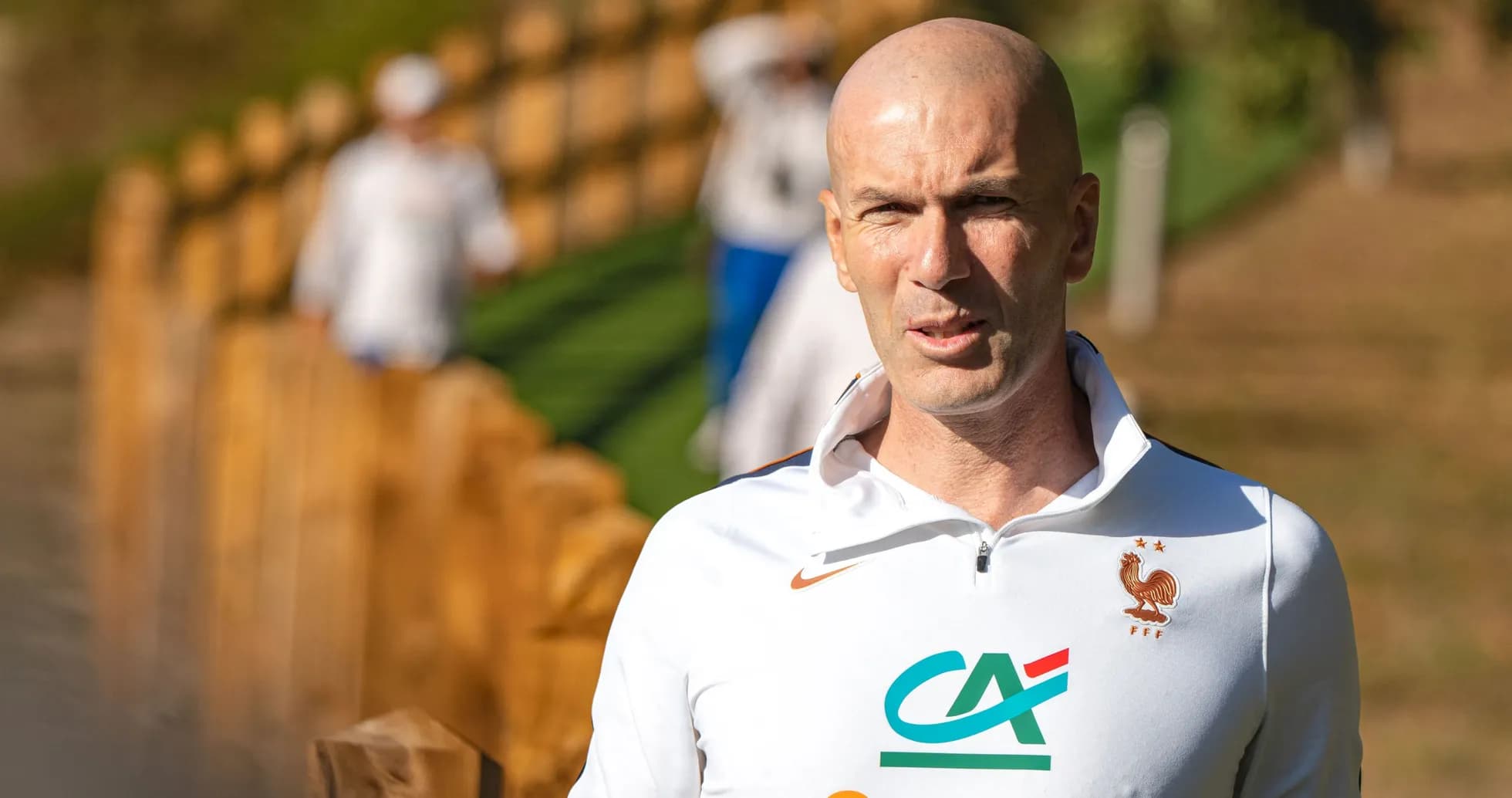
Zinedine Zidane has never been one for half-measures. When he steps into a job, the walls tend to shake. With France, the tremors have started already.
Officially appointed as Didier Deschamps’ successor on July 28, the Real Madrid icon has moved with the urgency of a man who has been planning this moment for years. His first appearance at Clairefontaine on Monday did not feel like a gentle handover. It felt like a reset.
A new voice. A new tempo. A new way of doing things.
Breaking from Deschamps’ long shadow
Deschamps’ 14-year reign built a machine: disciplined, consistent, relentlessly efficient. Zidane respects that legacy, but he is not here to preserve a museum piece.
Speaking to La Provence, FFF president Philippe Diallo made it clear that the shift is deliberate and profound. Zidane, he said, is “breaking with the past,” turning “a real new page” for Les Bleus. No soft phrasing. No suggestion of continuity for continuity’s sake. This is a conscious rupture.
The most obvious sign came not on the pitch, but on the calendar.
Deschamps had a rhythm. Squad announcements on Thursdays, broad lists, room for flexibility and late decisions. Zidane walked in and tore up that small but symbolic script. His first squad for the Nations League fixtures against Turkey, Belgium, and Italy dropped on a Friday. A minor detail, perhaps, but in elite environments, routines matter. Changing them sends a message: the old habits are gone.
Then came the second jolt.
He named 23 players. Not 26. No comfort blanket, no extended bench to keep everyone happy. A tighter, sharper group. A squad built to play, not just to be there.
Diallo seized on that immediately. “He took 23 players instead of 26. That is a first sign. He is going to make them play,” the FFF president pointed out. Some names surprised. Others, widely expected, did not make the cut. The signal was unmistakable: reputations alone no longer guarantee a place.
This is Zidane’s squad now, not an inherited list with minor edits.
A cultural shift, not just a tactical tweak
France under Deschamps became synonymous with control: tournament nous, defensive balance, the ability to grind through adversity. Zidane, of course, knows how to win knockout football better than almost anyone, but his approach carries a different emotional charge.
Diallo painted the picture of a coach driven by more than structure. “In everything he is going to do, I think he wants to change things. Change things with a clear objective, which is to win,” he said, tying Zidane’s revolution to something deeper than tactics. This is about what the French shirt gave Zidane as a player and as a man — and his urge to repay that debt.
That sense of personal history matters. Zidane is not just another big-name coach parachuted into a top job. He is the defining figure of modern French football, now entrusted with reshaping the very institution that shaped him.
The federation believes that emotional bond can fuel a new level of ruthlessness.
From golden age to something greater?
France are not in crisis. This is not a rescue mission. Deschamps leaves behind a team that has reached finals, collected trophies, and lived in the latter stages of every major tournament. Diallo called it a “golden age,” and he is not wrong.
The challenge for Zidane is harsher: not to repair, but to improve something already excellent.
Diallo did not hide the scale of the expectation. He sees Zidane as “the one best suited to extend this golden age for us,” but that is only the starting point. Reaching the final four, he suggested, should be the baseline. The real target is to “go a little beyond that, to go and win titles.”
France have been close often. World Cup winners in 2018, finalists in 2022, European Championship runners-up in 2016. The story of the Deschamps era is one of almost relentless contention. Zidane is being asked to turn contention into domination.
That is why the details matter already: the smaller squad, the unexpected selections, the break with long-standing routines. These are not cosmetic tweaks. They are the early brushstrokes of a coach who wants full control of the canvas.
The Nations League games against Turkey, Belgium, and Italy will not define Zidane’s tenure, but they will reveal its tone. Will France play with more risk? Will the talent pool be used more aggressively? Will established hierarchies hold?
One thing is already clear: this is no gentle continuation. France have chosen disruption, embodied by a man who has made a career out of winning on his own terms.
Zidane has turned the page. The question now is simple: does he turn this golden age into an era no one else can touch?