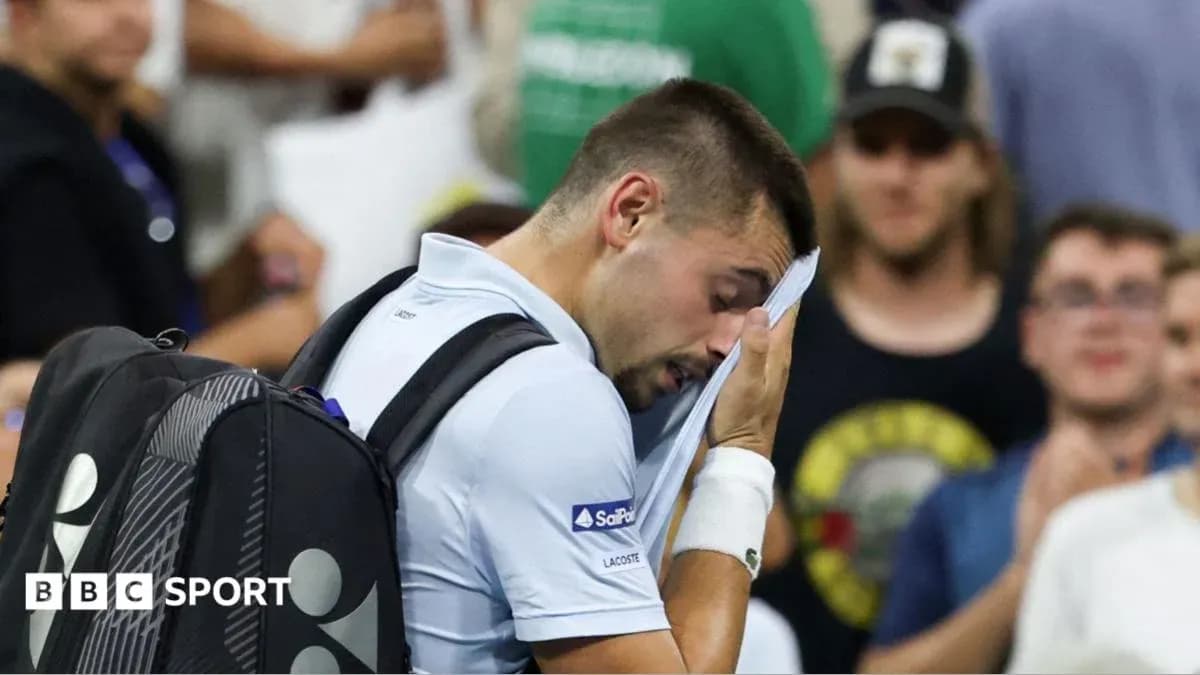
Arthur Gea stood on the baseline one point from history, the first lucky loser ever to reach a Grand Slam quarter-final. Three hours later, he was out of the US Open, emptied by a match that will haunt him for a long time.
The 21-year-old Frenchman had Botic van de Zandschulp on the ropes, then on the canvas, then somehow let him walk out of Arthur Ashe Stadium with a 3-6 6-7 (0-7) 7-6 (9-7) 7-6 (7-3) 6-4 win after five hours and 13 minutes – the fourth-longest match ever recorded at Flushing Meadows.
One point. That was the margin.
Gea’s dream turns into a marathon
Gea’s route here had already felt improbable. Ranked 87 in the world, he did not make the main-draw cut when the entry list closed and had to fight through qualifying. Even that went wrong. Seeded first, he fell in the final qualifying round to American Nishesh Basavareddy and packed his bags thinking he would leave with $66,000 and a few regrets.
Then Casper Ruud pulled out injured on the eve of the tournament. Gea’s name came out of the lucky-loser pool. A second chance, the kind players talk about but rarely truly get.
He tore into the main draw. Wins over Juan Manuel Cerundolo, Zachary Svajda and Michael Zheng carried him into the last 16, the kind of surge that can change a career and a bank balance. By the end of this run, even in defeat, his prize money had jumped to $480,000.
Against Van de Zandschulp, the fairytale looked ready for another chapter.
Gea took the first set 6-3, then produced a flawless tie-break to sweep the second 7-6 (7-0). The Dutchman, ranked 70, looked stranded. Gea was hitting cleanly, serving with authority, and carrying the swagger of a man who had been playing with house money all week.
The pressure finally told in the third. Van de Zandschulp clung on, dragged the set into a tie-break and still Gea earned a match point. The door was open. He couldn’t walk through it. The Dutchman escaped, stole the breaker 9-7, and with it stole belief.
From there, the contest turned brutal. Gea again moved to the brink in the fourth, this time serving for the match, only to falter under the weight of the moment. Van de Zandschulp broke back, forced another tie-break, and this time dominated it 7-3.
By the fifth, both men were running on fumes. Van de Zandschulp, somehow the fresher of the two despite the punishment, grabbed the decisive break and closed it out 6-4. When it was over, he admitted he had “no clue” how he had pulled off what he called a “crazy comeback”.
Gea left as the 13th lucky loser in history to fall in the fourth round of a major. So close to a landmark, and yet still on the wrong side of it.
Zverev finally finishes early – and keeps the night shift
Waiting for Van de Zandschulp in the quarter-finals is Alexander Zverev, who for once did not have to play into the small hours of the New York night.
The top seed and reigning French Open champion dismissed Italian 21st seed Luciano Darderi 6-2 6-2 7-6 (7-3) to reach the last eight, wrapping up his work before midnight after three consecutive late finishes at 1:55am, 2:15am and 1:09am.
Freed from the usual nocturnal grind, Zverev joked he did not quite know how to handle the novelty of an early finish, quipping about heading back to the practice courts or even a bar. He made it clear, though, that he wants the lights again on Wednesday.
He said he will ask for another night session against Van de Zandschulp, laughing that he has “rented this court out from 11pm until 2am for two weeks” and wants to keep that booking going.
The Dutchman will walk into that quarter-final with five hours of drama still in his legs. Zverev walks in with his feet up and his rhythm intact.
Blockx hangs on, Khachanov battles back
Earlier in the day, another young story unfolded with a different kind of grit.
Belgium’s Alexander Blockx, seeded 28th, admitted he came close to retiring against Francisco Cerundolo, his body threatening to betray him just as his tennis career is gathering speed. Fighting rib pain and struggling particularly on serve, he still found a way past the Argentine 6-3 4-6 7-5 7-5 to reach his first Grand Slam quarter-final.
He became the first Belgian man ever to make the last eight at the US Open, a slice of national history carved out through stubbornness as much as shot-making. Blockx said he was “really close” to stopping, convinced that if he had dropped the third set he would likely have quit. Instead, he held on, turned the match, and now has at least two more days to patch himself together.
If he is fit enough, he will face Karen Khachanov on Wednesday. The Russian, ranked 50 in the world, had his own five-set mountain to climb, turning around a tense battle with 14th seed Learner Tien to win 7-5 4-6 6-7 (6-8) 6-1 6-4.
Tien’s defeat ended the American’s bid to help deliver four home men into the US Open quarter-finals for the first time since 1995. Khachanov, a seasoned campaigner at this level, shut that door with a ruthless fourth set and a composed finish in the fifth.
So the second week in New York moves on with a lucky loser who nearly rewrote history, a Belgian who refused to walk away, a Russian who dug in, and a top seed who has made the night shift his own.
The margins at this tournament have already been brutal. How many more careers will be reshaped by a single point before the trophy is lifted?