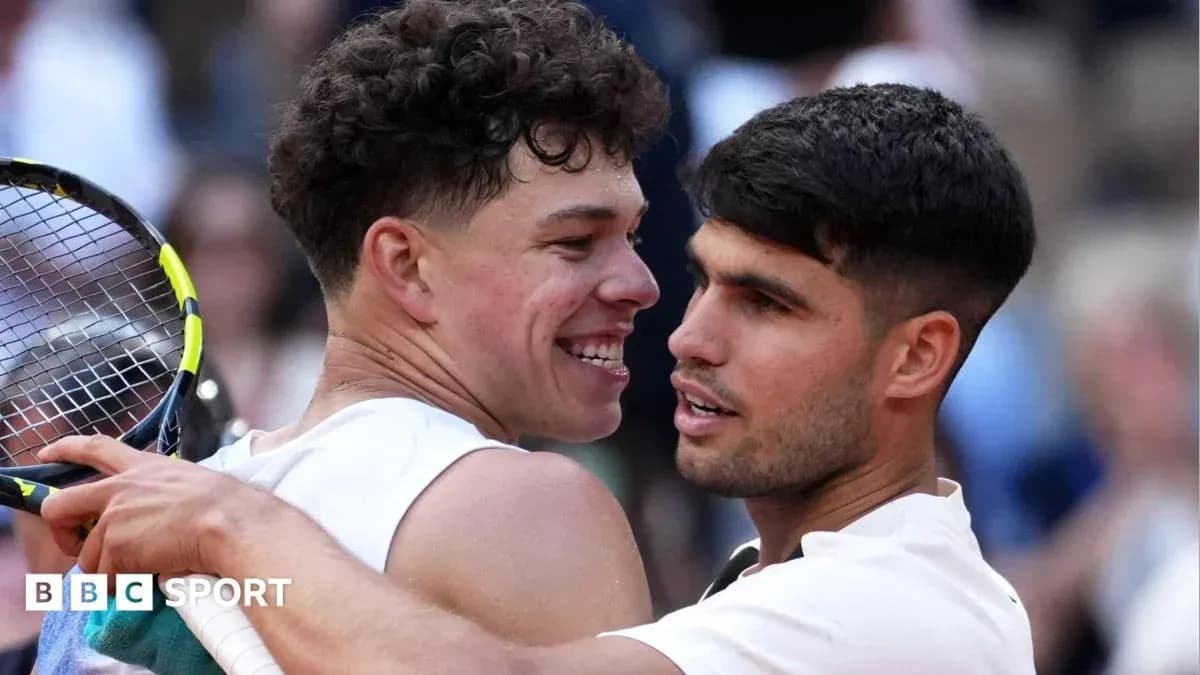
Carlos Alcaraz versus America. That’s what the next few days at Flushing Meadows threaten to become.
The defending champion, adored in New York for his electric tennis and easy charisma, now stands between a nation and its long-awaited homecoming. Twenty-three years have passed since Andy Roddick lifted the US Open men’s singles trophy. If an American is to have the chance to end that drought this year, one of them will have to go through Carlos Alcaraz. Maybe two.
Three home hopes remain in the men’s draw – Ben Shelton, Frances Tiafoe and Alex Michelsen – and every one of them is parked in Alcaraz’s half.
Alcaraz against 24,000 New Yorkers
On Tuesday, Arthur Ashe Stadium stages the first showdown: Alcaraz against eighth seed Shelton in a quarter-final that feels bigger than its billing. The Spaniard is a seven-time major winner now, a global star, and yet he knows he will walk into a cauldron.
He expects to be facing more than the man across the net.
“I think he [will] use the crowd, the people behind him, especially when he's playing here at home,” Alcaraz said, fully aware that 24,000 New Yorkers can sound like double that when they sense blood.
Shelton, 23, is hunting his second US Open semi-final. He has never beaten Alcaraz. Ashe might be his best weapon.
If the left-hander rides that wave and finally cracks the Spaniard, the tournament is guaranteed an American finalist: the winner of Shelton–Alcaraz will meet either Tiafoe or Michelsen in the semi-finals. If Alcaraz survives again and reaches Sunday’s final, the Roddick wait goes on.
A generation chasing Roddick’s shadow
American men have knocked on the door plenty of times since Roddick’s last final in 2006, when he lost to Roger Federer. Semi-finals have come and gone, home favourites have stirred the crowd, but the final Sunday has stayed stubbornly out of reach.
Only Taylor Fritz has broken through to a final in that span, two years ago, when he fell to Jannik Sinner. Tiafoe lost to Fritz in that all-American semi-final and has his own scar tissue against Alcaraz, having been stopped by him in the last four in 2022.
Now 28, seeded 11th, Tiafoe is chasing a third shot at a first Grand Slam final. His tennis has sharpened again. He reached the Cincinnati final last month and has carried that form, and that swagger, into New York.
The relationship between Tiafoe and this city is something close to theatre. He feeds off the noise, and the noise feeds off him.
“It's an out-of-body experience, no question. No real explaining that type of feeling,” he said of the Ashe roar. “It's like you're not even touching the ground at one point. Energy is so high, and it seems like the level of play matches that.”
If Tiafoe brings that version of himself into a semi-final against Alcaraz, the stadium might shake.
Michelsen steps into the light
On the other side of that potential semi-final sits Alex Michelsen, 22, far quieter in demeanour, far lower in ranking, but suddenly impossible to ignore.
The world number 46 has been happy to let others carry the spotlight. Tiafoe, Shelton, Fritz, Tommy Paul – they have soaked up the interviews and the prime-time billing. Michelsen has slipped through “under the radar”, as he puts it, and into his first Grand Slam quarter-final without dropping a set.
That anonymity ends now. Ashe does not allow passengers.
“First, second, third rounds, all matches I'm feeling nerves. It's a human experience,” he admitted. “But it's just about going out there and managing them to the best of my ability. I feel like I've done that very well.”
He will need that composure in a likely night-session furnace, where every point can feel like a verdict.
A home surge on both sides of the draw
This is not just a men’s story. Six Americans – three men, three women – are into the last eight at Flushing Meadows, the highest total since 2002. The sense of a home surge is real.
On the women’s side, the drought narrative doesn’t exist. Coco Gauff already broke that tension last year, winning the US Open as a teenager and confirming what many had forecast for years. Now 22 and the defending champion, she is chasing a second title. To keep that bid alive, she must get past Russian fifth seed Mirra Andreeva on Wednesday.
In the other half, the all-American collision is already set. Third seed Jessica Pegula, the model of consistency on the WTA Tour but still without a major title, faces Emma Navarro on Tuesday for a place in the semi-finals. Pegula lost last year’s final to Aryna Sabalenka, who also stopped Navarro in the semi-finals that season.
Pegula knows this stage. Navarro is trying to reclaim it.
Navarro’s second act
Navarro, 25, has not been back to a major semi-final since that run, her season disrupted by health issues that forced her to step away from the tour. In New York, she looks like herself again.
She beat Russian 21st seed Anna Kalinskaya on Ashe in the last 16, a win that felt like more than a scoreline – a reintroduction in front of a crowd that could yet become her ally.
“I should have talked to the crowd a little, asking them to come back and cheer me on for that match. I'm definitely going to need them,” she joked, already looking ahead to Pegula.
It was half a punchline, half a plan. New York loves a story, and Navarro has one.
A city choosing sides
So the stage is set: Alcaraz, the global phenomenon, walking into a stadium that might roar for his opponent; a trio of American men chasing a ghost from 2003; Gauff defending her crown; Pegula and Navarro wrestling for the right to carry the flag deeper into the second week.
The US Open has its favourite son in Alcaraz. It also has a country desperate to see one of its own lift that men’s trophy again.
In the days ahead, Arthur Ashe Stadium will have to decide which matters more.