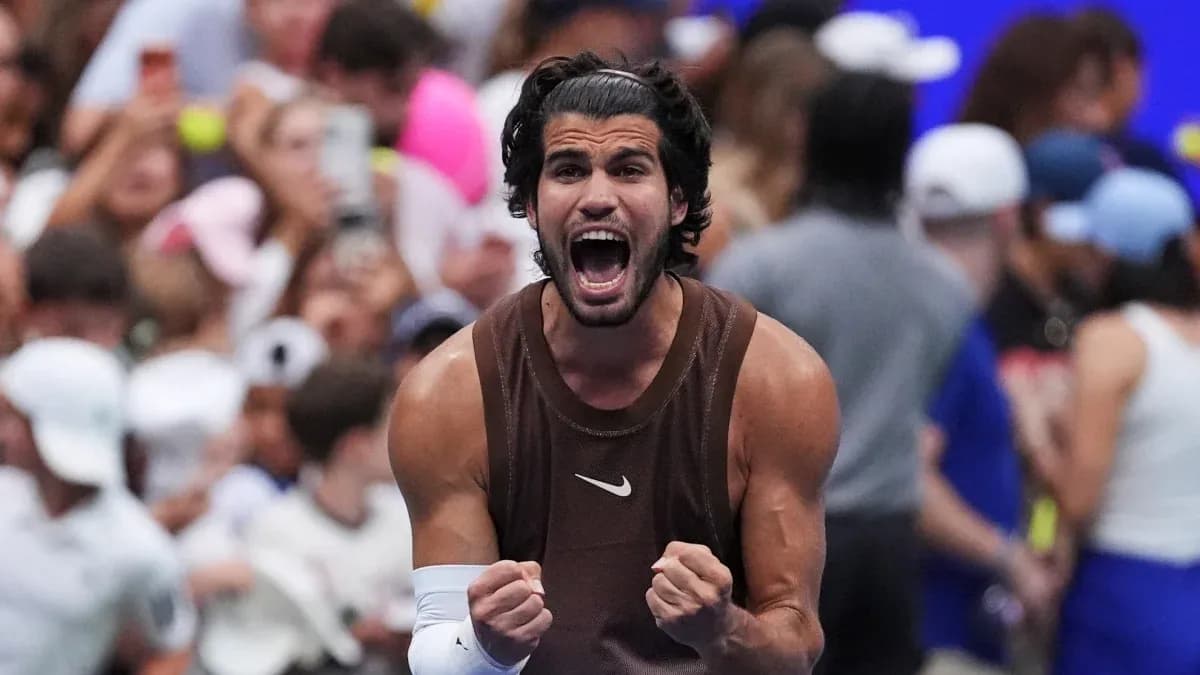
Carlos Alcaraz is back in New York looking like a threat again, but the fight he’s choosing off the court has shifted – and that matters almost as much as his forehand.
For the last 18 months, the Spaniard’s name sat near the top of one of tennis’ most ambitious player movements: a coordinated push from leading stars to secure a larger slice of Grand Slam revenue, better welfare, and a stronger voice in how the sport is run. Now, as he tears through the US Open draw after nearly five months out with a wrist injury, he’s stepped away from that front line.
A star steps back from the revenue revolt
According to The Times, Alcaraz’s long-time agent Albert Molina informed the group driving the Grand Slam revenue campaign shortly before the US Open that his client would no longer take part.
That campaign had been built on heavyweight backing. Aryna Sabalenka, Jannik Sinner, Coco Gauff – some of the game’s most marketable and influential figures – had aligned behind a clear demand: lift the players’ share of Grand Slam revenue to 22% by 2030, and do more to protect the people who actually walk onto court.
It wasn’t just about prize money. Sinner made that plain during a tense 2026 season when frustrations stopped being whispered and started being broadcast.
“It’s more about respect, you know?” he said. “Because I think we give much more than what we are getting back.”
Players backed those words with action. At Roland Garros, several stars pared back their pre-tournament media duties, a symbolic move aimed at the percentage of Grand Slam income they believed was trickling down to them.
The pressure told. Wimbledon pushed its prize fund up to £64.2 million. The US Open bumped total player compensation by 20% to $108 million and introduced a $2 million Player Support Program. The four majors agreed to create a Grand Slam Player Council, a formal platform for player voices that had long felt peripheral to the sport’s biggest decisions.
Amid all that, Alcaraz had been a powerful name on the letterhead. His reported exit doesn’t mean he’s suddenly against those goals. It does strip the movement of one of its brightest symbols of unity – a 21-year-old multiple major champion who embodies tennis’ future as much as its present.
From revenue to survival: Alcaraz redraws his priorities
The shift in his stance tracks neatly with the hardest stretch of his young career. A wrist injury forced him to miss both Roland Garros and Wimbledon, ripping him out of the season’s heartbeat and planting the first real doubt over his body’s ability to withstand the tour’s relentless churn.
He has come back from that layoff with a different message. Less about percentages and councils. More about survival.
“In the future, I’m going to take some breaks, some long breaks,” Alcaraz said. “Maybe not four months, but one month, two months, missing some tournaments, because it’s impossible to play them all.”
That’s not a throwaway line from a player easing his way back. It’s a recalibration. Alcaraz is still chasing the biggest trophies, but he’s stopped pretending he can – or should – chase every single one.
New York answers the tennis question
When he arrived at Flushing Meadows, the questions were obvious. What kind of level could he summon after four and a half months out? Would the wrist hold? Would the explosiveness still be there, or would we see a cautious version of the most electric player of his generation?
The answers came quickly.
Roman Safiullin, Jaime Faria, Wu Yibing and Tommy Paul all fell as Alcaraz marched into the quarterfinals. The scores told one story; Paul’s reaction told another.
“It felt like he’s playing at a completely different level than me,” Paul admitted.
Alcaraz sounded like a man who had felt the same thing.
“So it probably doesn’t matter that I was out for four months and a half,” he said. “Every time that I come here, I play my best.”
That is the paradox of his summer. The time away cost him two majors, slowed his momentum and pulled him out of a player movement that had leaned on his star power. It also gave him clarity. Rest is no longer a luxury or a guilty secret. It’s a necessity.
A different kind of power
The Grand Slam revenue campaign will continue without him. Sabalenka, Sinner, Gauff and others still have the leverage and the appetite to push for their 22% target, still have the platform to demand more respect, more say, more security.
But losing Alcaraz from that core group matters. In a sport that sells itself on its biggest names, unity among the elite is its sharpest weapon. When one of those names steps back, the picture changes. Not fatally. Just noticeably.
For Alcaraz, the calculation is simpler. He has rediscovered his level in New York. He has reasserted himself as a contender. And he has drawn a line under the idea that a generational talent must also be a full-time workhorse.
The tour will keep spinning. The revenue fight will roll on. The Grand Slams will keep tweaking prize pots and unveiling new structures.
Alcaraz, though, has made his choice clear: he will fight for the biggest stages – just not at the cost of playing them all.