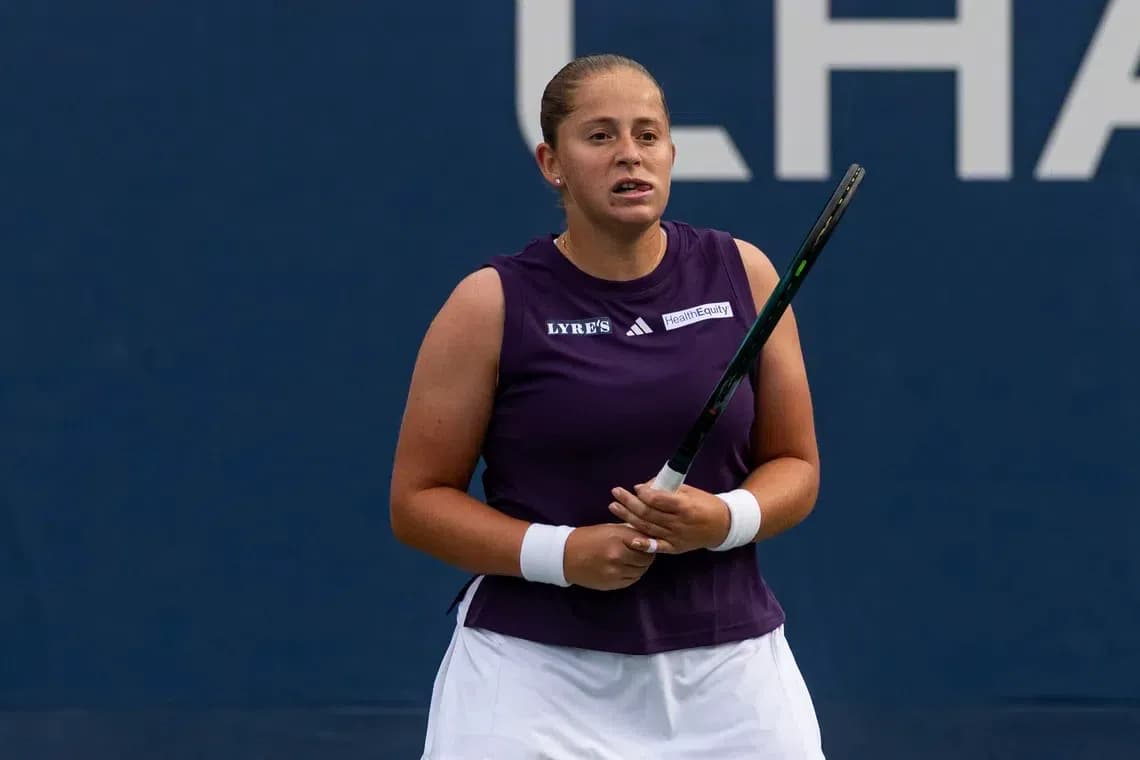
NEW YORK – Jelena Ostapenko does not do quiet evenings at the US Open.
The Latvian firebrand was at the heart of another storm on Sept 7, turning a routine women’s doubles win into a simmering confrontation that spilled beyond the lines of the court.
Alongside the ever-unflappable Hsieh Su-wei, the fourth seeds moved into the quarter-finals with a 6-4, 6-4 victory over the Australian-Chinese Taipei duo Maya Joint and Chan Hao-ching. The scoreline was tidy. The atmosphere was anything but.
Flashpoint on the changeover
The match ignited during a changeover when Hsieh walked toward the chair umpire, clearly unhappy. Ostapenko quickly joined her, pointing directly at the opposing team’s box and demanding the official step in.
According to Ostapenko, the opposing coach had been clapping and shouting after their errors and delivering sarcastic praise in Chinese when they hit good shots. Hsieh translated the remarks for her partner, and the mood turned sharply.
“They do this because they know they cannot beat us,” Ostapenko told the umpire, describing the behaviour as “very disrespectful” and asking for a Chinese translator to be brought in. The complaint was firm, public and impossible for anyone in the stadium to miss.
The umpire indicated the situation would be handled, and the players returned to their seats. The tension stayed.
Turning anger into fuel
When play resumed, Ostapenko and Hsieh channelled the anger into their tennis. The fourth seeds tightened their level, stepped into returns and closed the door on any hint of a comeback. The second set mirrored the first on the scoreboard, but the intensity had clearly shifted.
Once the final point was won, Ostapenko let out a roar in the direction of the opposing box, a visceral celebration aimed as much at the coach as at the result. There was no conciliatory end to follow. Hsieh and Chan did not meet at the net for a handshake after the heated contest, underlining just how sour the evening had turned.
A familiar edge
For Ostapenko, this kind of scene is no anomaly. The 2017 French Open singles champion has built a reputation as one of the tour’s most combustible competitors, her shotmaking often matched by her willingness to confront anything she perceives as disrespect.
Her history in New York already carries scars. At the 2025 US Open, she clashed with American Taylor Townsend in a verbal exchange that spiralled, accusing Townsend of having “no class” and “no education”. She later apologised, saying her choice of words had been misunderstood because English is not her first language.
The pattern, though, is hard to ignore. Ostapenko plays on the edge and lives there too, and when she feels a line has been crossed – by an opponent, a coach, or a crowd – she does not hesitate to push back.
This time, the edge carried her and Hsieh into another Grand Slam quarter-final. The tennis was sharp, the partnership effective, the result emphatic. The question now is whether the drama that seems to follow Ostapenko will stay in the background as the stakes rise, or whether New York is bracing for another flare-up before this tournament is done.