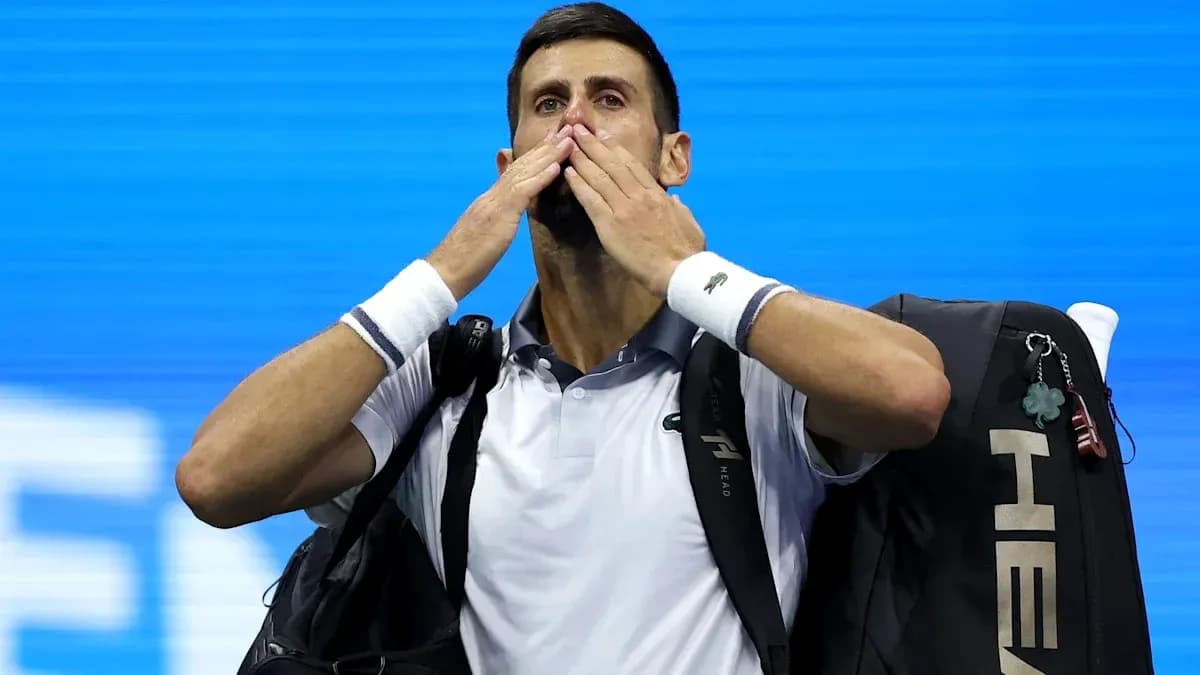
Novak Djokovic has spent a career dividing opinion. On court, he is the relentless competitor, the 24-time Grand Slam champion who has been booed, idolised, deported, and disqualified. Off court, according to the man who knows his body better than anyone, he is something else entirely.
Carlos Costa, Djokovic’s physio, has pulled back the curtain.
The mentor behind the menace
Djokovic’s reputation has long been shaped by flashpoints – the deportation saga in Australia, the default at the 2020 US Open, the confrontations with crowds. Easy headlines. Easy labels.
Costa paints a different picture.
“He loves helping younger players,” the physio said on ‘A BOLA’. That love, he explains, isn’t a PR line. It interrupts practice sessions.
Djokovic will stop his own training block to talk to players who are, or soon will be, trying to take his place. He has done it with Felix Auger-Aliassime. He has done it with Joao Fonseca. These are not practice partners; they are rivals.
Not long ago, Auger-Aliassime asked for advice. Djokovic, Costa says, responded immediately. The same with Fonseca. No cameras, no fanfare, just a serial winner dissecting the sport for the next generation.
He then went out and beat Auger-Aliassime in a brutal Wimbledon quarter-final: 7-6, 3-6, 6-3, 6-7, 7-6. Earlier in the year, he had been dragged into a five-set war and beaten by Fonseca in the third round of Roland Garros: 4-6, 4-6, 6-3, 7-5, 7-5.
He advises them. Then he tries to crush them. That is Djokovic in a nutshell.
And it is not limited to players on his side of the draw. American teenager Iva Jovic has also tapped into his knowledge, with Djokovic repeatedly offering guidance. The Serb may never win a popularity contest, but he is clearly pouring plenty back into the sport that has defined him.
You do not have to like him. You do have to accept that a lot of the players you cheer for have probably leaned on his advice.
An obsession that never switches off
If his generosity surprises, his obsession with detail does not.
“I have never seen anything like Novak Djokovic,” Costa said. The words come from someone who spends every working day measuring the limits of elite bodies. Djokovic, he insists, lives at a different intensity.
His vision. His daily work on court. His insistence that every detail matters – right down to how long it takes a member of his team to hand him a towel. If something deviates from the plan, there is friction. Not because of ego, but because he believes tiny lapses add up.
Inside his team, Djokovic even sets tests. He wants to know whether his staff are truly searching for the best recovery methods, the sharpest treatments, the latest science. Complacency is not tolerated.
One example stuck with Costa. Djokovic asked why Jannik Sinner was doing specific eye-training drills while he was not. That question did not come from a coach’s briefing. It came from Djokovic watching, noticing, and refusing to ignore what might be a marginal gain.
He scours videos. He scans locker rooms. If another player is doing something different, he wants to know why. Costa, who already studies physiotherapists from other sports and takes courses to stay current, suddenly finds himself under the same pressure as a player serving at break point.
And there is a non-negotiable rule within Team Djokovic: answers cannot take too long. Curiosity, in this camp, is urgent.
Watching Sinner – and the clock
Djokovic’s fixation on Sinner is not random.
The Italian now sits at world No. 1. He has collected five Grand Slam titles since Djokovic last lifted a major. He leads their head-to-head 7–5. At Wimbledon this year, Sinner did what very few have done on that court: he beat Djokovic comfortably.
For a man who has spent more than a decade as the sport’s benchmark, that kind of shift stings. It also fuels him.
Djokovic is 39. The chase for a 25th Grand Slam, that elusive step beyond his own record, grows harder with every season. Younger bodies, fresher legs, new ideas – all of them are coming for him.
So he studies Sinner’s eye drills. He quizzes his team. He demands innovation. He treats every routine as a living document, not a finished product. If there is a one-percent edge to be found, he wants it before anyone else.
The next test comes in Beijing, at the China Open, where he will play his first match since the US Open when the tournament begins on Monday, September 28. The stakes are clear. The margins are thin. The hunger, by all accounts, is undimmed.
If Novak Djokovic is to climb back to the top of men’s tennis and drag that 25th major out of a younger man’s era, it will not be because the sport made room for him.
It will be because, even now, he is still asking why he doesn’t do everything his rivals do – and then a little bit more.