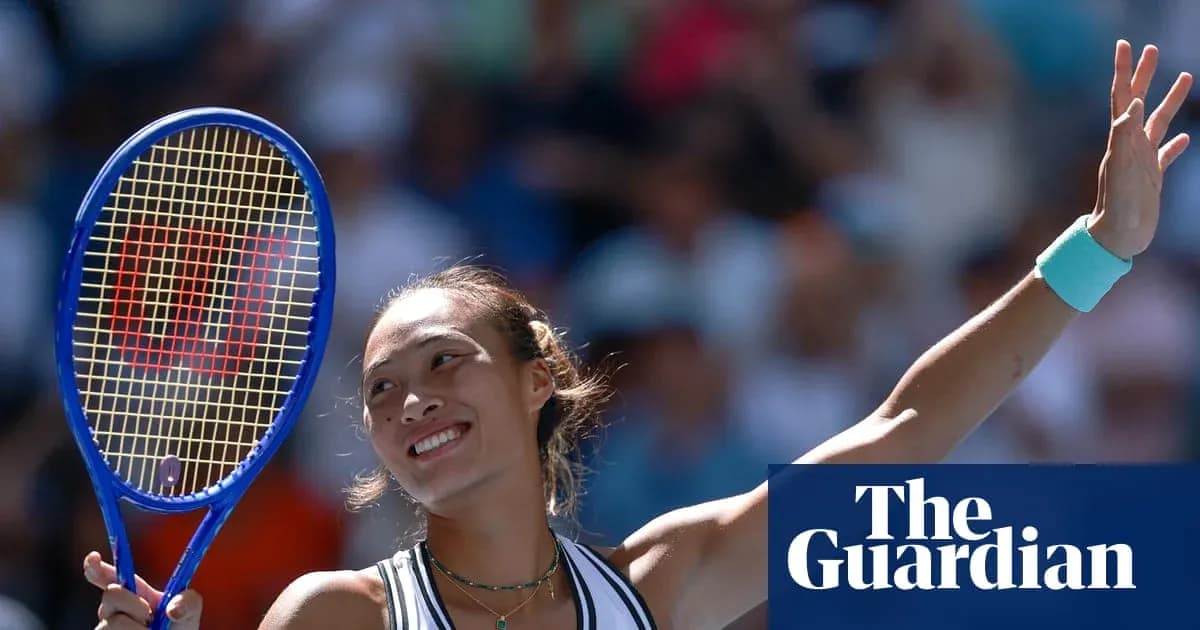
At this US Open, one rule has taken shape in brutal clarity: do not, under any circumstances, lead 5-0 against Zheng Qinwen.
Madison Keys found that out first. Iga Swiatek discovered it next.
Two days after shredding Keys from 0-5 down in a deciding set, Zheng walked back into the storm and did it again, this time against a six-time grand slam champion and one of the sport’s most ruthless frontrunners. Swiatek raced to 5-0 in the opening set of their fourth-round clash, the kind of lead she usually turns into a procession.
Then Zheng shut the door.
She tightened her game, stopped missing, and dragged Swiatek into rallies she no longer controlled. Seven games in a row later, the set belonged to Zheng, and with it the momentum, the crowd, and the match. She finished the job 7-5, 6-3 to reach the US Open quarter-finals and carve out one of the defining wins of her career.
It was not a fluke. It was a pattern.
“In one moment, I even forgot the score in the first set at 4-5,” Zheng said afterwards. “That shows how I am focused. I guess, to come back 0-5 [again] is not lucky, that’s [what] I can say.”
At this level, turning 0-5 into 7-5 is a rarity. Doing it in back-to-back sets against two different major champions is almost unheard of. Doing it to an Olympic silver medallist in Keys and then to the woman widely regarded as the standard-bearer of her generation is something else entirely.
Swiatek arrived in New York with fresh confidence after winning her first title of the season in Toronto, a run that suggested the world had better get used to her dominance again. For five games, that version of Swiatek was on court: heavy off both wings, disciplined, suffocating.
The moment she lost her grip, though, her game disintegrated. Unforced errors poured off the racket. The forehand, usually a hammer, scattered balls wide and long. Zheng sensed it and did what the best front-runners do: she refused to offer a way back.
“I wouldn’t say it had anything to do with mentality. It was more that I started making mistakes from easy balls and Qinwen stopped doing mistakes,” Swiatek said, pointing not to nerves but to execution.
For Zheng, this is more than an upset. It is a pivot point.
Coming into New York, she had beaten Swiatek only once in eight meetings, but that one cut deep. It came in the semi-finals of the 2024 Paris Olympics at Roland Garros, where Swiatek had just completed a third straight French Open triumph. Zheng walked out of that match with Olympic gold and a new status back home, instantly one of China’s most recognisable athletes.
Her rise had already gathered speed. She reached the 2024 Australian Open final and climbed to a career-high No 4 in the rankings last year. Then her body intervened. Elbow surgery stalled everything. The ranking collapsed.
By June, Zheng had fallen to No 160. The numbers on the page told the story: an 11-13 record this season before the US Open, a player searching for rhythm and confidence. To even get into the main draw in New York, she had to swallow her pride and go through qualifying.
Seven matches later, that feels like a lifetime ago. Seven wins, from the outside courts of qualifying to the bright lights of the second week, have rebuilt not just her ranking but her presence. She is no longer a dangerous floater trying to remember how it felt. She looks like a contender again.
Next comes Elena Rybakina, the second seed, who is now one win away from becoming world No 1 for the first time. If Zheng’s path has been about survival and resurgence, Rybakina’s has been about cold, relentless quality.
On Louis Armstrong Stadium, she dismantled Naomi Osaka 6-1, 6-4 in just 66 minutes. The numbers underlined the dominance: 29 winners, only 17 unforced errors, and just one break point faced – and even that went unconverted. Rybakina took time away from Osaka, pounded her serve, and never allowed the two-time US Open champion to settle.
Osaka needed her very best to live with that level. She did not have it. Struggling with achilles pain and unable to find her usual serving rhythm, she spent most of the match reacting, not dictating, and against Rybakina that is a losing battle.
On the other side of the women’s draw, Mirra Andreeva keeps rewriting the expectations for a player of her age. The French Open champion and fifth seed fought past Austria’s Anastasia Potapova 5-7, 6-4, 6-3 to reach her first US Open quarter-final. It was not flawless, but it was hard-edged, the kind of match that tests a young champion’s patience as much as her shot-making. Andreeva passed.
In the men’s event, Alexander Blockx found his own breakthrough. The 28th seed reached a grand slam quarter-final for the first time, grinding past 24th seed Francisco Cerundolo 6-3, 4-6, 7-5, 7-5. No theatrics, no drama from 0-5 down, just a steady, convincing step into new territory.
Zheng, though, has set the tone for this fortnight. Two opponents, two 5-0 leads overturned, and a draw that suddenly has to reckon with a player who has remembered exactly who she is. Now she walks into a showdown with Rybakina, one win from the world No 1 ranking.
If 5-0 is no longer safe against Zheng Qinwen, what scoreline is?