The US Open has slipped into its second round, the early nerves gone, the real business beginning. Day 5 in Queens carries the feel of a turning point: big names on court, storylines forming, and a schedule stacked from late morning until the lights burn deep into the New York night.
This year’s tournament stretches across three packed weeks, from Sunday, August 23 to Sunday, September 13, at the USTA Billie Jean King National Tennis Center. Qualifying has already cleared the decks; the main draws are in full swing, and every session now has the weight of consequence.
Where the Tennis Lives on Screen
In the United States, the US Open remains firmly in ESPN’s grip. The bulk of the action runs on ESPN and ESPN2, with selected matches spilling onto ABC and the ESPN app. For anyone who has cut the cord, that means one thing: you need a live TV or sports streaming package that carries those channels.
Several options do the job:
- DirecTV: The base package, priced at $59.99 for the first month, includes ABC and ESPN+.
- ESPN Unlimited: A direct route into ESPN’s ecosystem, offering live sports and archived programming from $29.99 per month.
- Fubo: Its Sports plan, at $65.99 per month, carries ABC, ESPN, and ESPN2, with a quarterly billing option available.
- Sling: The Essentials plan brings ESPN and ESPN2 for $19.99 per month. For one-off days of drama, there’s a Sling TV Day Pass at $4.99.
- YouTube TV: The Sports Plan includes ABC, ESPN, and ESPN2 for $64.99 per month.
The rights picture is clear: if you want every angle, you’ll be living on these feeds.
How to Watch for Free
Not everyone wants to lock into a full subscription to catch a fortnight of tennis. In the US, free trials offer a way in. DirecTV, FuboTV, and YouTube TV all run trial periods that, timed right, can carry you through key stages of the tournament without an immediate bill.
There’s another route, too.
In Australia, 9Now will stream the 2026 US Open for free. For fans in the US, the UK, or elsewhere, that opens the door to a virtual workaround. A virtual private network (VPN) can place your connection in Australia, unlocking geo-restricted coverage.
The process is straightforward:
- Sign up with a streaming-friendly VPN such as ExpressVPN.
- Install the VPN app on your chosen device.
- Connect to an Australian server.
- Head to 9Now and start watching.
Most of the better VPN services charge a fee, but many offer free trials or money-back windows. Used smartly, that can mean live US Open coverage without paying beyond the trial period.
One final technical tweak: for tennis, motion-smoothing on your TV can sharpen the speed and clarity of play. Turn it on for the matches, then switch it off when you go back to films or dramas to avoid that unwanted soap-opera sheen.
Day 5: The Matches That Matter
Today’s play begins at 11 a.m. ET, with the schedule quickly tilting toward some heavyweight round-two clashes.
On the women’s side, the day builds steadily:
- 11:30 a.m. ET – Naomi Osaka vs. Kateřina Siniaková
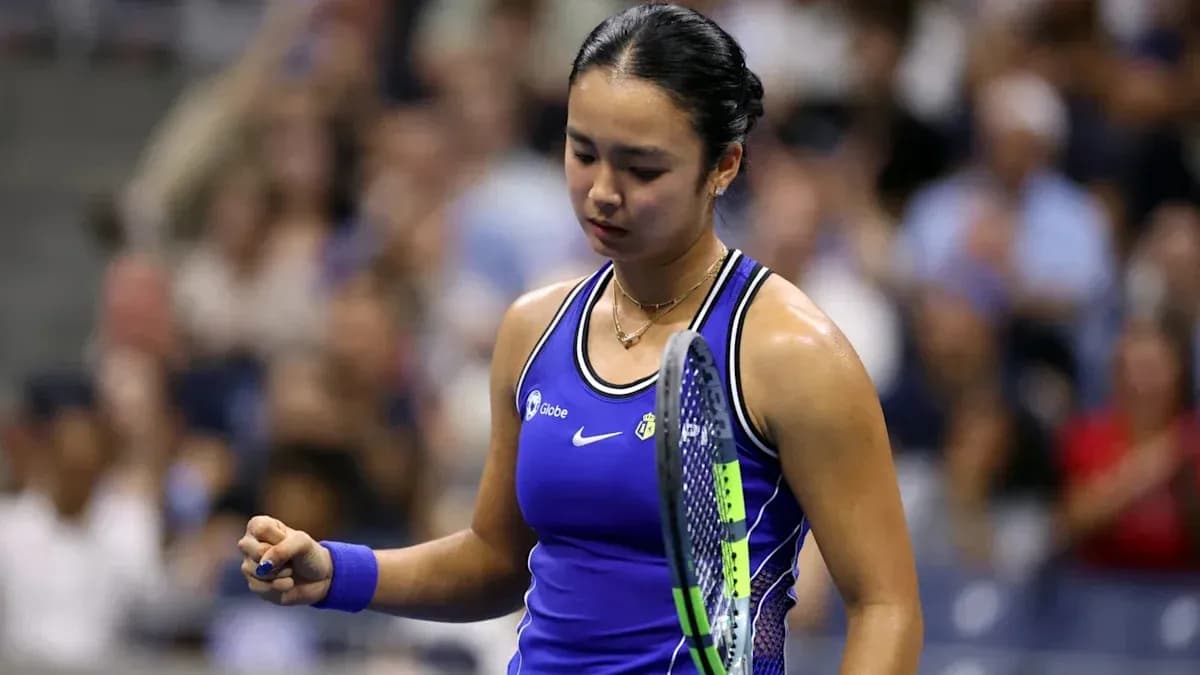
- 12:40 p.m. ET – Alex Eala vs. Oleksandra Oliynykova
- 7 p.m. ET – Coco Gauff vs. Paula Badosa
Osaka’s return to the big stage always draws eyes, while Gauff under the lights in New York has become appointment viewing. Badosa brings enough power and guile to turn that evening session into a genuine test.
The men’s draw carries its own intrigue:
- 11 a.m. ET – Félix Auger-Aliassime vs. Karen Khachanov
- 1 p.m. ET – Taylor Fritz vs. Mattia Bellucci
- 7 p.m. ET – Learner Tien vs. Gael Monfils
- 8:10 p.m. ET – Alexander Zverev vs. Quentin Halys
Auger-Aliassime against Khachanov is a clash of heavy hitters. Fritz, one of the leading American hopes, steps into a prime afternoon slot. Later, Monfils brings his trademark flair to a night match, before top seed Zverev closes the day against Halys.
Every session now feels like a filter. Pretenders fall away. Contenders harden.
The Shape of the Tournament
The 2026 US Open schedule is tightly choreographed:
- Qualifying events: August 24–27
- Men’s and women’s singles: August 30–September 13
- Mixed doubles: August 24–26
- Men’s and women’s doubles: September 3–12
- Junior events: September 3–12
- Wheelchair events: September 8–12
The closing weekend carries the traditional weight:
- Women’s Doubles Final – Friday, September 11
- Women’s Singles Final & Men’s Doubles Final – Saturday, September 12
- Men’s Singles Final – Sunday, September 13
First staged in 1881, the US Open is the second-oldest of the Grand Slams, trailing only Wimbledon. The history hangs over every night session, every tiebreak, every upset.
Who’s Chasing the Title?
The 2026 field is loaded with pedigree: 17 former Grand Slam singles champions, 10 of them past US Open winners. It is a draw thick with experience and scar tissue.
On the men’s side, one notable absence shapes the bracket. Jannik Sinner is out through injury, clearing a lane at the top. Alexander Zverev comes in as the No. 1 seed, with Carlos Alcaraz at No. 2 and Félix Auger-Aliassime at No. 3. Each carries expectation; each knows that Sinner’s withdrawal has removed one major obstacle.
The women’s draw is led by Aryna Sabalenka as top seed, Elena Rybakina at No. 2, and American Jessica Pegula at No. 3. Sabalenka’s raw power, Rybakina’s clean baseline game, Pegula’s consistency and tactical clarity – three very different paths to the same goal.
The United States boasts 28 players in the main draw, more than any other nation. Beyond Pegula, the home challenge leans on Coco Gauff, Amanda Anisimova, Ben Shelton, Taylor Fritz, and the enduring presence of Venus Williams. For the locals in Queens, there is no shortage of American storylines to follow from day to day.
The stage is set, the field is deep, and the calendar is unforgiving. Three weeks from now, only two singles champions will be left standing. For now, it’s Day 5, the lights are warming up over Flushing Meadows, and the second round is where reputations start to meet reality.