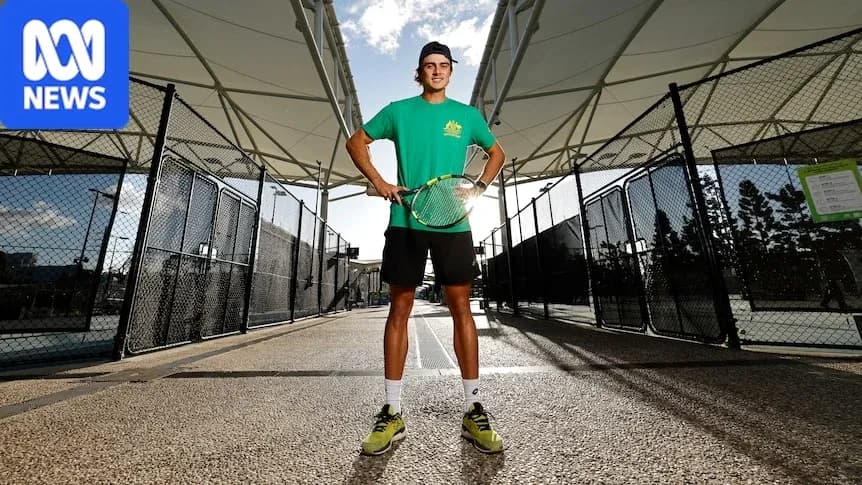
Adam Walton’s Davis Cup debut has been a long time coming, even if he never dared to script it.
On Saturday and Sunday in Brisbane, at Pat Rafter Arena, the 27-year-old will pull on Australian colours for the first time in the competition, completing a journey that started on a makeshift court inside a country race track in North Queensland — and almost entirely outside the traditional tennis system.
A Childhood Played on Anything and Everything
Home Hill sits roughly 1,200 kilometres north of Brisbane, a small town where sport is a way of filling long, hot days. For Adam and his older brother Jack, it was an obsession.
They played everything. Rugby league. Swimming. Whatever ball was available. Tennis came later, almost by chance.
“My brother is 15 months older than me; we were very competitive growing up. It wasn't just tennis; it would be any sport. We even 'scissors, paper, rock' for the dishes,” Walton recalled.
He picked up a racquet at five. The local tennis court, tucked inside the town’s race track, became their second home. The brothers would wait patiently on the edge of the course for the horses to pass before sprinting across to the courts, careful not to spook the animals.
This was not Melbourne Park or a polished academy in Europe. It was dust, grass, and a couple of courts in the middle of a racing circuit. It was also where the foundations were laid.
No Junior Stardom, No Grand Plan
For most pros, the road runs through the ITF junior circuit, the junior slams, and the relentless grind of teenage travel. Walton never got near that conveyor belt.
“As a little kid, I didn't really dream of becoming a tennis player. I was never a top Australian junior; I never travelled to the junior slams,” he said ahead of this year’s French Open.
No headlines. No junior trophies that marked him out as a future star. Just a decent junior from a small town, good enough to keep going, smart enough to know he wasn’t ready.
So when many of his peers chased points and prize money at 17 and 18, Walton went in a different direction.
A Late Bloomer Finds His Stage
The turning point came with an offer from the University of Tennessee. College tennis in the US gave him time — and a structure — to grow.
“I would have been no good at 18, trying to play professional tennis,” Walton admitted. “I've always been a bit of a late bloomer; I needed to grow up physically and mentally. Once I finished university, I was definitely ready.”
Those years in Knoxville hardened his game and his mindset. The college circuit can be brutal: loud crowds, tight team matches, constant pressure. Walton emerged from it not just improved, but transformed.
Only after graduating did he commit fully to the professional tour. No safety net. No excuses.
The impact was swift. Within two years, he had cracked the world’s top 100 in the ATP singles rankings, climbing to world No. 93 and forcing his name into conversations he was never supposed to be part of.
Taking Down a Former World No.1
The breakthrough moment came on one of tennis’s grandest stages.
At Roland Garros this year, Walton went toe-to-toe with former world No.1 Daniil Medvedev and refused to back down. Over five sets, he dragged the Russian into a dogfight and came out on top, a result that echoed far beyond Paris.
That win did not arrive in isolation. On the Challenger Tour, Walton has built a serious body of work: five singles titles and four doubles titles, week after week of graft in smaller venues that rarely make headlines but shape careers.
Those results forced their way onto the radar of Australian selectors. The reward has now arrived.
Wearing Green and Gold at Home
Walton has earned his first call-up to the Australian Davis Cup team for this weekend’s tie against Poland in Brisbane. Whether he plays singles, doubles, or watches from the bench, he knows the significance.
“Whether I play or whoever plays, either way I'll do my best for Australia and I just can't wait to do it here in Brisbane, too,” he said.
For a boy who used to wait for horses to clear the track before he could hit a ball, the scene at Pat Rafter Arena will feel a world away. The stands will be full, the stakes real, the jersey heavy with history.
Australia’s latest late bloomer now steps into that history, not as a prodigy, not as a pre-ordained star, but as proof that the game still has room for those who take the long way round.