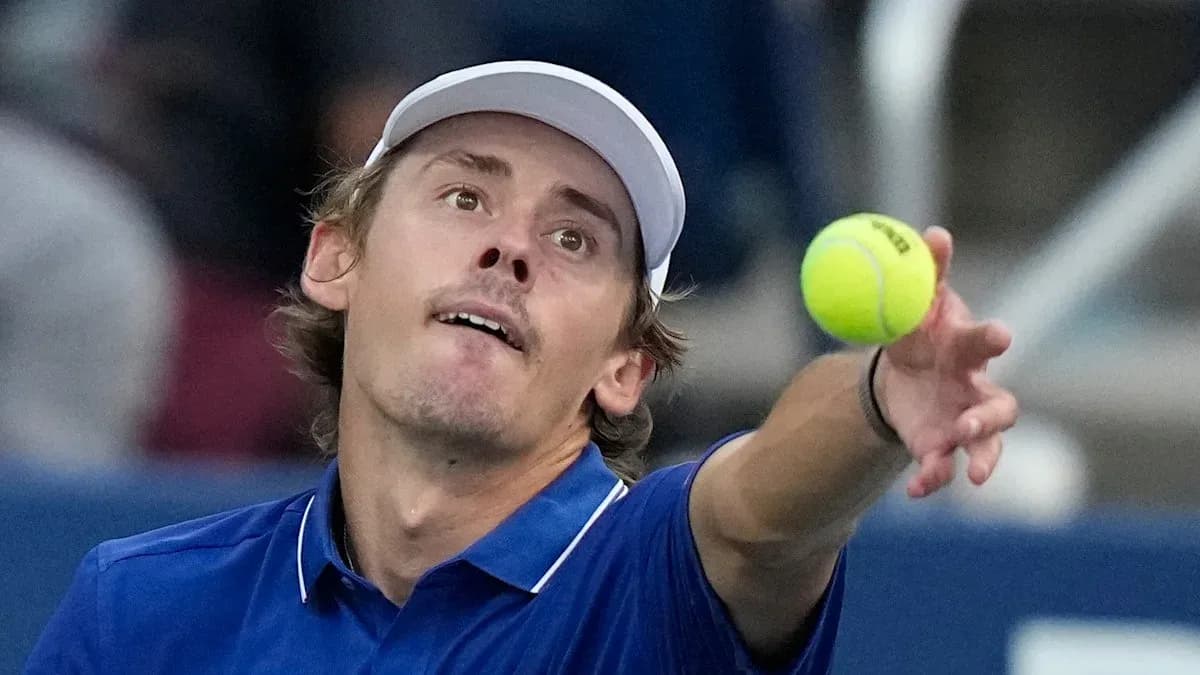
Alex de Minaur doesn’t deal in excuses. Not on this night, not after this loss.
The Australian, who had never dropped a match to Botic van de Zandschulp in four previous meetings, walked off Louis Armstrong Stadium with a straight-sets defeat and a brutally simple verdict on his own performance.
His US Open is over in the second round, beaten 6-4, 7-5, 6-2 by a player he has routinely handled. This time, he never truly arrived.
A day late, a step slow
De Minaur had been forced to back up just a day after his delayed first-round win over Italian qualifier Andrea Guerrieri. The quick turnaround didn’t help, but this wasn’t about scheduling. This was about a game that deserted him.
Rust clung to almost every rally. The usually relentless, precise counterpuncher sprayed errors in bunches. The forehand, normally one of his most trusted patterns under pressure, went haywire.
Straightforward balls flew long. Routine winners died on the frame. Others sailed metres beyond the baseline, the kind of misses that draw a collective groan because they don’t belong to a top-five player in the world.
De Minaur didn’t try to dress it up.
“My level today wasn’t good enough. It’s pretty straightforward,” he said, as quoted by AAP.
He spoke of doing the right things around the chaos — staying competitive, staying locked in mentally, bringing energy. None of it translated through the strings.
“It was just one of those days where just the feeling of the ball on the strings wasn’t there,” he said. “I was making a lot of errors, which is not really my normal game style. I can't really explain the reasoning of it, but just it felt like the more I tried, the more intensity, the more fired up I was getting, I just kept on making unforced errors.
“When those sort of things happen and the odd chance that you have, he comes out with some good tennis - it's just a recipe for a tough day at the office.”
The pressure finally told in the scoreline. Van de Zandschulp didn’t need to be spectacular; he just had to be solid and ready when the Australian blinked. De Minaur obliged, again and again.
A calm voice in the middle of a storm
The defeat slots into a worrying pattern.
After a quarterfinal run at the Australian Open — the seventh major quarterfinal of his career — de Minaur’s season at the slams has steadily flattened. Third round at Roland-Garros. Fourth round at Wimbledon. Now, out in the second round in New York.
Away from the majors, early exits at ATP Tour events have started to stack up, loud enough to trigger public debate about whether it’s time to end his long relationship with coach Adolfo Gutierrez.
The two have been together for almost 20 years, ever since de Minaur moved to Spain at the age of nine. In tennis terms, that’s a lifetime.
From the commentary box on Nine, Jelena Dokic acknowledged the whispers.
She said she wasn’t surprised there were calls for a split, but she also underlined just how rare such a long-standing partnership is in a sport that churns through coaching teams at speed.
“Only Alex knows what he needs … a lot of players will change coaches quickly, especially if they feel like the results are not there,” she said. “That’s up to him to make those decisions and what he wants to do. Let’s not forget Adolfo has gotten him to such a high point in his career – to the top five in the world.”
For now, de Minaur himself isn’t throwing fuel on any fire. He cut a frustrated but measured figure.
“Obviously would have loved to do better, as any competitor would, but it’s what happens in this sort of sport. Everyone loses matches,” he said.
“Everyone is losing matches that maybe they would love to have back.
“… It’s one I would love to have back, but we move forward and it’s not the end of the world.”
The burden of perfection
The technical issues are one thing. The emotional load is another.
Dokic suggested that de Minaur’s own personality might be tightening the screws. His perfectionism, the same trait that helped drag him into the game’s elite, now risks turning every match into an ordeal.
“We know his mindset, we know what a perfectionist he is. He wants to get to the top and maybe not doing that in the last two years has affected him,” she said.
The signs have been there. After his Wimbledon exit, de Minaur looked on the verge of tears, openly wrestling with his form and expectations.
“For him, wins have become almost a relief and not so much satisfaction and joy, and that's hard,” Dokic said. “Losses have almost been end-of-the-world type things. He's been really, really hard on himself. I think he has to give himself a bit more of a pat on the back and a bit more credit.
“Whatever he decides to do with coaching, the way that he goes about things and the mindset around it is going to have to change. It's very hard to keep this up, to constantly expect from yourself to win. That's been an issue for him.
“When you've got the constant pressure of feeling like you want to win and get to the top, and maybe that's not quite happening the way you want to, you can start to lose motivation, you can get really flat.
“I think that that’s what’s happened – he’s lost a little bit of that mojo to be out there.”
Her assessment didn’t stop at mentality. She floated the idea that de Minaur might also need to reassess his schedule, trim his playing load, and give himself room to breathe.
A lonely flag in New York
De Minaur’s exit has a wider impact on Australian hopes in New York.
His loss leaves Dane Sweeny as the last Australian standing in either singles draw, after Sweeny stunned Italian No.13 seed Lorenzo Musetti earlier in the day.
The spotlight, for now, shifts to Sweeny. The questions, though, will keep circling around de Minaur.
Does he change his coach? His calendar? His mindset?
He insists this isn’t the end of the world. The ranking, the resume, and the work ethic back that up.
But for a player who has built his identity on reliability and resilience, nights like this — when the ball won’t sit on the strings and the forehand won’t obey — demand answers.