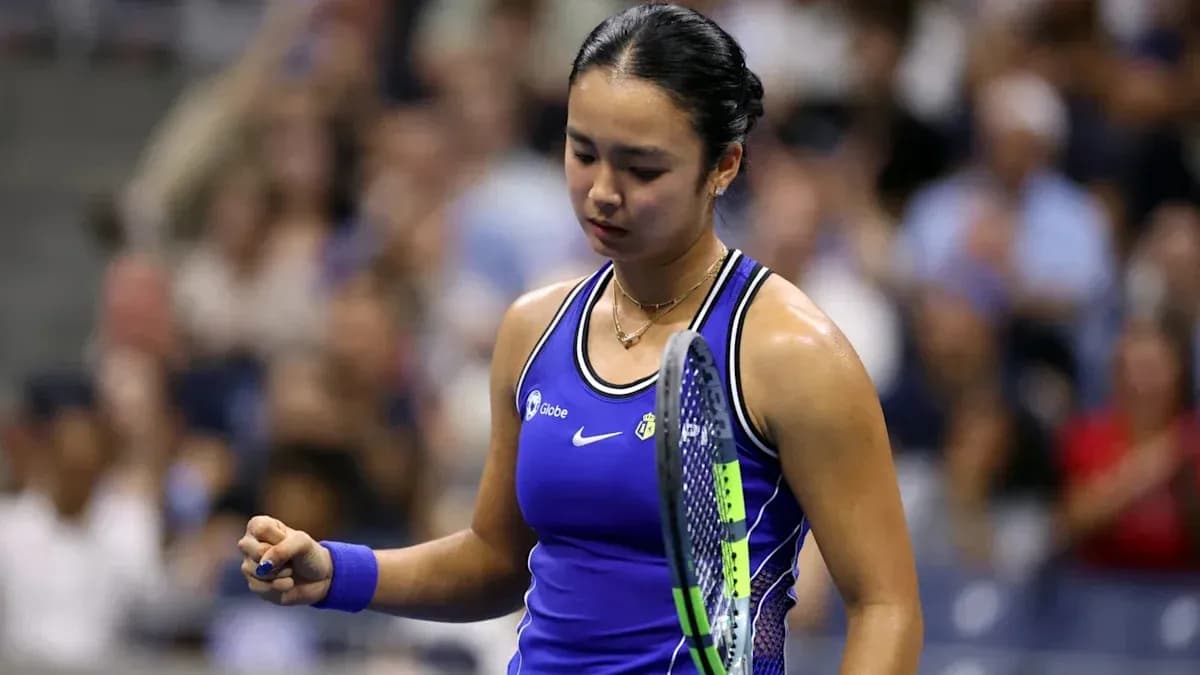
Alexandra Eala is no longer just a promising name on an entry list. She is arriving in New York as an event in herself.
The 21-year-old from the Philippines has turned a breakthrough season into something bigger: a movement. A rising ranking, a first WTA title, and a fan base that behaves less like a polite tennis crowd and more like a national team’s cheering section. At the U.S. Open, that energy is about to hit one of the sport’s biggest stages.
A Crowd That Sounds Like a Team
Mary Joe Fernandez has seen a lot in this sport. Former world number four, now a seasoned ESPN voice, she has watched Eala’s ascent from close range — and what stands out isn’t just the ball striking.
“Her following, the fans that just come to watch her not just play her match, but to watch her practice, is off the charts,” Fernandez said on a conference call this week.
Practice. Not matches. Practice.
At the Miami Open, courtside seats for Eala’s training sessions filled up. In recent tournaments, the noise around her has swelled to the point where it feels less like a tour event and more like a team competition.
“It’s just gotten bigger and bigger everywhere she goes,” Fernandez said. “It’s almost like she’s playing a Billie Jean King Cup match when she’s out there. Every point is loud. Every point she wins, it feels like she’s won more than a point.”
That’s what makes Eala different. She is not just playing for herself. She carries a country that has never had a women’s player ranked this high, and a Southeast Asian region that rarely sees its flag-bearers this deep in the sport’s elite.
Washington as a Statement
If the noise around her once felt like hype, Washington turned it into hard proof.
Eala stormed through the field to claim her first WTA title this month, and she did it the hard way. She beat Elina Svitolina. She beat Naomi Osaka. Then she took out Jessica Pegula in the final.
“She was outstanding in Washington,” Fernandez said. “Her game is really good. She backs it up. She’s improved tremendously... She’s getting better and better.”
That week did more than give her a trophy. It validated the sense that this isn’t a brief surge. It’s a player with the weapons and composure to live in the top tier.
A New Flag at the Top of the Game
The rankings now tell the story plainly. At 18 in the world, Eala is the highest-ranked Filipino and Southeast Asian player in WTA history. That number carries weight far beyond her own résumé.
For the WTA, her rise opens a door into a market and a diaspora that has long been passionate about sport but underrepresented in top-level tennis. From Manila to the global Filipino communities scattered across the U.S., the Middle East, and Europe, Eala offers something rare: a player who looks, sounds, and plays like their own.
Fernandez pointed to that opportunity — not just for Eala, but for the tour. A star from a new region, with a loud, loyal following, is gold for a sport that thrives on identity and connection as much as it does on rankings and seedings.
Big Stage, Big Responsibility
Now comes New York, where stories either explode or evaporate.
Patrick McEnroe, another ESPN analyst and former U.S. Davis Cup captain, didn’t bother hiding what he thinks tournament organisers should do.
“The USTA better make sure they put her on big courts,” he said. “I think the crowd is going to be wild for her. It’s going to be a great story.”
He’s right about the setting. Eala on a side court would feel like a missed moment. Put her on a show court, though, and the atmosphere could tilt a match, maybe even a week.
Because this is what she brings: noise, colour, and a sense that every point might be worth more than the scoreboard suggests.
The U.S. Open has never been shy about embracing a fresh storyline. The question now is simple: how big a stage will they give to one of the game’s fastest-rising stars — and how far can Alexandra Eala push this surge once the lights go up in New York?