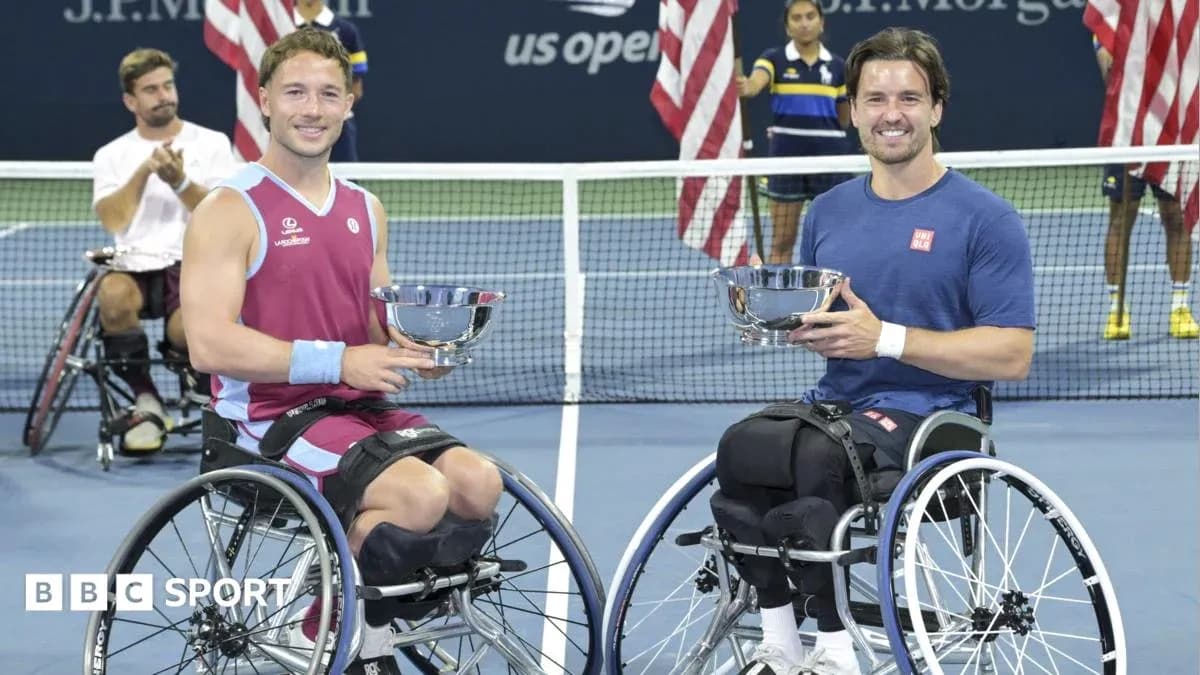
Alfie Hewett and Gordon Reid are used to living on the edge in New York. On Saturday night, they went there again – and came back with a sixth US Open men’s wheelchair doubles crown as a partnership, five years after their last.
The British duo, so often the benchmark in their sport, were a set and a break down to Martin de la Puente and Ruben Spaargaren before ripping up the script to win 2-6 6-3 10-7 in a match tie-break at Flushing Meadows.
For Reid, 34, it was a milestone that underlined a career of relentless excellence: a 30th Grand Slam doubles title, 11 years after his first. Twenty-six of those have come with Hewett at his side. The numbers are staggering, but they tell only part of the story.
From flat start to furious fightback
The opening set was a shock to the system. De la Puente and Spaargaren came out swinging, attacking returns, clean lines, and a clarity of purpose that had the British pair on the back foot from the first games. Hewett and Reid, usually so sharp in the big moments, were broken twice and lost the set 6-2.
When they slipped a break behind early in the second, the scoreboard hinted at a changing of the guard. The rallies lengthened, the tension tightened. This was no exhibition; this was a challenge to a dynasty.
The response was exactly what champions are supposed to deliver.
Hewett, 28, began to dictate with his return, reading Spaargaren’s serve better, stepping in on anything short. Reid steadied the ship at the net, closing angles, forcing errors. The energy shifted. The crowd sensed it, too.
The pressure finally told. The British pair broke back, then broke again, wresting control of the set and taking it 6-3. From trailing by a set and a break, they had dragged the final into a deciding match tie-break – a format they know as well as anyone and fear less than most.
Tie-break time, champion’s composure
The match tie-break was a microcosm of their partnership: a few nervy points, a lot of grit, and, when it mattered most, absolute clarity.
At 10-7, with the title on their racket, they finished the job. No wild celebration, just the release that comes from surviving a serious test and emerging with yet another major trophy.
For Hewett, the victory ended a wait that had started to feel too long in New York.
“We've not won here for five years so this is something we've been desperate for and highly motivated for,” he said on court, the relief clear. Then came the promise that should concern every rival in the draw: “It won't be the last, we've got plenty more doubles to play in the future.
“These are the sort of matches we want to play in front of such an amazing crowd. I'm glad we could put on a bit of a show for you tonight.”
Reid, ever the veteran presence, allowed himself a moment of reflection on a partnership that has defined an era.
“It's been more than 13 years we've been playing together and he's not sick of me yet,” he joked. “Hopefully we've got a few more years left in us.”
A dynasty that refuses to fade
Thirteen years together at the top level is rare in any form of tennis. To sustain that partnership through injuries, schedule demands, constant targets on their backs, and a rising generation of challengers is something else entirely.
Yet here they are: older, wiser, still winning the biggest prizes.
A sixth US Open doubles title as a team. A 30th Slam doubles trophy for Reid. Another chapter written under the lights of Flushing Meadows, where they once again proved that experience, resilience and a refusal to yield can still outlast youth and momentum.
If this is what they look like after 13 years together, what might the next few seasons hold?