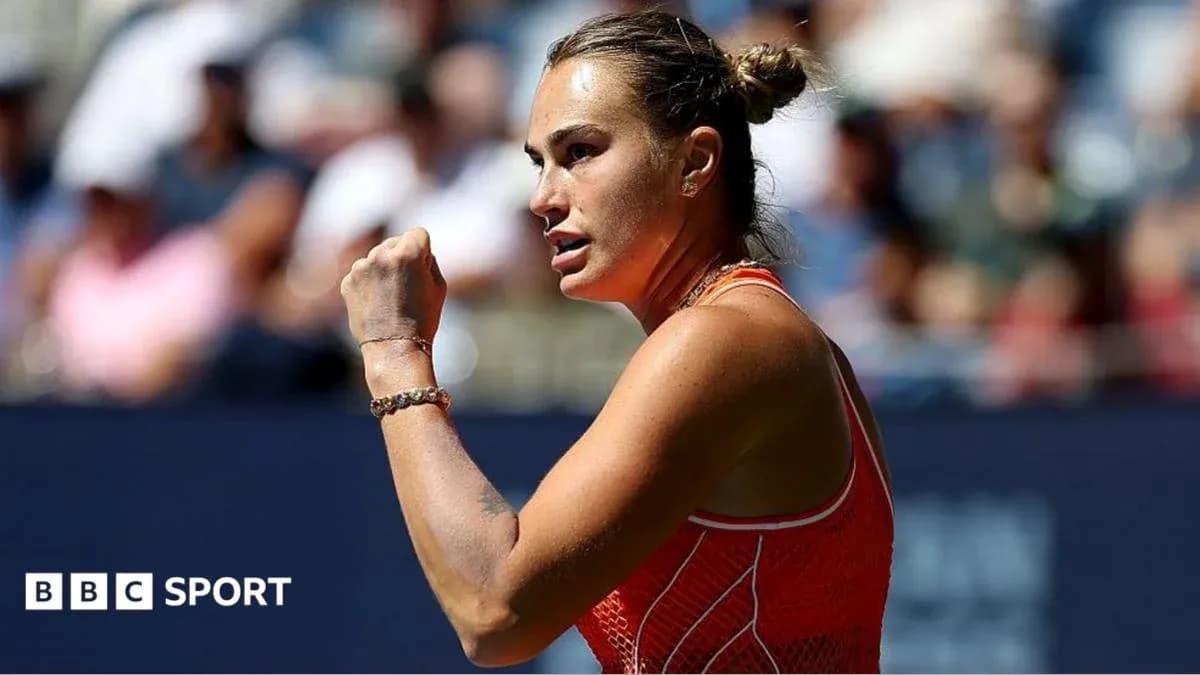
Aryna Sabalenka had already made peace with defeat. Then she tore it up.
The two-time defending US Open champion looked certain to be heading out against Wimbledon winner Linda Noskova, down 4-2 in the deciding set and trailing 2-0 in the final-set tie-break. Her title run, her aura on Arthur Ashe, even her grip on the No. 1 ranking – all of it seemed to be slipping.
Instead, she dug in and turned the night into another chapter of defiance.
Sabalenka clawed back to win 7-6 (7-1), 3-6, 7-6 (10-7) in just under two and a half hours, extending her remarkable unbeaten streak in New York to 19 matches and booking a sixth straight US Open semi-final. No woman had managed that since Serena Williams in 2016. Now Sabalenka stands alongside that company.
A champion on the brink
For long spells, this did not look like the work of a player in complete control of her kingdom.
She opened with authority, breaking Noskova in the Czech’s first service game and racing out to a 5-2 lead. The ball was exploding off her strings, the rallies short, the tone ominous for the sixth seed on the other side of the net.
Then the first crack.
Serving for the set, Sabalenka tightened. A double fault – one of four on the night – fed Noskova a way back. The Belarusian lost the game, lost her rhythm, and suddenly the set looked far more complicated than it needed to be.
She steadied in the tie-break, though, playing it like a statement. A 7-1 demolition, all clean hitting and front-foot aggression, restored order. On the scoreboard, at least.
The doubts never really left.
Noskova swings back
Noskova, riding an 11-match Grand Slam winning streak, refused to fold. She matched Sabalenka from the baseline, then began to outplay her.
Sabalenka had chances early in the second set, three break points that could have killed the contest. She squandered all of them. The pressure swung back across the net.
At 3-2, Sabalenka’s serve betrayed her again. A double fault at 30-40 handed Noskova the break. This time, the Czech didn’t blink. She held firm, took the set 6-3, and dragged the No. 1 seed into a decider for the first time at this year’s tournament.
The numbers told their own story. Noskova finished with more winners, fewer unforced errors, and saved seven of the nine break points she faced. For long stretches, she looked like the more composed, more efficient player.
Sabalenka, though, is not built for quiet exits.
On the edge – again
The third set was a test of nerve as much as tennis.
Sabalenka’s serve, such a weapon in her title runs, turned into a live grenade. Two more double faults saw her broken for a third time in the match. Noskova then held to love for 4-2. The defending champion slumped in her chair at the changeover, staring at the court as if searching for answers that had deserted her since spring.
This was only her second quarter-final win since March. The early-season dominance on hard courts – titles in Brisbane, Indian Wells and Miami – had faded into inconsistency on clay and grass. She had fallen from a set up in the French Open quarter-finals. She had suffered last-16 exits in Toronto and Cincinnati. The aura of inevitability had gone.
At 4-2 down, it felt like New York might finally turn on her too.
Instead, the familiar steel returned. Sabalenka tightened her groundstrokes, cut down the reckless misses, and started to bully the rallies again. She reeled off three straight games, flipping the set from 2-4 to 5-4 and putting the pressure squarely back on Noskova.
The Czech held to force the tie-break. One last sprint to the line.
Noskova surged again, 2-0 up in the breaker. Sabalenka stared at the brink for a second time.
A different kind of Sabalenka?
This is where the old Sabalenka might have combusted. The one who smashed racquets, who let frustration spiral, who admitted after Paris that emotion had dragged her under.
On Arthur Ashe, something else showed up.
She loosened, as she later admitted. She hit through the ball, not away from it. The aggression stayed, but the panic didn’t. Point by point, she clawed her way back, leaning on the big game that has made her such a force on hard courts.
The pressure finally told on Noskova. Sabalenka stormed through the breaker to complete a 10th straight tie-break win at the US Open, a streak stretching back to 2021. Fittingly, she sealed it with a second serve that carried all the nerve and conviction she had been searching for all night.
An ace. On second serve. With the match on the line.
Sabalenka let out a roar that felt less like celebration and more like release.
History, rankings and what comes next
The win keeps her world No. 1 ranking safe – for now. Elena Rybakina can still dislodge her if the world No. 2 beats Zheng Qinwen on Wednesday and goes on a deep run. Sabalenka’s fate at the top does not rest entirely in her own hands.
What she does control is her path in New York.
She moves into a sixth straight semi-final at Flushing Meadows, unbeaten in all six of her quarter-finals here. Next up is either American No. 3 seed Jessica Pegula or fellow Belarusian Emma Navarro, the 26th seed, as Sabalenka chases a fourth consecutive US Open final.
Noskova leaves with numbers that would usually win you a quarter-final: more winners, fewer errors, big points saved, a top seed pushed to the edge. What she doesn’t leave with is the victory that seemed, twice, to be within reach.
Sabalenka walks away with something less tangible but just as important as another semi-final: evidence that, under suffocating pressure, she can hold her nerve rather than be ruled by it.
If this really is the new version of Aryna Sabalenka, the rest of the draw has a serious problem.