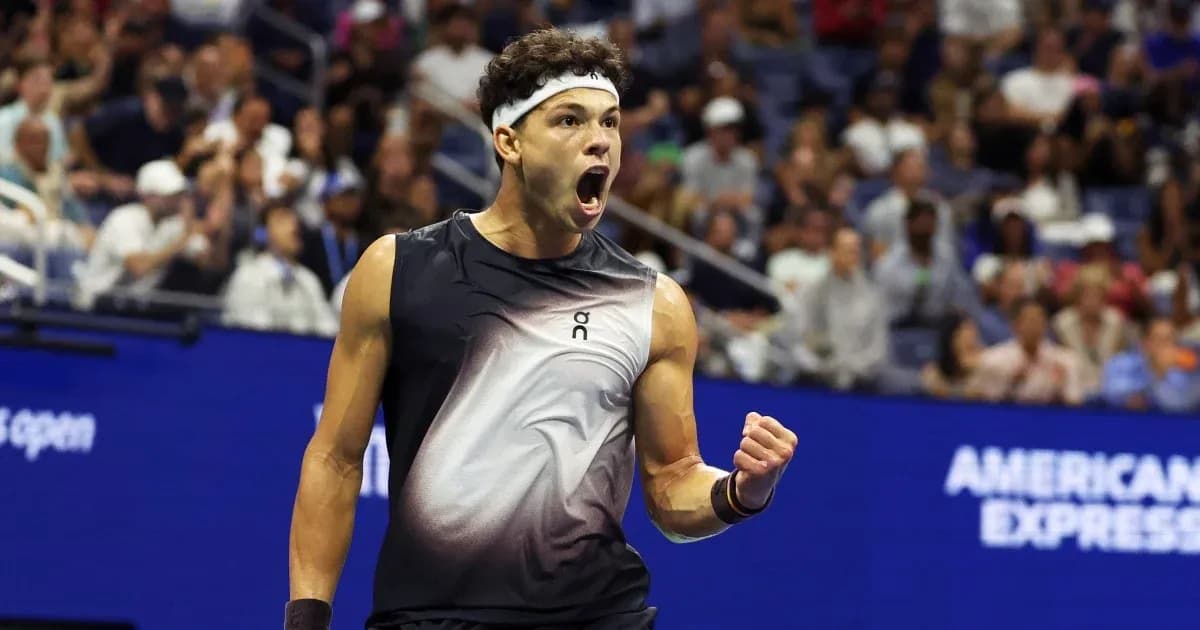
By the time Ben Shelton finally raised his arms to the sky, New York was deep into tomorrow. The clock inside Arthur Ashe Stadium read 3:33 a.m., the air was heavy, and 20,000 people still refused to go home.
There’s late, and then there was this.
Shelton, the 21-year-old American with the lefty cannon and a taste for chaos, outlasted defending champion Carlos Alcaraz in a five-set epic to reach the U.S. Open semifinals, ending the Spaniard’s 18-match Grand Slam winning streak and rewriting the tournament’s record books for the latest-ever finish.
The No. 8 seed won 4 hours and 28 minutes of trench warfare, 10-7 in a deciding-set tiebreak, on a night when both men looked at times as if their bodies might give in before their belief did. At one stage, Alcaraz bent over and vomited into a towel, a brutal snapshot of a quarterfinal that refused to let either player off easy.
Shelton now faces fellow American Frances Tiafoe in the semifinals. One of them will walk out on Sunday to contest the U.S. Open final, carrying the weight of a drought that stretches back to Andy Roddick’s 2003 triumph in this same city.
For a nation starved of a men’s Grand Slam champion, that alone feels seismic.
A night that wouldn’t end
The day at Flushing Meadows had already been a marathon. Three of the four singles quarterfinals went the distance, all decided by match tiebreaks. Aryna Sabalenka had opened proceedings by edging Wimbledon champion Linda Noskova, keeping alive her bid for a third straight U.S. crown. Later, Tiafoe staged a series of comebacks to squeeze past fellow American Alex Michelsen and book his date with Shelton.
By the time Alcaraz and Shelton walked under the Ashe lights, the crowd had settled in for a long one. They got more than they bargained for.
Alcaraz, seeded No. 2 and still rebuilding his season after a wrist injury cost him months on tour, edged a tight opening set in a tiebreak. It felt familiar: the champion absorbing pressure, then striking at the right moment.
Shelton didn’t flinch. He tore into the second and third sets, riding his serve and forehand, feeding off a crowd that roared for both men but surged whenever the American uncorked another fearless strike. The match tilted his way, not in a sudden surge but in waves, each rally a test of nerve and lungs.
Just when Shelton looked ready to run away with it, Alcaraz snapped back. The Spaniard stormed through the fourth set 6-1, a ruthless reset that hinted at a familiar script: the champion reasserting control, the challenger running out of gas.
Instead, the fifth became a street fight.
Trading blows to the last ball
The final set was not about patterns or tactics so much as survival. Both men attacked, both men missed, both men kept coming. Service games felt fragile. Momentum lasted a handful of points at best.
The pressure finally told in the tiebreak.
Shelton, who had ridden the edge all night, found enough first serves and bold swings to keep Alcaraz at arm’s length. The defending champion, who two years earlier had set the previous late-finish record with his 2:50 a.m. win over Jannik Sinner on this same court, could not conjure one more escape.
At 10-7, it was over. The new record belonged to Shelton and Alcaraz, and the American had the win that will define his young career—for now.
Around them, thousands of fans stayed glued to their seats, refusing to drift into the Queens night. They cheered for Alcaraz, the sport’s electric showman. They roared for Shelton, the new home hope. They simply refused to let the moment pass quietly.
“It’s incredible,” Shelton said on court, still buzzing. “I always say that this is the greatest sports city in the world, I say that this is the greatest stadium in the world. I’m just hoping that my best friend and my sister over there don’t have to be at work at 6 a.m. in three hours.”
It was a line born of exhaustion and adrenaline, but it captured the night: New York stretching itself thin for tennis, tennis giving everything back.
What comes next
For Alcaraz, this defeat stings, but it also draws a line under a stop-start season. The 21-year-old who once seemed to sprint past the rest of the sport now has to chase again, his sights fixed on rediscovering the relentless form that made him the game’s brightest light.
Shelton, meanwhile, steps into a different kind of spotlight. A U.S. Open semifinal. An all-American clash with Tiafoe. A guaranteed U.S. finalist for the first time in over two decades.
The drought isn’t over yet. But in the small hours of a New York morning, it finally felt like the chase had real teeth again.