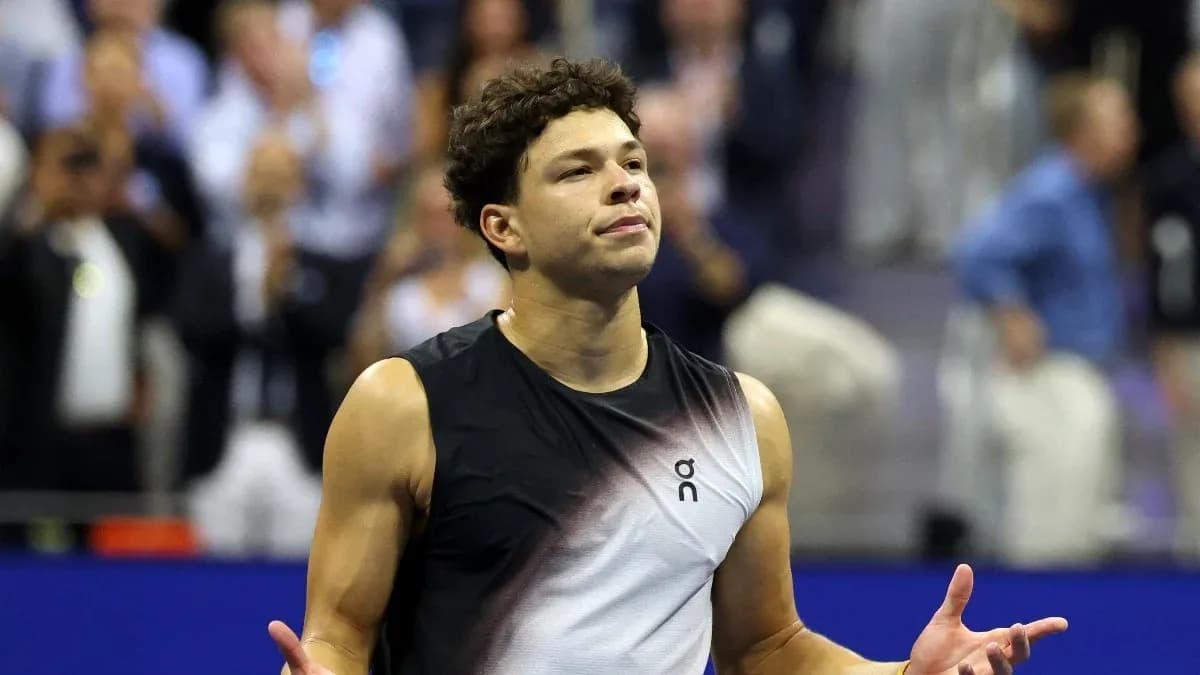
Ben Shelton walked into Arthur Ashe Stadium already a symbol of American tennis promise. He walked out a Grand Slam finalist.
On a hot New York night thick with noise, nerves and celebrity glare, the 23-year-old cracked open his ceiling, beating close friend Frances Tiafoe 4-6, 6-3, 6-3, 7-5 to reach his first major final at the US Open 2026. Two years after a breakout semifinal run here, Shelton has gone one step further — and this time, it feels like the product of hard edges and grown-up resolve, not just raw electricity.
“I think I’ve grown up. I’m more mature, more focused,” he said on court, voice steady but eyes still wide. “I know what my goal is, I know what my job is out here, and I’m 100 percent committed to those goals.”
On this stage, that commitment is constantly tested. Arthur Ashe is not just a court; it’s a circus of power and distraction. Every changeover, every glance at the big screen offers another reminder that this is tennis on a different planet.
“It’s not easy, playing here on Arthur Ashe,” Shelton admitted. “You’re playing in front of all your favourite athletes and movie stars. So to keep your head down and focus for over three hours is not an easy task. I keep looking up at the screen like, ‘Oh, shoot, Jalen Brunson’s here.’”
On Friday night, he kept his head just long enough.
A Rivalry Wrapped in Brotherhood
For all the fireworks, this was never a grudge match. It was something far more delicate: two standard-bearers of American tennis, bonded by friendship, colliding for a place in the sport’s most exclusive room.
“First on Foe, he’s like a big brother to me, to be honest,” Shelton said. “Every time we get to take this court together, Arthur Ashe, and play each other is super special.
“This is where we want to be at the end of this tournament. This is both of our favourite tournament in the world, favourite court in the world. And to be able to light it up in front of you guys is the best feeling that there is.”
For a set, it looked like the big brother would keep control.
Tiafoe took the opener 6-4, using his experience and variety to blunt Shelton’s power. He rode out early pressure, absorbed the booming lefty serve, and punished the looser rallies. When he clawed back from 0-2 down in the second set to level at 3-3, then 4-4, the match seemed to tilt his way. Shelton’s early surge had been erased; the crowd sensed a familiar script.
The momentum was with Tiafoe. Shelton had to rip it back.
The Turning Point
Serving at 4-5 in the second set, Tiafoe blinked. Shelton didn’t.
From 30-15, Shelton lasered a backhand winner to earn break point, then forced a forehand error to snatch the game and the set, 6-3. The comeback was complete, the semifinal level at one set all, and the dynamic had flipped. Tiafoe, once in control, now chased.
Shelton served out the set with authority, racing to 40-0 and closing it when another Tiafoe forehand drifted wide. That game felt like a line in the sand: the younger man no longer just hanging in rallies, but imposing himself, point after point.
The pressure began to squeeze.
In the third set, Tiafoe’s backhand — so often a rock — started to crack. Serving at 2-3, he fell behind 0-40 after two backhand errors. Shelton pounced, whipping a brilliant backhand winner to pile up break points, then another to seal the break. It was ruthless, clean, and loud.
From there, Shelton tightened the vice. He powered through a love hold, slamming two huge aces and drawing a forehand error to move to 5-3. Tiafoe, suddenly searching for answers, could only watch as the set slipped away. Shelton closed it out 6-3, taking a two-sets-to-one lead with a growing sense of inevitability.
The kid who once rode waves of adrenaline now looked like a man managing a big match.
Holding His Nerve
The fourth set carried the weight of history. An all-American semifinal. A packed Ashe. A nation waiting for a home finalist.
Tiafoe, to his credit, refused to fold. He fought, he hustled, he tried to drag the contest into a fifth set, where chaos often reigns. But Shelton’s serve held firm, his backhand stayed true, and his belief only grew.
When the decisive moment came, it was brutal in its simplicity. At 6-5, serving to stay in the match, Tiafoe double-faulted. After three hours of trading blows, the semifinal ended not with a screaming winner, but with a mistake from the older man and a surge of emotion from the younger.
Shelton didn’t roar right away. He didn’t collapse to the court. He sprinted to the net and wrapped Tiafoe in a long embrace, a hug between rivals who know exactly what the other has given to reach nights like this. There was a grin, a tongue wag, a few words only they could hear.
Only then did Shelton turn to his box.
At first, the celebration felt almost subdued, as if his mind was still catching up to the scoreboard. Then he reached his coaches, threw his arms around his father and the rest of his team, and the reality finally hit. Years of work, of hype, of questions about whether his explosive game could translate into deep Slam runs — all of it funneled into that embrace.
High in the stands, his girlfriend Trinity Rodman beamed, part of a family tableau that framed this as more than just a sporting achievement. This was a culmination, and a beginning.
There will be an American in the US Open men’s final. His name is Ben Shelton, and this time he arrives not just as a promise, but as a player who has learned how to grow up under the harshest lights in tennis.
The question now is no longer whether he belongs on this stage. It’s how far he can push it from here.