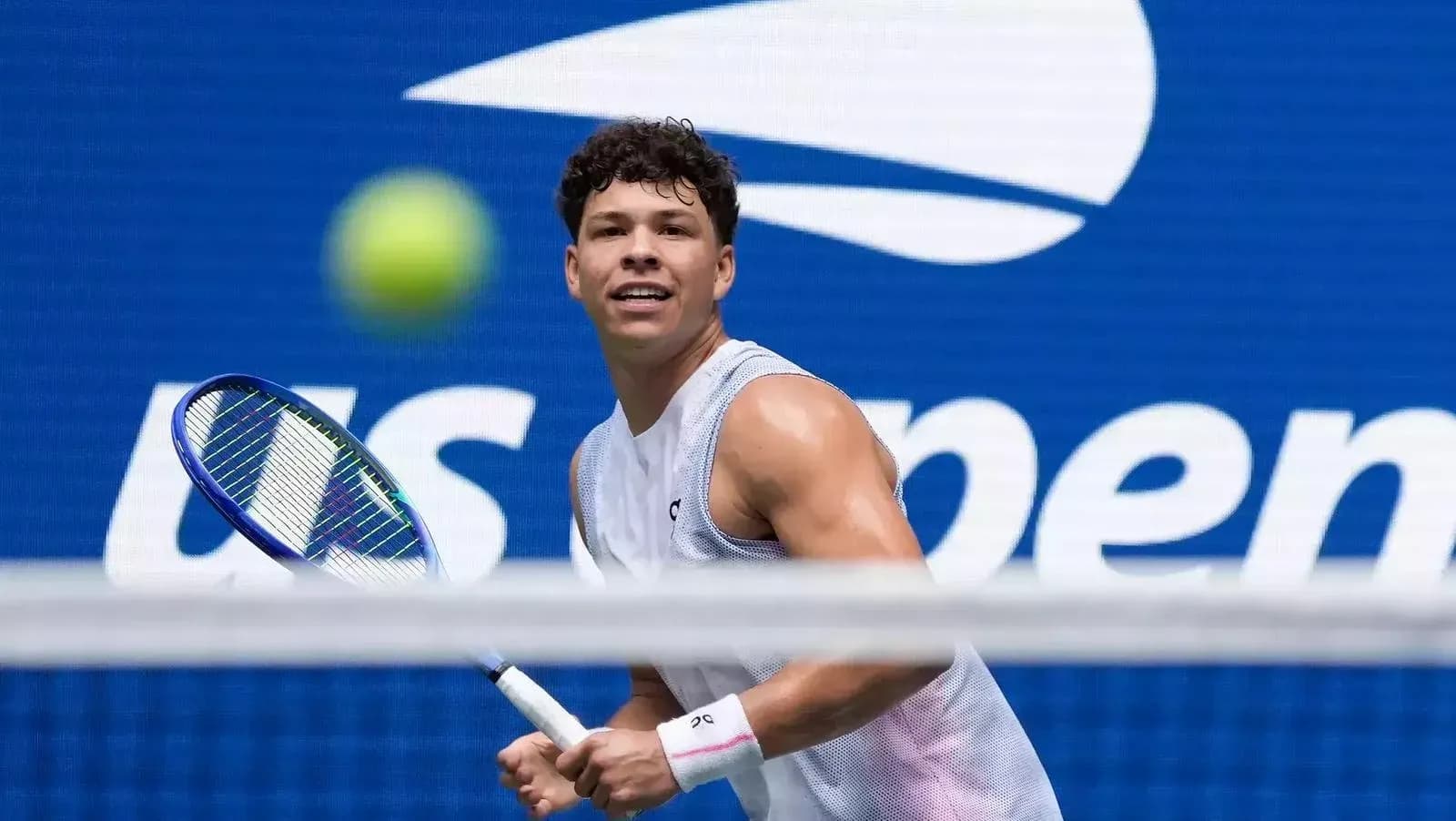
QUEENS, N.Y. — By the time Ben Shelton slapped away the final forehand and let out a roar into the New York night, it was 2:08 a.m. at Arthur Ashe Stadium. The stands had thinned, the air had cooled, but the message was loud enough for anyone still paying attention: the American charge at this US Open has a spearhead, and his name is Ben Shelton.
The 21-year-old powered into the quarterfinals on Friday night with a 7-6(3), 6-7(5), 6-2, 6-4 win over Denis Shapovalov, extending his dominance over the Canadian to 5-0 in their head-to-head.
A Rivalry Tilting One Way
Shelton walked on court with every reason to feel confident. He had never lost to Shapovalov. He’d beaten him indoors in Dallas earlier this year in three tight sets. He’d outlasted him at Wimbledon in a five-set epic in the Round of 32.
This one followed a familiar pattern. It was tight, then it wasn’t.
The first set set the tone. Both men swung freely, both hunted for the first strike, both leaned on their serves. When the tiebreak arrived, Shelton’s composure separated them. He jumped ahead, took control of the rallies, and closed it 7-3 with the air of a player who knows he owns the matchup.
Shapovalov, though, is rarely a quiet participant. The Canadian bit back in the second set, matching Shelton’s power and finally getting a foothold in the exchanges. Shelton twice served for the set. Twice he blinked.
“That second set was tough,” Shelton admitted afterward. “I was serving for the set twice and ended up losing the set when I felt like I was in control. I really had to reset and refocus. It was important for me to get the next two sets and not be out here in a five-set war. I am happy with the way I recovered.”
The tiebreak went Shapovalov’s way, 7-5. Momentum seemed to tilt. For a moment.
Shelton Shifts Gears
What followed was the kind of response that separates a dangerous talent from a serious contender.
Shelton came out for the third set with a different edge. He amped up the pace on his serve, hunted returns earlier, and went after Shapovalov’s second serve with conviction. The Canadian’s level dipped; Shelton pounced.
The third set raced by 6-2. The rallies shortened. The American dictated with his first strike, and Shapovalov struggled to hold his ground.
An early break in the fourth gave Shelton the kind of cushion he rarely surrenders. From there, he managed the scoreboard like a veteran, guarding his serve, picking his spots to attack, and never allowing Shapovalov a real opening. At 6-4, it was done. Another late-night statement. Another American into the last eight.
Shelton now stands as one of four American men in the quarterfinals, all chasing the same ghost: Andy Roddick, the last homegrown champion here back in 2003. The drought has stretched across generations. Players have come and gone. Shelton is intent on writing a different ending.
Surviving the Early Rounds
This run hasn’t been a smooth cruise through the draw. It’s been a climb.
In the first round, under the lights of Arthur Ashe on Monday night, Shelton opened against Tallon Griekspoor and looked, briefly, like a man searching for his footing. He trailed 0-2 almost before he’d settled into his return stance. After just 28 minutes, the Dutchman had blitzed through the first set 6-1.
Shelton’s response was immediate and emphatic. He grabbed a 2-0 lead in the second set, steadied his serve, and let the New York crowd pull him into the fight. The noise grew, his confidence followed, and from there he rolled through the key moments, turning a shaky start into a commanding finish to seal the match.
On Wednesday, the challenge came from Hubert Hurkacz, one of the cleanest servers in the game. Shelton dismantled the opening set in 32 minutes, landing 85% of his first serves and suffocating Hurkacz’s return chances. The Pole struck back, breaking Shelton and taking the second set 7-5, but the American refused to let the match drift.
By the fourth set, Shelton had the upper hand again. Serving at 6-5, he stepped up to the line, found his spots, and converted match point to book his place in the third round. Each test sharpened him. Each wobble seemed to harden his resolve.
A New Dynamic Against Tsitsipas
Now comes a different kind of examination: Stefanos Tsitsipas in the quarterfinals on Sunday.
They have history. Three years ago, they met in Cincinnati. Back then, Tsitsipas was entrenched at No. 4 in the world, a fixture in the game’s elite. Shelton, ranked No. 41, was still climbing, still learning, still absorbing what it meant to face a player of that stature. The Greek won a tight two-set match and walked away as the established star.
The landscape has flipped.
Shelton enters this US Open quarterfinal as the world No. 9, the top American in the field, a man whose game and presence now demand attention. Tsitsipas, once a top-five mainstay, has slipped outside the top 50 and arrives in New York fighting to reassert himself.
The stakes are clear. For Shelton, this is already his second Grand Slam quarterfinal of the year after reaching the same stage at the Australian Open. He is no longer the upstart hoping to surprise. He is expected to contend, expected to handle the occasion, expected to carry the weight that comes with being the leading home hope.
The late nights, the tiebreaks, the comebacks — they’ve all led to this. On Sunday, under the Ashe lights again, Shelton won’t just be chasing a semifinal spot. He’ll be testing how far, and how fast, this new era of American men’s tennis can really go.