Carlos Alcaraz didn’t ease his way back. He walked on court after four and a half months out, stared down the uncertainty, and played like a man who’d been waiting far too long to feel a racket in his hand.
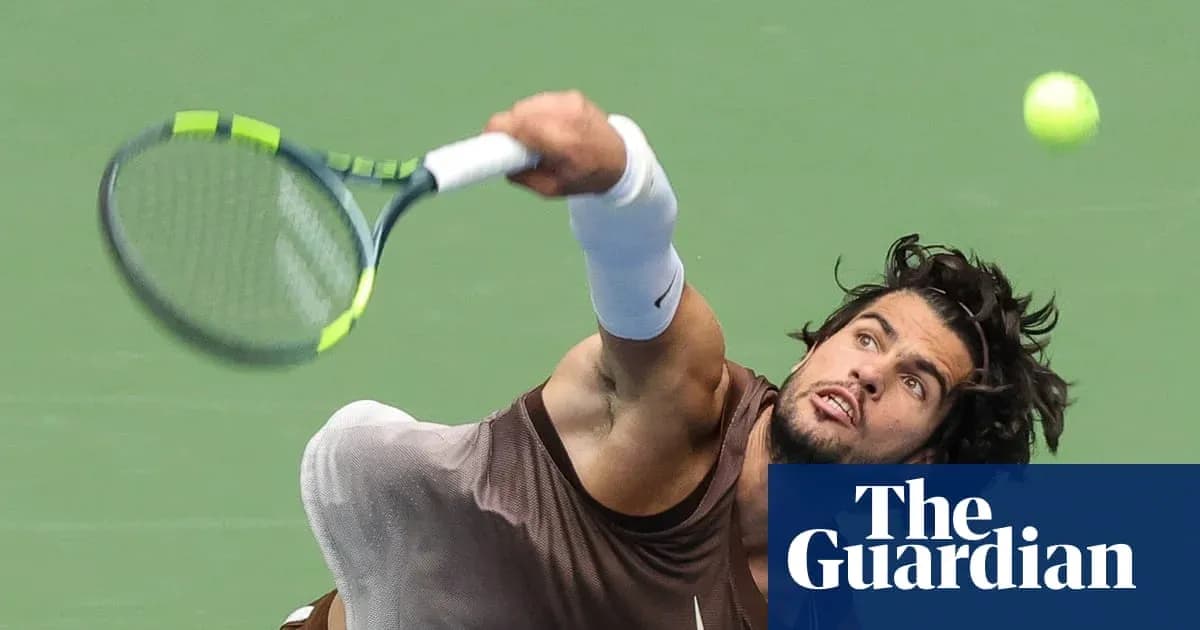
At 5-4, 30-15 in the opening set of his first singles match since his wrist injury, instinct took over. Wide serve, smooth and precise. Roman Safiullin knifed a dipping backhand return at his feet. Alcaraz glided forward, bent low and, with the kind of touch the tour has sorely missed, feathered a half‑volley over the net for a winner.
One shot. Pure Alcaraz. The grin came instantly. So did the hold. And from there, the contest never really wobbled as the Spaniard sealed a commanding 6-4, 6-4, 6-4 victory.
A comeback without a safety net
No warm‑up events. No gentle best‑of‑three easing into rhythm. Alcaraz chose the deep end: a grand slam return, best-of-five, with a wrist that had not been tested at this intensity since his layoff.
Across the net stood Safiullin, a heavy ball‑striker whose pace was always going to probe that wrist. This wasn’t a soft landing; it was a stress test.
The response was emphatic. From the first games, Alcaraz swung freely on his forehand, the shot many already call the best in the world. He didn’t hide it, didn’t protect it. He unleashed it.
The numbers told the story. Twenty forehand winners. Just nine unforced errors off that wing. When he drifted into trouble on serve, he didn’t retreat into caution. He blasted his way out, taking the ball early, ripping through the court, dictating from the baseline as if the last four and a half months had been a brief pause rather than a serious interruption.
Afterwards, the assessment was as clear as his ball‑striking.
“It’s pain-free right now,” Alcaraz said of his wrist. “I felt great. I don’t know how it looked from outside but, from inside, my feeling was that I was hitting normal. I was playing pretty normal, playing my style, and the arm, the wrist, everything felt great. I’m going to still take care of it, obviously, these days and before the matches and everything, but I’m just really happy it’s pain-free finally.”
One question mark: the serve
For all the confidence off the ground, one element of his game told a more cautious tale. The serve.
Alcaraz kept his speeds down, his first serve averaging just 113mph. For a player capable of far more, that was a clear sign of management, not limitation elsewhere in his game. The tape under the arm sleeve, visible in both practice and matches, underscored the point: the wrist may feel good, but he and his team are not about to gamble everything on a few extra miles per hour.
That approach makes sense this early in a comeback. But it comes with a cost. Fewer free points. Longer service games. More rallies. Across a two‑week major, that can decide how deep a player goes.
For now, it’s a trade-off he’s willing to accept.
Nerves, noise and a different kind of goal
This was not just another first round. It was a day loaded with emotion. In his box sat his parents, his brothers, his team. Even rapper Travis Scott watched on. A full house, a big stage, and a player trying to trust his body again.
“It was a difficult day for me, to be honest, but at the same time, a really beautiful one,” Alcaraz admitted.
“I started the day really nervous. Really, really nervous, thinking: ‘I’m going to make it, I’m going to compete again.’ I had more nerves than usual, but just happy, because for me, my goal here is to compete, to enjoy, and let’s see how my body’s going to react after the matches, after the competition again.
“I don’t know how far I’m going to go in the tournament. I didn’t know if I was going to lose this one, if I’m going to make the second round, final. I don’t know how far I’m going to go. But what I just really want to do is enjoy every time that I’m going to walk into the court feeling the energy from the people, feel the competition, walking up, I’m thinking, all right, it’s match day. That’s what I’m going to do this tournament.”
On day one, he got exactly that: the walk, the noise, the nerves, the fight. He also got something else, something every contender needs at a slam.
Proof that, for now, his body will let him be himself again.