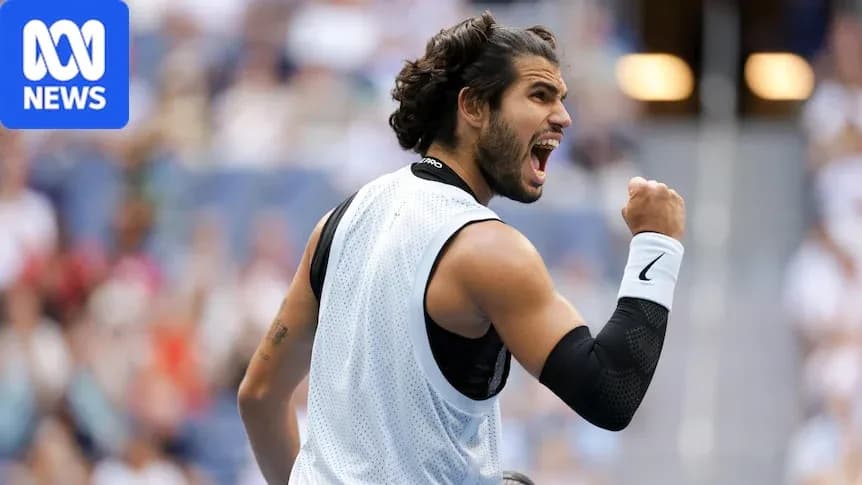
Carlos Alcaraz didn’t just win. He sent a message.
The defending US Open champion dismantled 20th seed Tommy Paul 6-4, 6-3, 6-4 on Arthur Ashe Stadium, marching into the quarterfinals and looking every inch the man to beat again in New York.
The champion returns at full throttle
Five months out with a right wrist injury. Two grand slams missed. A problem that has shortened or softened more than a few careers.
You wouldn’t have known it.
Alcaraz, already a seven-time grand slam champion, has hit top gear at Flushing Meadows, stretching his major match-winning streak to 18 with a performance that mixed swagger, precision and cold-blooded efficiency. The numbers backed up the eye test: 33 winners, many of them outrageous, several of them demoralising.
One shot told the story. Early in the second set, locked in a baseline exchange, Alcaraz unloaded on a forehand down the line that screamed through at 164km/h. It was the kind of strike that makes a stadium gasp and an opponent blink. For a player coming off a serious wrist issue, it was a clear, brutal statement: the power is back.
He has thrived on this court ever since his breakthrough major triumph here four years ago, and once again Ashe felt like his stage. Match point arrived with another ferocious forehand, a rocket that underlined the gap between the two men on the day.
Asked if he felt back to his best in New York, Alcaraz didn’t hesitate. This is his place, his rhythm, his comfort zone. Quarterfinals now in five of his six appearances at the US Open tell their own story.
Paul pushes, Alcaraz answers
The scoreline looks tidy. The contest on court was sharper than that.
Paul, one of the quickest players on tour, refused to play the role of a compliant supporting act. He chased, he scrambled, he countered, and he produced his second around-the-post winner of the tournament, a reminder of his flair and athleticism.
Alcaraz didn’t blink.
He stuck to his identity: front-foot tennis, taking the ball early, dictating with heavy, aggressive strokes and stepping in on the return. He knew Paul’s timing and variety could turn rallies into chaos, that the American’s “dangerous” shots could skid and dip in awkward ways. So he took that time away, went after the second serve, and kept Paul pinned under pressure.
The approach worked. Alcaraz repeatedly squeezed errors from Paul’s forehand wing, opened up the court with angles, then finished with that thudding forehand or a crisp backhand up the line. His aggressive returning helped him control the scoreboard and, crucially, his own emotions. With the crowd leaning towards the home hope, he played like a man content to be the villain.
New York, his kind of stage
On Ashe, the noise never really settles. The second seed fed off it.
Even with much of the showcourt crowd willing Paul into the contest, Alcaraz’s audacity kept dragging the attention back to him. Drop shots, line-licking forehands, sudden bursts of pace — it was the full New York show. His record against Americans at the slams now stands on the brink of a remarkable mark: 13-0 with this win.
He did ease off slightly as the finish line approached. Serving for the match, the level dipped, a reminder that even the best feel the weight of closing out big nights in this stadium. The hesitation didn’t last. He regrouped, tightened the screws again, and delivered the final blow with the composure of a player who has lived these moments many times before.
The straight-sets score, the clean hitting, the control in key moments — all of it pointed in the same direction. The man who spent nearly half a year on the sidelines looks like he never left.
A quarterfinal with bite looming
Next up: a quarterfinal against either American Ben Shelton or Greek star Stefanos Tsitsipas, a matchup that promises either a bruising, high-octane duel with a homegrown power server or a tactical chess match against one of the game’s purest strikers.
On the other side of the draw, the American charge carried its own intrigue. Frances Tiafoe faced Daniil Medvedev with the chance to set up an all-American quarterfinal against Alex Michelsen, the 22-year-old who had earlier taken out 27th seed Tomas Martin Etcheverry 7-6(8/6), 6-4, 6-4.
The storylines are stacking up across the tournament. But at the heart of the men’s draw, one image lingers: Alcaraz, wrist healed, forehand unleashed, walking off Arthur Ashe again with the look of a man who fully expects to be back here on the final Sunday.