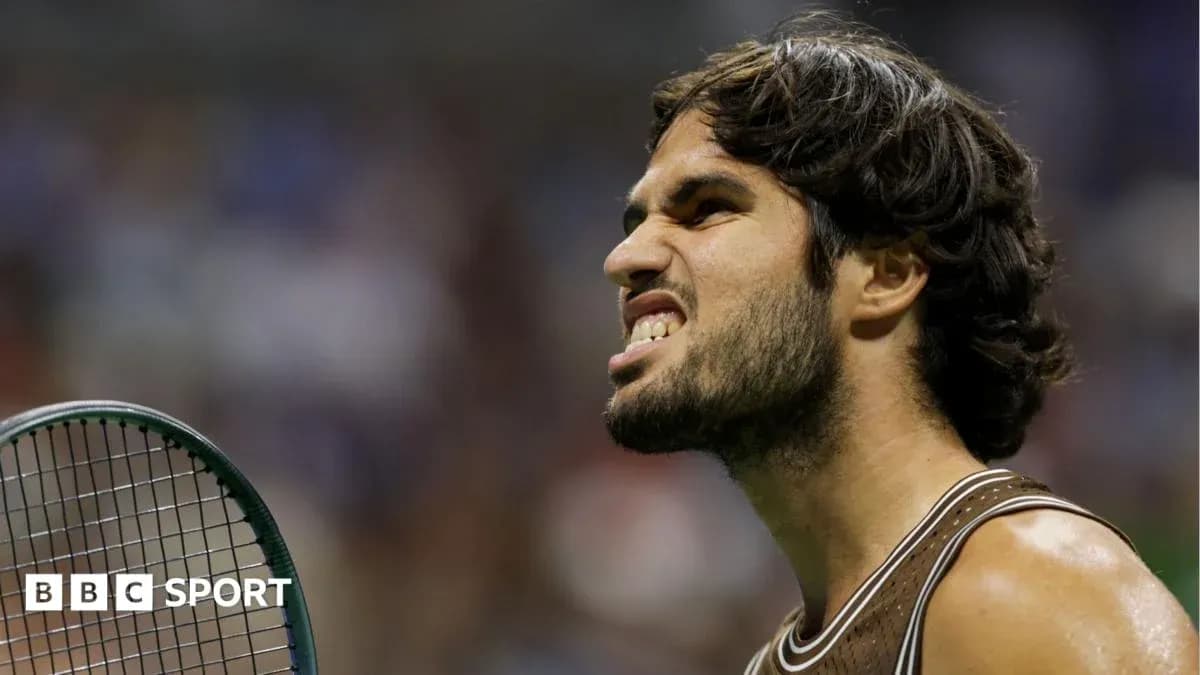
Under the New York lights, the defending champion flirted with danger before slamming the door.
Carlos Alcaraz, still feeling his way back from a long lay-off with a right wrist injury, dropped the opening set to Portugal’s Jaime Faria, then tore through the rest of the night to win 4-6 6-0 6-3 6-2 and reach the US Open last 32.
For a set, Arthur Ashe Stadium watched a champion search for himself. Faria, ranked 72 in the world and playing with nothing to lose, took full advantage. He broke early, stayed bold on return and forced Alcaraz into rushed decisions and mistimed forehands. The Spaniard’s timing was off, his patterns unclear, his impatience obvious.
The turning point arrived almost immediately in the second set.
Serving at 0-1, 15-40, Alcaraz stared at two break points that would have left him trailing by a set and a break. He saved both, dug out the hold – and the match flipped. The pressure finally told, not on the favourite, but on the underdog who suddenly had to sustain a level he had never produced on this stage before.
From there, Alcaraz surged. He rattled through the second set 6-0, the kind of bagel that announces not just a reset, but a reassertion. The forehand, the shot that had been the great unknown after the wrist injury, began to crack through the court again. He stepped in, took the ball early, and started dictating rallies from the baseline rather than reacting to them.
“It was a tough match for me. I felt great in the first set, but I didn’t take time and that cost me,” he said afterwards, reflecting on that slow start and the mental shift that followed. “After that I tried to be focused, stay calm and think the good things will happen.”
Once he found that gear, Faria’s resistance faded. The third set brought a more competitive scoreboard, but not a change in direction. Alcaraz controlled the tempo, mixed in heavier topspin with sudden accelerations down the line and read the Portuguese player’s serve with increasing ease. A single break was enough for 6-3.
By the fourth, it looked like the Alcaraz New York has come to expect. He stalked the baseline, swung freely on the forehand and moved with the elastic speed that makes the court feel too small for his opponents. The scoreline – 6-2 – reflected a champion who had remembered exactly who he is.
This US Open always carried a question mark for him. This is his first tournament since mid-April, his first serious test of that injured right wrist in the furnace of best-of-five sets. He insisted after his straight-sets win over Roman Safiullin in the first round that he was “playing normal” and not holding back on his forehand. After this four-set workout, he doubled down on that feeling.
“I know once I step on the court, I’ve just got to go for it every time. I’ve got to feel normal,” he said. “I have to hit like I was hitting before the injury. I’m feeling great. There is no reason to be afraid and not hitting normal.”
If the first match answered whether he could swing freely, this one tackled a different issue: how his body would react when pushed deeper, longer, harder. He embraced that examination.
“At the end, I realised that playing four sets was really good for me to test everything physically, to test my body, how I feel, and how I’m going to feel tomorrow after this match,” he said.
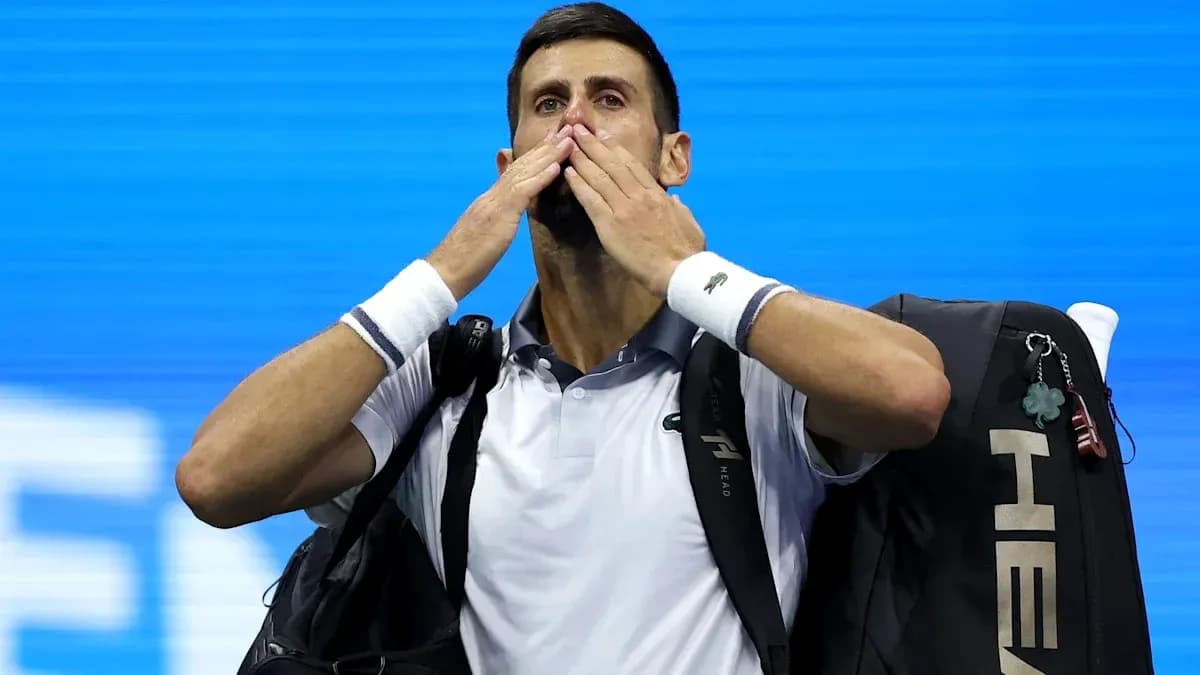
The context around him is shifting, too. Jannik Sinner is absent from New York through injury. Novak Djokovic, the 24-time major champion and ever-present benchmark, has already gone out. The draw, once stacked, suddenly looks wide open. For a two-time US Open winner who is still finding his top gear, it is an invitation as much as an opportunity.
The tests, though, are only going to sharpen. Higher-ranked opponents than Safiullin and Faria await. The cumulative strain of multiple five-setters looms in the second week. How that wrist, and the rest of his body, responds to that grind will define his title defence as much as his shot-making.
Next up is China’s Wu Yibing, ranked 113 in the world, in the last 32. On paper, it is another match Alcaraz will be expected to control. On a wrist that only recently returned to full duty, nothing is quite that simple.
Around him, the men’s draw on day four brought its own stories.
- American 20th seed Tommy Paul, a potential fourth-round opponent for Alcaraz, kept his campaign on track with a 6-2 6-3 5-7 6-4 win over Croatia’s Dino Prizmic. Paul will now meet Kazakh 15th seed Alexander Bublik, who dismissed French veteran Adrian Mannarino with a ruthless 6-3 6-1 6-1 performance.
- The American charge did not stop there. Eighth seed Ben Shelton continued his push to become the first home men’s champion since Andy Roddick in 2003, edging past Poland’s Hubert Hurkacz 6-3 5-7 7-6 (7-3) 7-5 in a tight, nervy encounter.
- Two-time semi-finalist Frances Tiafoe added more home comfort for the crowd, handling Japan’s Rei Sakamoto 6-3 7-6 (7-2) 7-5 with authority and flashes of his trademark flair.
- Not everyone survived. Spanish 12th seed Rafael Jodar suffered the heaviest blow of the day, swept aside 6-2 6-1 6-1 by China’s world number 124 Bu Yunchaokete – a scoreline that underlined just how unpredictable this men’s draw has become.
Through it all, Alcaraz remains the man with the trophy to protect and the wrist to prove. One scare survived, one step closer, and a wide-open fortnight stretching in front of him.