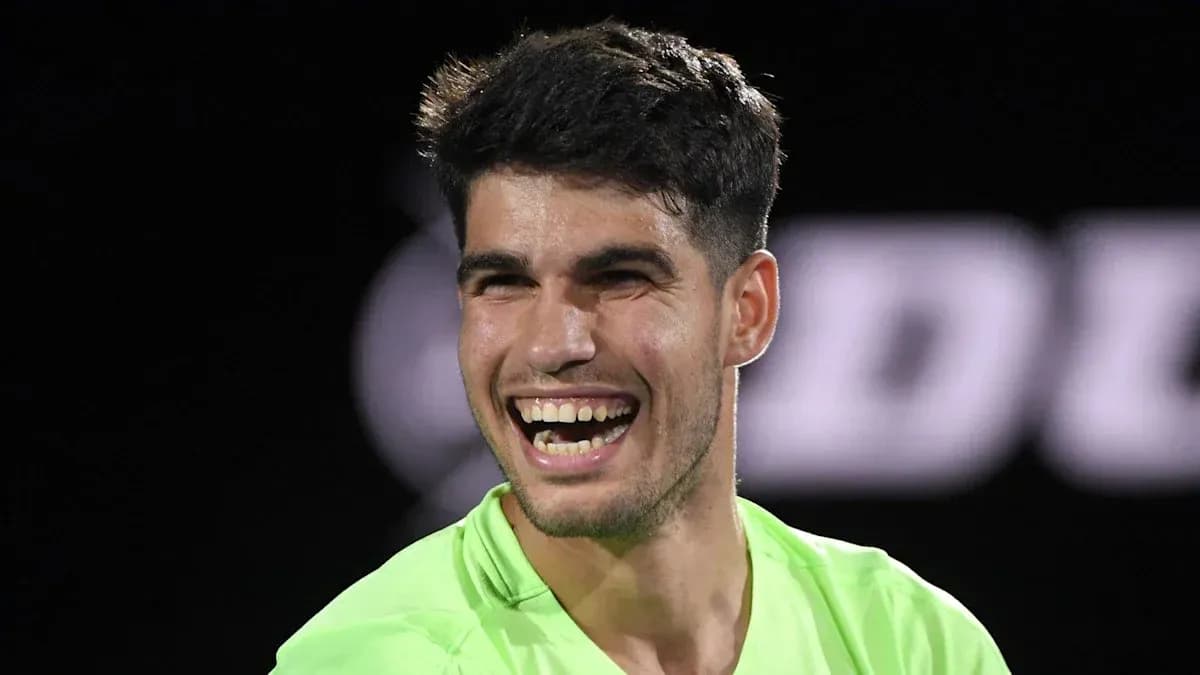
Carlos Alcaraz grew up with a racket in his hand and a coach at the kitchen table.
Before he was the world-beating prodigy, he was a four-year-old on a court in Murcia, following the footsteps of a man who had already lived – and lost – his own tennis dream: his father, Carlos Alcaraz Gonzalez.
The first Carlos
In Spain, long before his son burst onto centre courts, Carlos Sr. was the Alcaraz everyone in local tennis knew.
As a teenager he carved out a reputation with sharp, competitive tennis that pushed him into the national rankings. By 1990, he had climbed all the way to the ATP rankings, a significant achievement for a young player trying to break through from a regional base.
Then the climb stopped.
Not because of talent. Because of money. Financial limitations cut short a career that was just beginning to open up. The door to the “big leagues” never fully swung wide for him.
He refused to walk away from the sport. Instead, he embedded himself in it. He became tennis director at Real Sociedad Club de Campo de Murcia, the same club with deep family roots: his own father had helped build it years earlier. Three generations, one set of courts. Tennis was no hobby in the Alcaraz household; it was the family business and the family language.
From that vantage point, Carlos Sr. did something arguably more influential than cracking the top of the tour. He built an environment where his son could go further than he ever did.
Father, coach, constant presence
When Carlos Jr. picked up his first racket, it came from his father’s hand. The coaching started almost immediately and never really stopped.
Carlos Sr. became his son’s coach, spending long days and longer nights on court, drilling technique, feeding balls, insisting on standards. The hours were relentless. The relationship held.
The work paid off.
As the younger Alcaraz surged through the junior ranks and into the professional spotlight, his father remained a quiet but unmistakable figure in the background – often in the stands, sometimes in the player box, always in the story.
The bond between them runs deeper than a typical coach-player arrangement. Speaking to Sports Illustrated, Carlos Jr. put it simply: “I loved tennis since the beginning. I mean, my father brought me my first racket, and the first time that I played tennis I fell in love.”
That first racket has turned into Grand Slam hardware and global acclaim, but the sentiment has not shifted.
On court at the Australian Open, in the afterglow of another big win, Alcaraz chose again to circle back to his father. “I'm just really proud and happy to see my dad [living] these experiences because it was really his dream when he was playing tennis. I'm just really proud and really happy to see him making this dream with me,” he said.
For Carlos Sr., who once stared at the financial ceiling of his own career, those words land differently. His son is not just playing for himself; he is carrying the family’s unfinished story into packed arenas and primetime slots.
The first Carlos built the court. The second Carlos is ruling it.