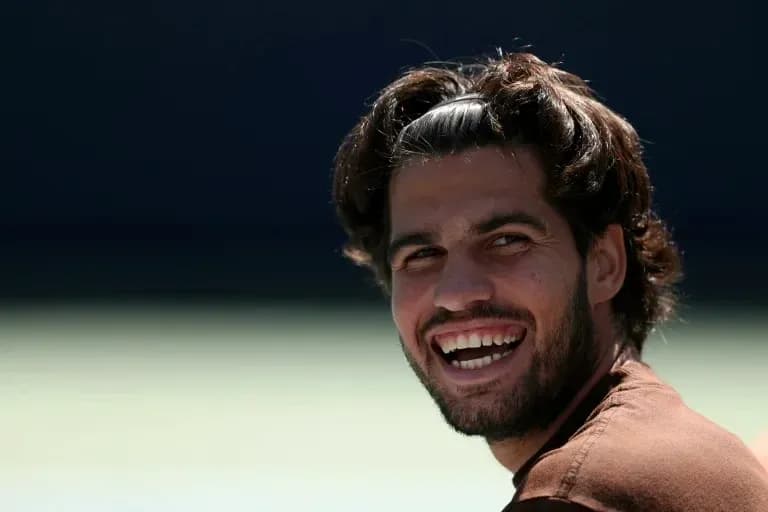
Carlos Alcaraz walks back into the New York glare on Monday carrying two things that don’t sit easily together: four months of rust and the weight of a defending champion.
Out since April with a right wrist injury, the Spaniard returns to Arthur Ashe Stadium trying to frame his season with Grand Slam bookends. He started 2024 by winning the Australian Open and becoming the youngest man to complete a career Grand Slam. Now he tries to close it by proving that layoff hasn’t dulled his edge.
Across the net in his opening match: Roman Safiullin. Not a marquee name, but a dangerous one.
Alcaraz vs Safiullin: No Soft Landing
The head-to-head stands at 1–1, and the history between them already carries a little bite.
Safiullin stunned Alcaraz at the ATP Paris Masters in 2023, muscling him around the court and exposing an off-night from the then-world number two. Alcaraz struck back at the Paris Olympics the following year, restoring a measure of order, but he knows exactly what the 29-year-old Russian can do on a hard court.
Safiullin comes in with a recent reminder of his threat. At Wimbledon he blasted past Andrey Rublev and Joao Fonseca to reach the fourth round before bowing out to Novak Djokovic in four sets. He hits big, takes the ball early and can pin opponents behind the baseline for long, suffocating stretches.
That’s not the sort of opponent a player usually wants for a first match in four months.
Alcaraz, though, has sounded nothing but bullish about his wrist and his readiness. He has spoken of demanding practice sessions, of going “100 percent” again. Training courts are one thing. A night match in New York, with Safiullin teeing off from the back of the court, is something else entirely.
The defending champion will need his full repertoire quickly: the first-strike forehand, the variety, the touch. If Safiullin finds his range early, this could turn into a real test of both nerve and fitness for the Spaniard.
Sabalenka’s Slide Meets a Familiar Foe
Aryna Sabalenka arrives as the two-time defending US Open champion and the top seed. She also arrives in a skid.
Since ripping through Indian Wells and Miami with back-to-back WTA hard court titles in March, her season has frayed. A quarter-final exit at Roland Garros, a fourth-round loss at Wimbledon, and the sense of a player searching for the ferocity that once felt automatic.
The stakes in New York are sharp. Sabalenka could lose her world number one ranking even if she becomes just the third woman, after Chris Evert and Serena Williams, to win three straight US Open titles.
First up is Camila Osorio, ranked 59 in the world and beaten twice already by the Belarusian. Those previous meetings came on very different surfaces: grass at Wimbledon in 2021 and clay in Madrid in 2023. On both occasions Sabalenka’s raw power and heavier ball simply overran the Colombian.
Osorio will try to stretch rallies, vary height and spin, and drag Sabalenka into awkward corners of the court. Sabalenka will try to blast straight through her.
Despite the dip in results, Sabalenka insists her belief has not cracked. “Throw tough challenges at me, I will come back stronger,” she says. New York will test whether that conviction still holds when the forehand misfires, the double faults creep in and the Ashe crowd starts to murmur.
If she finds her range early, Osorio may again feel overmatched. If the doubts resurface, this could become a nervy opening chapter to a title defence already under scrutiny.
Osaka Back Where She Knows How to Win
Naomi Osaka steps onto the Flushing Meadows hard courts with something that can’t be faked: history.
She owns two US Open titles, from 2018 and 2020, part of her four-major haul. This place has seen her best tennis and some of her most turbulent moments, yet she returns with a calm, almost matter-of-fact belief.
“I think I've proven myself here, so I can kind of bank on that and use that to have confidence,” she said recently. Her results this summer back that up. A semi-final in Washington, a quarter-final in Toronto, and her best-ever run at Wimbledon, where she upset Sabalenka on the lawns.
All of this comes after a long reset. Osaka has spoken candidly about her mental health, stepping away from the sport to address it, then taking 15 months off for motherhood before her 2023 return. The comeback has not been linear, but it has gathered momentum.
Her first-round opponent, Anastasia Zakharova, ranked 101, faces Osaka for the first time. That unfamiliarity cuts both ways. Zakharova can swing freely with little expectation; Osaka must impose herself quickly and avoid giving the Russian a foothold.
On hard courts, Osaka’s game still looks built to do damage: a heavy first serve, clean flat groundstrokes, and the ability to take time away from opponents. If she lands those early, this could be a statement start.
Five years have passed since her last Grand Slam title in Australia. With her confidence rebuilding and the New York hard courts under her feet again, the question hangs over Day 2: is this the tournament where Naomi Osaka’s story at the majors begins a new chapter rather than revisiting the old?