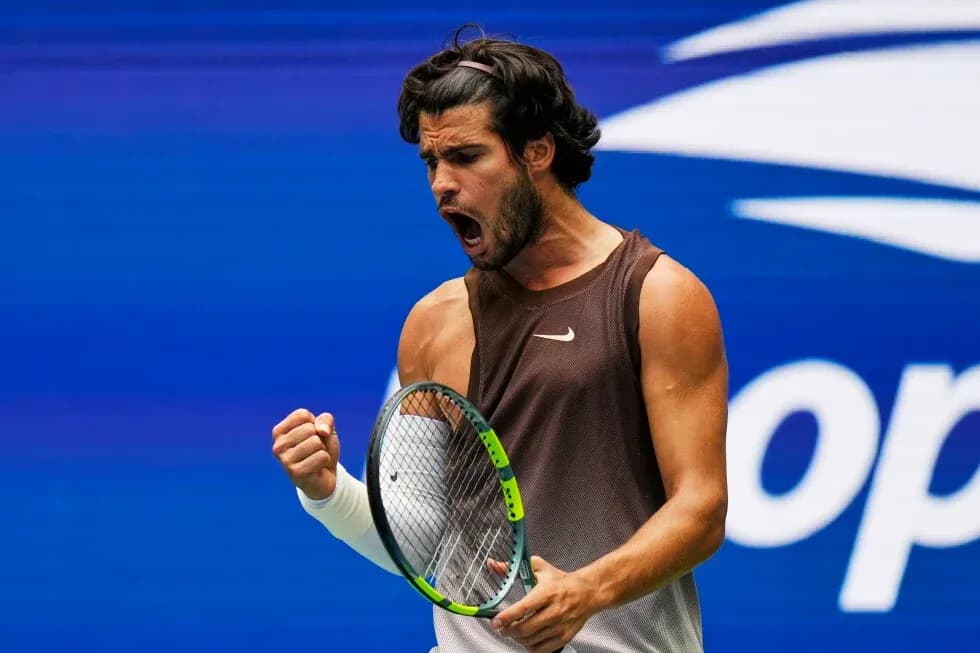
NEW YORK — Carlos Alcaraz walked back into Arthur Ashe Stadium with nerves in his stomach, a grin on his face and, crucially, no pain in his right wrist. By the end of the night, he had something else: a reminder to the rest of the men’s draw that the defending champion is very much alive.
The 23-year-old Spaniard brushed aside Roman Safiullin 6-4, 6-4, 6-4 on Monday, his first competitive match since April and his first real test of that troublesome wrist. It passed.
“I don’t know how it looked from outside, but from inside, my feeling was that I was hitting normal,” Alcaraz said. “I was playing pretty normal, playing my style, and yeah, the arm, the wrist, everything felt great.”
For a player who skipped Roland Garros and Wimbledon, this was a cold plunge straight back into Grand Slam tennis. No tuneups. No safety net. Just Ashe, a night crowd and the weight of expectation. Early on, the tension showed. The strokes were solid, but the shoulders were tight.
Then the old rhythm returned.
As the match settled, Alcaraz started to lean into the noise, cupping a hand to his ear to drag more volume from the stands, punching the air after a feathered volley in the final game. The points lengthened, the angles sharpened, and the body language shifted from cautious to swaggering. It looked like the player who has turned New York into his playground.
“I had more nerves than usual,” he admitted. “But just happy, because, for me, my goal here is to compete, to enjoy, and let’s see how my body’s going to react after the matches, after the competition again.
“I don’t know how far I’m going to go in the tournament. I didn’t know if I was going to lose this one, if I’m going to make the second round, final. I don’t know how far I’m going to go. But what I just really want to do is enjoy every time that I’m going to walk into the court feeling the energy from the people, feel the competition.”
He may not know how far he’ll go. The rest of the field has a pretty good idea.
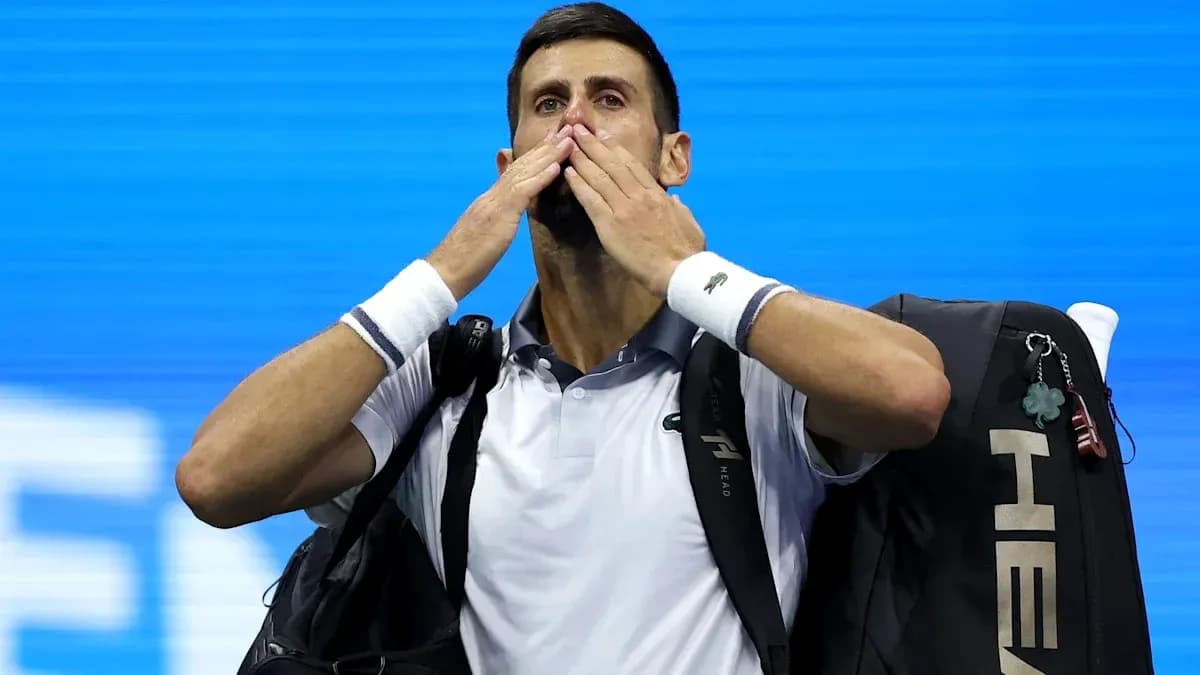
No man has defended the U.S. Open title since Roger Federer’s five-year stranglehold from 2004 to 2008. The path has rarely opened as invitingly as it has this week. Top-ranked Jannik Sinner is out with a knee injury. No. 4 seed Novak Djokovic, a four-time champion here, crashed out in the first round on Sunday, his first-ever opening-round defeat at Flushing Meadows after a 19-0 start to his career in New York.
With Djokovic gone and Sinner sidelined, the draw lost its anchor. If Alcaraz’s body holds up, the seven-time Grand Slam champion suddenly looms as the man everyone else has to solve.
On Monday, though, the night began with a familiar force restoring order on Ashe.
Sabalenka settles in — and stands out
Aryna Sabalenka, chasing her own slice of history, walked out first and did what she usually does in this stadium: she won.
The two-time defending champion beat Camila Osorio 6-4, 6-4, opening her bid to become the first player since Serena Williams (2012–14) to win three straight U.S. Open titles. Sabalenka has made this court her stage, reaching the last three finals, rebounding from a loss to Coco Gauff in 2023 with titles in 2024 and 2025, the latter over Amanda Anisimova.
“I feel like this is one of my favorite stadiums,” she told the crowd. “I really experienced the best emotions here in this stadium.”
She did it in a new look, too. Gone was the black mesh that drew criticism during her mixed doubles outing with Djokovic last week. On Monday, the orange Nike dress sat under orange mesh, a day-session version of the same bold idea.
Sabalenka brushed off the noise about the outfit, insisting only her own taste mattered. The wardrobe switch, she explained, was more logistical than dramatic.
“To be honest, I didn’t know that I have a day dress,” she said. “I thought I have a black dress with orange underneath. I figured (out) when I went to Nike that I actually have day session and night session, which is just like black and orange for the day.”
If the dress felt lighter, so did her tennis. She badly needed a clean performance after a rough summer: fourth-round exits in Toronto, Cincinnati and Wimbledon had dented her aura and her ranking prospects. Even a third straight title in New York might not be enough to keep her at No. 1.
The math is simple and unforgiving. No. 2 Elena Rybakina will overtake Sabalenka if she reaches the semifinals. If Sabalenka fails to lift the trophy again, Rybakina won’t even need to win a match to move past her.
On Monday, Sabalenka could at least control what was in front of her. The serve bit, the groundstrokes found their depth, and the defending champion left Ashe with a straight-sets win and the sense that, once again, this place might bring out her best.
Wawrinka bows out, Tsitsipas looks ahead
Elsewhere, the day carried the weight of farewell and the hint of a reset.
Stan Wawrinka, the 2016 champion here and one of the great late bloomers in tennis, played the final Grand Slam match of his career. The 41-year-old Swiss fell to Matteo Berrettini, closing the book on a major career that yielded three Grand Slam titles and some of the sport’s most memorable backhand winners.
“I’m going to miss it for sure. I’m going to miss it big time,” Wawrinka said, summing up a goodbye that had been coming, but still landed hard.
Another storyline turned in the opposite direction. Stefanos Tsitsipas, unseeded at the U.S. Open for the first time, took out No. 10 seed Arthur Fils 4-6, 7-6 (3), 6-1, 6-4. Fils arrived fresh off the biggest title of his career in Cincinnati; he left with a reminder that best-of-five is a different world.
Tsitsipas, once ranked No. 3 and twice a Grand Slam finalist against Djokovic, was asked if he believes he can climb back to that level.
“Why not?” he replied.
On this evidence, the confidence isn’t misplaced. After dropping the first set, Tsitsipas tightened his game, snatched the second in a tiebreak and then surged through the third and fourth, dictating rallies and turning defense into attack in a way that once felt routine for him.
The men’s draw, already shaken by Djokovic’s early exit, now has room for resurgent names as well as rising ones.
Shelton rallies, Swiatek cruises, Czech fortunes split
American No. 8 seed Ben Shelton gave the home crowd a scare before turning his match into a show. Broken three times in a 28-minute first set, he looked rattled against Tallon Griekspoor. Then the switch flipped. Shelton roared back 1-6, 6-1, 7-6 (3), 6-2, riding his serve and swagger to turn a flat start into a four-set win.
On the women’s side, former champions and recent finalists moved through with far less drama.
No. 8 seed Iga Swiatek advanced, as did 2017 winner Sloane Stephens. Two-time champion Naomi Osaka was slated for the night session, another familiar name in a draw full of past and present stars.
The Czech contingent, so often a force in New York, had a mixed afternoon. No. 6 seed Linda Noskova, the reigning Wimbledon champion, progressed, as did No. 7 seed Karolina Muchova, who lost to Noskova in that All England Club final. No. 10 seed Amanda Anisimova also moved on, keeping her own momentum after last year’s run to the U.S. Open final.
Sara Bejlek, the No. 28 seed and the player who stunned Sabalenka in Cincinnati, could not extend that form. She fell in three sets to Cristina Bucsa, a reminder that the leap from upset artist to consistent threat is often the hardest one to make.
Navarro holds her nerve as Boisson snaps
The rawest emotions of the day came not in a marquee match, but in a rain-delayed scrap on the outer courts.
No. 26 seed Emma Navarro finally subdued Lois Boisson 7-6 (6), 6-7 (1), 6-3 in a first-round encounter that started on Sunday and only finished on Monday. The stop-start nature of the contest made every momentum swing feel heavier.
When it ended, an ESPN camera captured the split screen of sport in one frame. Navarro turned to the crowd, fist clenched, soaking in the survival. Behind her, Boisson hammered her racket into the court again and again, frustration spilling over in the harshest light.
One player moving on, one player melting down. Same court, same moment, completely different worlds.
That contrast, like so much on day one, felt like a snapshot of a tournament suddenly wide open. A defending men’s champion back on his feet, a reigning women’s force chasing a Serena-sized milestone, a legend saying goodbye, a former prodigy asking “Why not?” about his own revival.
The brackets say it’s only the first round. The storylines already feel like the second week.