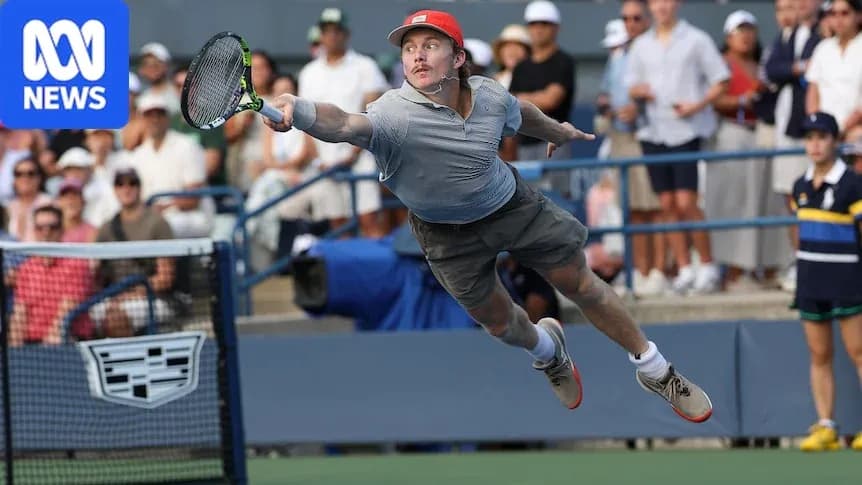
Dane Sweeny’s US Open ride ended not with a roar, but with a grimace.
The 25-year-old Australian, who had turned a late wildcard into the best week of his career, bowed out in the third round to Italy’s Luciano Darderi, the 21st seed, 6-4, 6-3, 6-3. A sore hip, a misfiring game, and a world number 22 in full control proved too steep a combination under the lights of New York.
For the first time in five years, Australia will not have a singles player in the second week at Flushing Meadows. Alex de Minaur’s shock defeat to Botic van de Zandschulp had already cleared the decks. Sweeny was the last one standing. Then he, too, ran out of road.
He knew it as the match slipped away.
"It's been an amazing week, a career-changing week, but I can't help but feel a bit disappointed just with today's performance," he said, the conflict obvious. The opportunity was huge; the level, by his own admission, was not. "I just wasn't really feeling it, just not really feeling the timing and the rhythm as I have been. I just made a lot of cheap errors and that was quite frustrating."
He didn’t complain much during the match, but the hip bothered him. The timing went. The forehand leaked. The scoreboard told a story he wanted no part of.
"I was OK to lose a match, but I really wanted to test him more and bring a good level so I could make an absolute fight out of it," he said. "Win or lose, I wanted to really make him work for the victory at least and I wasn't able to do that."
That honesty underlined how far he has come in a week that almost never started. Ranked 123 in the world, Sweeny only squeezed into the main draw when two late withdrawals opened the door for Tennis Australia to reshuffle its reciprocal wildcard. The ticket originally earmarked for Alexei Popyrin landed in Sweeny’s hands at the last moment.
He made it count.
On debut in the US Open main draw, the Queenslander surged into the last 32 of a major for the first time, a breakthrough run that will reshape both his ranking and his bank balance. The cheque alone — $402,500 — changes the landscape for a player who has spent years grinding on the lower tiers of the tour.
"The financial side of things, that will help with coaching and people you travel with," he said. It sounded practical, but for a player on the margins, this is what a big run really buys: a team, a schedule, a chance to plan instead of just survive.
The rankings will follow too. Sweeny is projected to climb to around 109 in the world, within touching distance of the sport’s magic number. Crack the top 100 by the end of the season and he walks through the front door at Melbourne Park in January, straight into the Australian Open main draw for the first time in his career.
"That's exciting too. But that will take care of itself," he said, catching himself before the dream ran too far ahead. "It's hard not to worry about that because we're indoctrinated to want that low number next to our name, but I can just focus on working hard, focus on improving. Particularly just staying really kind to myself and trying to enjoy the journey."
His journey paused in New York. Others saw their campaigns implode.
American hopes take a hit
On a bruising day for the home nation, three former US Open finalists — Taylor Fritz, Madison Keys and Amanda Anisimova — all crashed out in the third round, ripping a hole in the American challenge.
Fritz, the ninth seed and 2024 runner-up, had strolled through the first week without dropping a set and looked to be cruising again. Up two sets to love against Francisco Cerundolo, he seemed on course for another routine win.
Then the match turned.
Cerundolo, streaky but dangerous, suddenly caught fire. The Argentine raised his level, took the third set, then the fourth, and refused to back off. Fritz’s rhythm deserted him at the worst possible time, and the match slipped away 3-6, 4-6, 6-3, 6-4, 6-4. For Fritz, it was his earliest exit in New York in four years. For Cerundolo, it was a first trip into the fourth round.
The American women fared no better.
Madison Keys, the 2017 runner-up, looked to be strolling into the last 16 when she raced to a 5-0 lead in the deciding set against Zheng Qinwen. The match felt done. The crowd settled in for the handshake.
Zheng refused to accept the script.
Point by point, game by game, she clawed her way back, her power game finally landing with conviction. Keys tightened. The lead evaporated. From 0-5 down in the decider, Zheng completed one of the comebacks of the tournament to win 1-6, 7-6 (7/3), 7-5, then collapsed on the court in disbelief and joy. For a player battling through a career slump, it was a defiant statement.
Her reward is a showdown with 2022 champion and former world number one Iga Świątek, who edged past Marie Bouzková in a pair of tight tiebreaks, 7-6 (7/3), 7-6 (7/3). Świątek wasn’t sparkling, but she was solid when it counted, and that was enough.
Anisimova, seeded 10 and last year’s runner-up, could not find that same resolve. Her difficult season at the majors continued with a straight-sets loss to Anastasia Potapova, 6-2, 7-5. The frustration was written all over her game: flashes of the talent that took her deep here before, undercut by loose errors and a lack of momentum.
Amid the wreckage, one American star held firm.
Coco Gauff, the defending champion, steadied the home hopes with a composed 6-3, 6-4 win over Spain’s Cristina Bucșa. It was not her most explosive performance, but it didn’t need to be. She managed the match, managed the moment, and moved on.
On a day when so many American stories ended, Gauff’s stayed very much alive.