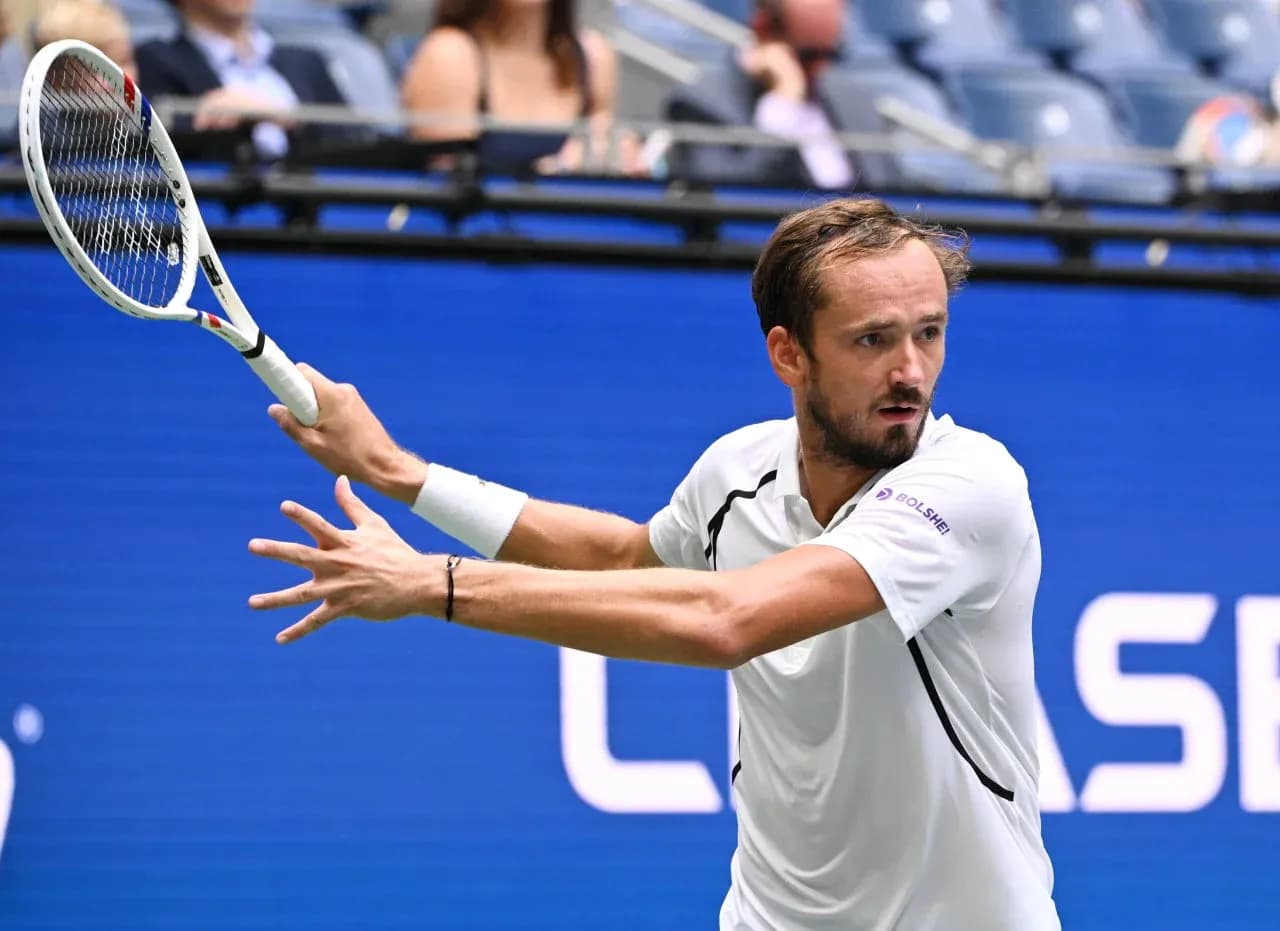
Daniil Medvedev has never hidden his temper. Usually, it’s the racket that pays. In Vienna, it was his own hand.
Locked in a tense third set against Cameron Norrie at the Vienna Open, the former World No. 1 turned his frustration inward. Trailing 0–2 in the decider and struggling to find any rhythm, Medvedev sat down at the changeover, clenched his right hand into a fist and hammered it into the court surface, again and again.
Then came the barb.
“If you hurt yourself, at least you don’t get the fine,” he was heard saying. “The ATP likes it when people get hurt.”
No smashed racket. No splintered frame. Just a pointed, sarcastic swipe at the rulebook and a player taking it out on his own body to avoid a sanction.
Anger, redirected
Tennis has long tolerated the theatrical racket smash as a kind of pressure valve. Medvedev has been one of its more volatile exponents, notably in Monte‑Carlo this season when he was thrashed 6-0, 6-0 and obliterated his racket in the aftermath.
Those days now carry a steeper price. With racket abuse climbing, the ATP has tightened its code of conduct. On court, umpires can move quickly from a warning to point and game penalties. Off court, the fines bite: typically in the $5,000–$10,000 range for a basic smash, rising sharply if the outburst damages the court or net, or endangers ball kids, officials or spectators.
Players have noticed. Some are adjusting in a way that makes for uncomfortable viewing.
Medvedev knows the financial sting as well as anyone. At the China Open, he lost not just a match but his entire tournament earnings after being disqualified from a semifinal against Novak Djokovic when a ball he hit in frustration accidentally struck a fan. The ruling underlined just how costly a moment of anger can be.
He is not alone in turning the rage inward. Compatriot Andrey Rublev has repeatedly battered his racket against his own legs, on occasion hard enough to draw blood. In Hangzhou against Hugo Gaston, Rublev punched the advertising boards so fiercely that his hands began to bleed, then played on and won.
In Vienna, Medvedev followed a similar path: self-inflicted pain, a verbal jab at the authorities, and then a cold, calculated response when it mattered most.
From 0–3 down to the last eight
For a while, the match looked to be slipping away. At the moment of his outburst, Medvedev trailed 0–3 in the deciding set. Norrie, solid and stubborn, kept asking questions from the baseline and appeared to have the Russian where he wanted him.
Medvedev clawed back to 3–3, only to falter again. Another loose service game left him 3–5 down, Norrie stepping up to the line to serve for the match with a match point in hand.
This is where Medvedev’s résumé showed. With his back pressed firmly against the wall, he tightened his patterns, dug into rallies and forced Norrie to play one more ball, then another. He saved the match point, broke serve, and dragged himself level.
The pressure flipped.
Both men held to reach a tiebreak, but the contest stopped being a coin toss. The former US Open champion seized control, reading Norrie’s intentions, picking the right moments to attack, and closing the breaker 7–1 with the authority of a player who has lived in these moments many times before.
From 0–3 down in the decider and staring at defeat at 3–5, Medvedev walked off the court as a quarterfinalist.
A familiar opponent, and a bigger picture
The victory sets up a last-eight clash with Adrian Mannarino, a player who has quietly built a reputation as one of the trickiest left-handers on tour. The head-to-head is tight: Medvedev leads 5–4, but crucially has taken five of their last six meetings. The matchup is nuanced, awkward, and exactly the sort of test that can sharpen a player in the final stretch of the season.
Medvedev arrives in Vienna in rich form. Across his last four events, he has collected two titles and reached two semifinals, a run that has reasserted his status among the game’s elite after some uneven patches earlier in the year.
The numbers back it up. Sitting at World No. 5 with 3,760 points and occupying fifth place in the Race to Turin, he stands on the brink of locking in another appearance at the ATP Finals. A deep run this week would all but seal his ticket for November.
In Vienna, the scars might be on his hand rather than his racket. The question now is whether that bruised fist becomes just a strange footnote, or the start of another late-season surge from one of the sport’s most combustible contenders.