Elena Rybakina’s 2026 season at the majors will be remembered for its dominance. It will also be remembered for two jolting defeats that briefly broke the spell.
She closed the Grand Slam year in New York with the authority of a champion. A straight-sets win over Aryna Sabalenka delivered the US Open title, the third major of her career and her second of the season after the Australian Open. Add Wimbledon 2022, and the 27-year-old now owns three of the sport’s four biggest prizes.
Seventeen wins, two losses. On paper, it looks almost untouchable.
But those two losses tell their own story.
Clay exposes a crack – and a name
Roland Garros has always felt like the most fragile part of Rybakina’s armour. She arrived in Paris this year with reasons to believe that narrative was changing. A title in Stuttgart, her fifth career crown on clay, and a quarter-final run at the Italian Open suggested a player increasingly at ease on the red dirt.
Her opening match backed that up. Rybakina swept past Veronika Erjavec 6-2, 6-2, a clean, controlled performance that hinted at a deep run.
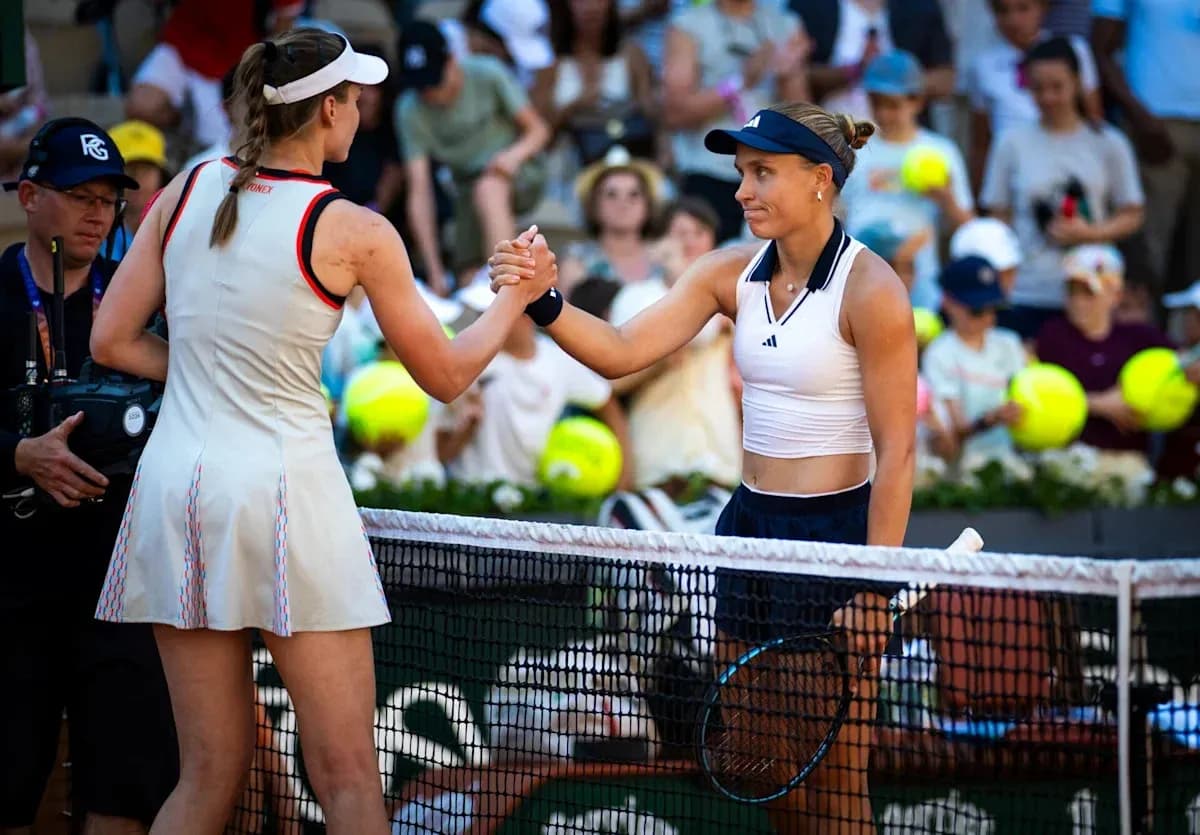
Then came Yuliia Starodubtseva.
Ranked 55 in the world at the time and with no Grand Slam record beyond the second round, the Ukrainian walked onto Court with little expectation on her shoulders and left with the biggest win of her career. She turned a one-set deficit into a 3-6, 6-1, 7-6(4) shock, handing Rybakina her earliest defeat at a major since the 2024 US Open, when a back injury forced a withdrawal.
It was not supposed to happen there, not to this Rybakina, not in this season.
For Starodubtseva, it was a breakthrough amid turbulence. She had recently endured a six-match losing streak and slipped outside the top 70. Suddenly, she was the player who had just taken out one of the sport’s most ruthless big-stage performers.
Grass brings another ambush
The second name on Rybakina’s 2026 Grand Slam hit list came where she is usually most assured.
Wimbledon, the scene of her 2022 triumph, normally feels like home. Her flat, penetrating groundstrokes and imposing serve make her a perennial favourite on grass. This year, the script twisted in the third round.
Across the net stood Elise Mertens, the 25th seed, a player Rybakina had beaten in seven of their previous eight meetings. The matchup, on paper, leaned heavily towards the former champion.
The match did not.
Mertens absorbed, redirected and then took control, edging a tight first-set tiebreak 7-6(4) before racing through the second 6-1. It was one of the shocks of the tournament, not because Mertens lacks pedigree, but because Rybakina so rarely looks that vulnerable on a surface that usually amplifies her strengths.
Two majors. Two unexpected exits. Two opponents who refused to read the rankings and accept the script.
Revenge in New York, and a new name in the rankings
Starodubtseva’s story did not stop in Paris. She battled through a slump, found her footing again, and in New York reached the third round of a Grand Slam for only the second time in her career.
Waiting for her there: Rybakina.
This time the Kazakh did not let the opportunity slip. In a tight, nervy first set, she edged the tiebreak 8-6, then tightened her grip to close out a 7-6(6), 6-3 win. It was a measured, quietly fierce piece of revenge on the way to lifting the trophy at Flushing Meadows.
For Starodubtseva, the loss still came with a reward. Her joint-best run at a major propels her into the top 50 for the first time, up to a new career-high of No. 43 in the world. Her name now sits on the ranking list as more than a Roland Garros curiosity; she is part of the conversation.
For Rybakina, the bigger picture is brutal in its simplicity: 17-2 across the four majors, the best Grand Slam season of her career.
Two defeats. Yuliia Starodubtseva in Paris. Elise Mertens at Wimbledon.
Everyone else, she beat. The question now is whether those two names mark rare blips in an era of control, or the first signs that the chase is finally closing in on her.