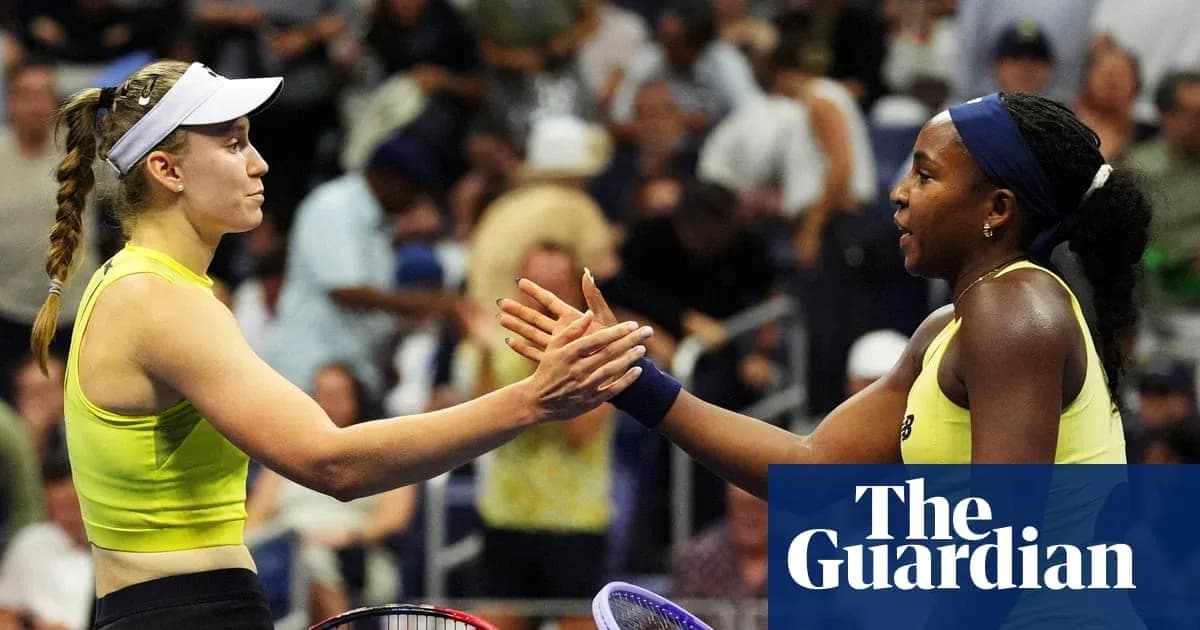
Elena Rybakina walked out for her first US Open semi-final looking like a stranger in her own skin. One set later, under the harsh lights of Arthur Ashe Stadium and the full roar of a crowd desperate for Coco Gauff to run away with it, she still hadn’t truly arrived.
Gauff had.
The American flew through the opening set, a blur of legs and resolve, chasing down everything, turning defence into attack and feeding off 22,000 voices behind her. Rybakina, by contrast, sprayed balls from the baseline, her usually immaculate serve misfiring, her timing off. The scoreline – 6-3 to Gauff – felt almost kind.
But champions don’t just win on their best days. They survive their worst.
Rybakina, who has quietly built one of the most formidable big-match résumés in the sport, dug into that steel. From a set down and with the stadium leaning heavily towards Gauff, she steadied, recalibrated and then overpowered the fourth seed, turning the match on its head to win 3-6, 6-4, 6-4 and reach her first US Open final.
It was a victory carved more from resilience than brilliance, yet it may prove one of the defining wins of her career.
A champion who keeps finding a way
Six matches into this New York campaign, Rybakina still hasn’t produced her peak tennis. The clean, ruthless dominance that carried her to Wimbledon in 2022 has only appeared in flashes. What has replaced it is something just as dangerous: a player who problem-solves in real time, absorbs pressure and refuses to crack.
This will be her fourth grand slam final. Since that breakthrough on grass at the All England Club, every subsequent major final has come on hard courts, a surface that now feels like her natural stage. She waited four years to add a second slam title; now she stands one match away from taking two in the same season.
Her run in New York was already momentous before a ball was struck in this semi-final. She arrived with a chance to scale one of the sport’s great peaks and become world No 1. The build-up was clouded by a worrying Achilles issue and a poor record at Flushing Meadows. She pushed through both. The ranking milestone finally fell in the quarter-finals with a tense win over Zheng Qinwen, but her reaction told its own story: satisfaction, yes, but no sense of completion. The target was the title.
Now, that ambition leads her into a final laced with narrative. Across the net will be the outgoing No 1, Aryna Sabalenka, in a reprise of their Australian Open showdown earlier this year, also won by Rybakina. The rivalry that has shaped the season gets its New York chapter.
Gauff’s forehand buckles under the weight
For Gauff, this night was supposed to be another step in a transformation that has been one of the stories of the last 12 months. Her serve, once so fragile that it reduced her to tears on this very court a year ago, has become a weapon. It carried her through tricky patches all summer and into these semi-finals, even as doubts resurfaced during her dramatic comeback against Mirra Andreeva, a match where she saved two match points but coughed up 12 double faults.
Those serving demons stayed mostly quiet in the early stages here. In the first set she hit her spots under pressure, mixed locations well and leaned on her movement to draw a stream of errors from Rybakina. The American took the opener with authority.
The problem came from the other wing.
Gauff’s forehand, long scrutinised, simply did not withstand the sustained examination from one of the game’s heaviest hitters. It broke down repeatedly as the match wore on, producing 15 unforced errors and gifting Rybakina the foothold she needed.
Momentum flips as Rybakina finds her range
The shift arrived quickly.
Rybakina opened the second set with a clear change of intent, dragging Gauff wider, especially off the backhand side, and carving the court open with angled backhands that finally began to bite. The ball started to come off her strings with that familiar, heavy precision. The rallies stretched. Gauff’s defence, so spectacular in the first set, suddenly looked more reactive than controlling.
Rybakina raced to a 4-1 lead. It was not a clean passage – both players sprayed errors in a scratchy, tense set – but the pattern had changed. Gauff’s forehand grew increasingly cramped and jerky, especially under scoreboard pressure. Serving at 4-5 to stay in the set, she played her worst game of the night: three forehand mistakes and a double fault handed Rybakina the set and, with it, the momentum.
From that moment, the match felt like it was being played on the Kazakhstani’s terms.
The serve finally roars
If Rybakina’s rise has been built on one shot, it is the serve. For a set and a half, that weapon looked strangely muted. In the decider, it finally exploded into life.
At 1-1, she slammed down two booming aces to seal a hold for 2-1, a small moment that carried a much bigger message. Her service games began to accelerate. Free points flowed. The tension shifted squarely onto Gauff, who now had to match that level just to stay attached to the scoreboard.
At 2-3, Gauff faced two break points and looked on the brink. She responded with courage, finding big first serves when she needed them most to claw back to 3-3. It felt like a last stand. Serving at 3-4, she could not repeat the escape. Rybakina pounced, stepped inside the baseline and broke, leaving herself one service game from the final.
Gauff’s last surge, Rybakina’s final answer
Gauff, as always, refused to go quietly.
Down 3-5, 30-30, she ripped a sensational backhand passing shot that brought the crowd to its feet and then broke serve for 4-5, igniting one last surge of belief around Ashe. For a moment, the night threatened to twist again.
Rybakina didn’t let it.
Shaking off the disappointment of failing to serve it out, she marched forward on the return. She stepped in, took time away, and forced Gauff into another bruising forehand examination. The pressure told. Rybakina broke immediately, sealing the match with a ruthless return game that underlined the mental edge she has honed all year.
On a historic night – the first time in 51 years that all four top seeds reached the US Open women’s semi-finals, and the first such occurrence at any major since Wimbledon 2009 – the supposed predictability at the top of the women’s game produced something else: a reminder of just how hard it is to stay there.
Rybakina has climbed to No 1, battled injury, and still found the resolve to fight through a tournament where she has rarely been at her fluent best. Now she walks into a final against Sabalenka, the season’s defining rival, with the chance to turn a solid year into a truly era-shaping one.