For years, Elena Rybakina was the grand slam champion spoken about in the second breath. Dangerous, yes. Lethal on her day, certainly. But always filed just behind the iron-willed, week‑in, week‑out dominators of her generation.
She walks out of New York with that story torn up.
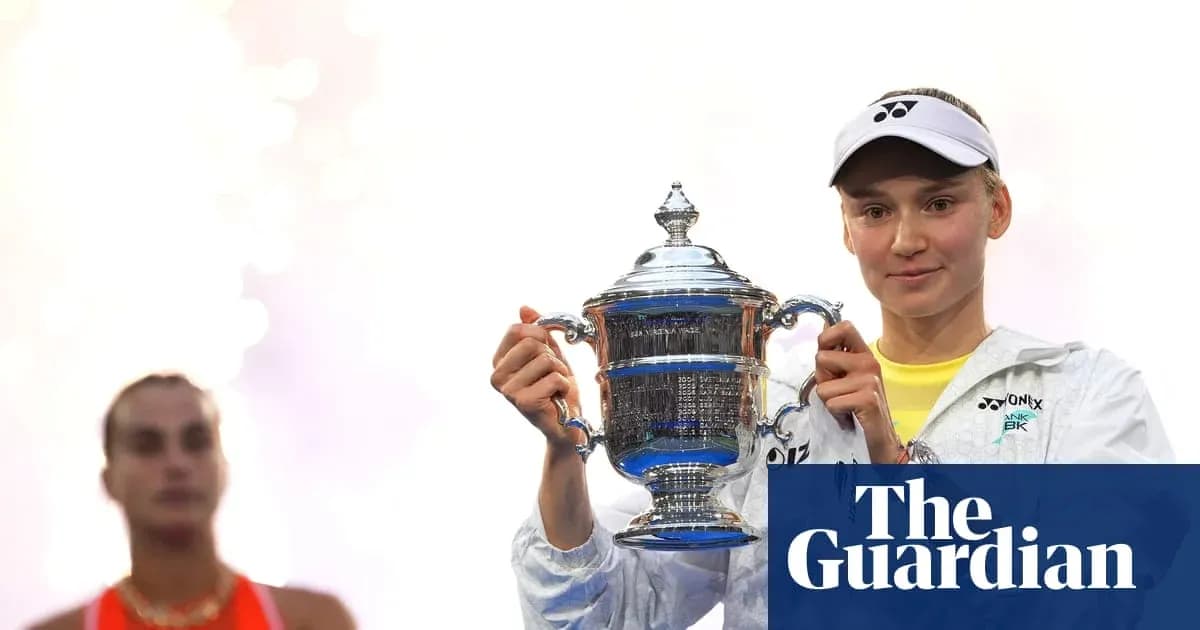
Rybakina leaves Flushing Meadows as the undisputed force in women’s tennis: world No 1, US Open champion, and the player everyone else is now chasing. Having wrestled the top ranking from Aryna Sabalenka, she then took the Belarusian’s title too, prising away her two‑time defending crown with a 6-4, 5-7, 6-2 victory in a final that crackled with tension and quality.
This was not the fortnight of a frontrunner cruising on rhythm. It was a mental siege, survived and then owned. Rybakina arrived in New York nursing an achilles injury that had benched her for a week and left her unsure she would even step on court. On top of that came the suffocating arithmetic of the ranking race, every result, every round framed by what she “needed” to do to become No 1.
Then the draw turned brutal. Four straight opponents in the second week were either grand slam or Olympic champions. Each one asked a different question of her game and her nerve. Each time, she answered without flinching.
By the time she walked into the final against Sabalenka, her greatest rival and the sport’s most imposing front‑runner, Rybakina carried the hardened edge of someone who had been fighting on every front for two weeks. She needed all of it.
A final between equals – until one of them rose higher
This was a rare kind of occasion: the top two players in the world, facing off with the No 1 ranking guaranteed to change hands, in a repeat of the Australian Open final earlier in the year. In nearly four decades of hard‑court majors at Melbourne and New York, it was only the second time the same pair had contested both finals in the same season.
Whenever Rybakina and Sabalenka meet on this stage, the level spikes. This was their third grand slam final against each other; once again, they produced a match that felt like the sport at full throttle.
They started at a sprint. Heavy first strikes, baseline duels played on a knife edge, rallies decided by inches. Yet from early on, there was a difference. The clarity of Rybakina’s ball‑striking cut through the chaos.
Remarkably, she did it while her greatest weapon malfunctioned.
Rybakina owns the most formidable first serve in the women’s game, but in the opening set of a major final she could barely buy one. She landed just 27% of first serves, only eight of 30 attempts. For most players, that is a death sentence against Sabalenka. For Rybakina, it became a test of everything else.
She passed it emphatically. She ripped returns at Sabalenka’s feet, stepped inside the baseline and squeezed the Belarusian’s service games. In the rallies, she dictated almost at will, her backhand in particular running like a metronome, driving deep and flat, never giving Sabalenka room to swing freely. Sabalenka, unsettled, was forced into errors and frustration.
At 2-3 in the first set, under pressure again, Sabalenka double‑faulted to hand over the decisive break. The moment stung. She then lashed a ball into the crowd and was hit with a code violation, a flash of temper that captured her mood. The defending champion stalked the baseline, tense, agitated, repeatedly failing to punish the stream of second serves on offer.
Rybakina, by contrast, looked cold and clear. The first set was hers, without her main weapon functioning.
Sabalenka strikes back
Sabalenka’s route to this final had been a victory in itself. After a difficult, turbulent summer, she had fought her way back into contention for a third straight US Open title. That resilience finally surfaced in the second set.
Her serve, ragged early on, started to click. The free points returned. With them came rhythm, and with rhythm came a more measured aggression. Rybakina’s first serve began to settle as well, but now her ground game flickered. A few more loose forehands, a touch more hesitation.
At 5-4, Rybakina served for the championship. The weight of the moment hung heavily. Sabalenka sensed it and pounced. She hammered a backhand return down the line to carve out her first break points of the match, both of them set points. Again Rybakina offered second serves. Again Sabalenka tightened, letting them slip.
But the pressure had shifted. Rybakina’s second serve was now under siege. At 6-5, Sabalenka came again, muscling her way to a third set point. This time she didn’t blink, crushing another backhand return winner to drag the final into a decider.
The stadium roared. The two‑time champion had finally found her full voice. Momentum, for the first time all night, belonged squarely to her.
The reset of a champion
Plenty of players crumble there. Up a set and a break in a major final against a reigning champion, serving for the title, then suddenly staring at a third set with the crowd surging for the other side.
Rybakina barely blinked.
She walked to her chair between sets, reset, and when she stood up again, the serve that had abandoned her returned with ruthless precision. The third set began with a different sound: the heavy, clean thud of first serves hitting their spots, aces flying past Sabalenka’s racquet, service games ripped through in a blur.
Now the burden flipped back to Sabalenka. Keep up, or watch the match run away. Like so many before her over the past year, she simply could not. Rybakina’s level in that final stretch was exactly what separates a very good player from the one who rules the tour: the ability to find your best when everything is on the line, not when it’s easy.
When the last ball flew long, the scoreboard told one story. The broader landscape of the sport told another.
Rybakina has not only taken Sabalenka’s ranking and her US Open crown; she has claimed the mantle as the dominant hard‑court player in the world. She now holds the Australian Open, the US Open and the WTA Finals, the three biggest prizes on the surface.
Her major tally stands at three: Wimbledon 2022, the 2026 Australian Open, and now New York. She steps into a distinguished group that includes Lindsay Davenport, Jennifer Capriati, Ash Barty, Angelique Kerber and Virginia Wade. One title, in one city, now separates her from the career grand slam. Only Roland Garros remains.
For years, Rybakina was the quiet threat in the draw, the champion others mentioned only after they had named the obvious favourites. After this New York fortnight, after this final, that hierarchy is gone.
She is the standard now. The question for the rest of the field is simple: who can live with it?