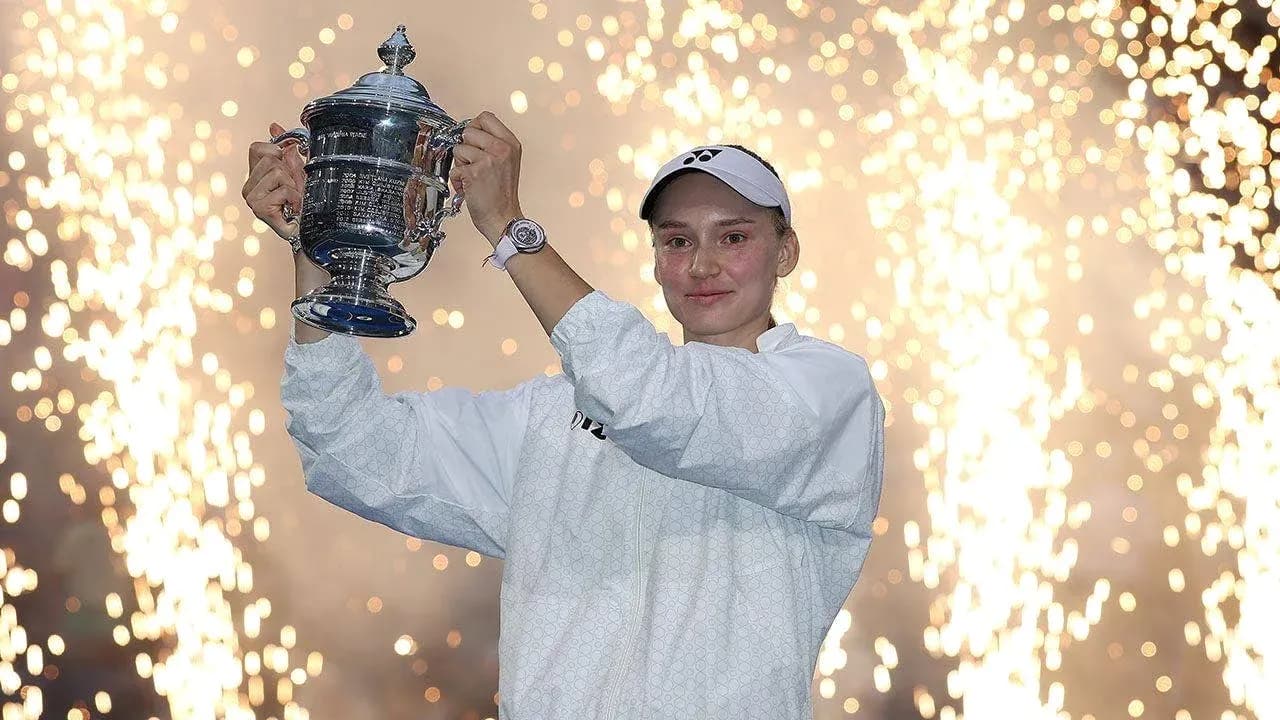
Elena Rybakina didn’t just take Aryna Sabalenka’s No. 1 ranking in New York. She took her throne.
On a hard, tense afternoon at Flushing Meadows, the 27-year-old powered past the two-time defending champion 6-4, 5-7, 6-2 to claim her first U.S. Open crown and move within one trophy of a career Grand Slam.
A final worthy of the rankings
This was No. 1 against No. 2, a rare showdown of the sport’s current heavyweights. Since 2000, only two other U.S. Open women’s finals had featured the top two seeds, both won by Serena Williams. This time, the second seed flipped the script.
Rybakina arrived in New York nursing “a little bit” of an injury, by her own admission, and without any grand expectations. By the end of Saturday, she was standing on the biggest hard-court stage in the world with Sabalenka’s title in her hands and Sabalenka’s ranking in her pocket.
“It’s tough to find words right now, honestly,” she said on court, still trying to process what she had just done. “I don’t expect nothing like this coming to this tournament. I’ve been dealing with a little bit with an injury, but somehow everything aligned together on my side.”
Everything aligned when it mattered most.
Sabalenka’s streak snapped
Sabalenka walked into the final with a 19-match winning streak at the U.S. Open. She had not lost at Flushing Meadows since Coco Gauff beat her in the 2023 final. One more win would have put her alongside Serena Williams, the last player to win three straight titles here, from 2012 to 2014.
She came close to keeping that march going. She clawed out the second set 7-5, refusing to surrender her territory on a court that has felt like home.
“I really felt like home here and cannot wait to come back next year,” Sabalenka told the crowd. “I wish I could perform a little bit better, but I guess next year.”
For two sets, the match had the feel of a rivalry with layers. Sabalenka had won their two previous meetings this year, at Indian Wells and Miami, both on hard courts. She led their head-to-head 10-8 coming in. She knew Rybakina’s patterns, and Rybakina knew exactly how hard she would have to hit to break them.
The turning point
Early in the third set, the tension spilled out. Rybakina dragged a backhand wide on a break point in the opening game and let her frustration show. It felt like a window for Sabalenka, a moment when the defending champion might reassert her authority.
Instead, it became the spark.
From there, Rybakina tightened her game and took control of the baseline. Her first-strike tennis, so devastating when calibrated, began to pin Sabalenka back. The rallies shortened, the errors flowed more freely from the top seed’s racket, and the second seed began to look like the inevitable winner.
The pressure finally told. Rybakina broke, then broke again, and the third set raced away from Sabalenka 6-2. The woman who had ruled New York for two years could not find a way to stop the surge.
A new No. 1 with bigger targets
Rybakina had already been guaranteed the No. 1 ranking next week, no matter what happened in the final. But this was about more than a mathematical ascent. By lifting the trophy Sabalenka had guarded for the past two seasons, she turned the changing of the guard into a statement.
She now owns major titles on grass, at Wimbledon in 2022, and on hard courts, with the Australian Open earlier this year and now the U.S. Open, both times conquering Sabalenka on the surface that has defined their rivalry.
Only one piece is missing. A French Open title would complete the career Grand Slam.
Born in Russia but representing Kazakhstan, Rybakina has built her resume quietly, without the same noise that has surrounded some of her peers. The numbers, though, are getting harder to ignore: multiple majors, the year’s first and last hard-court Slams, and now the sport’s top ranking.
Sabalenka still leads their rivalry 10-8. She still owns the power and presence to reclaim this stage. But on this day, in this city, Rybakina walked through the door Sabalenka had been holding open for two years and claimed the room as her own.
Next spring in Paris, the question will be simple: can anyone stop her from finishing the set?