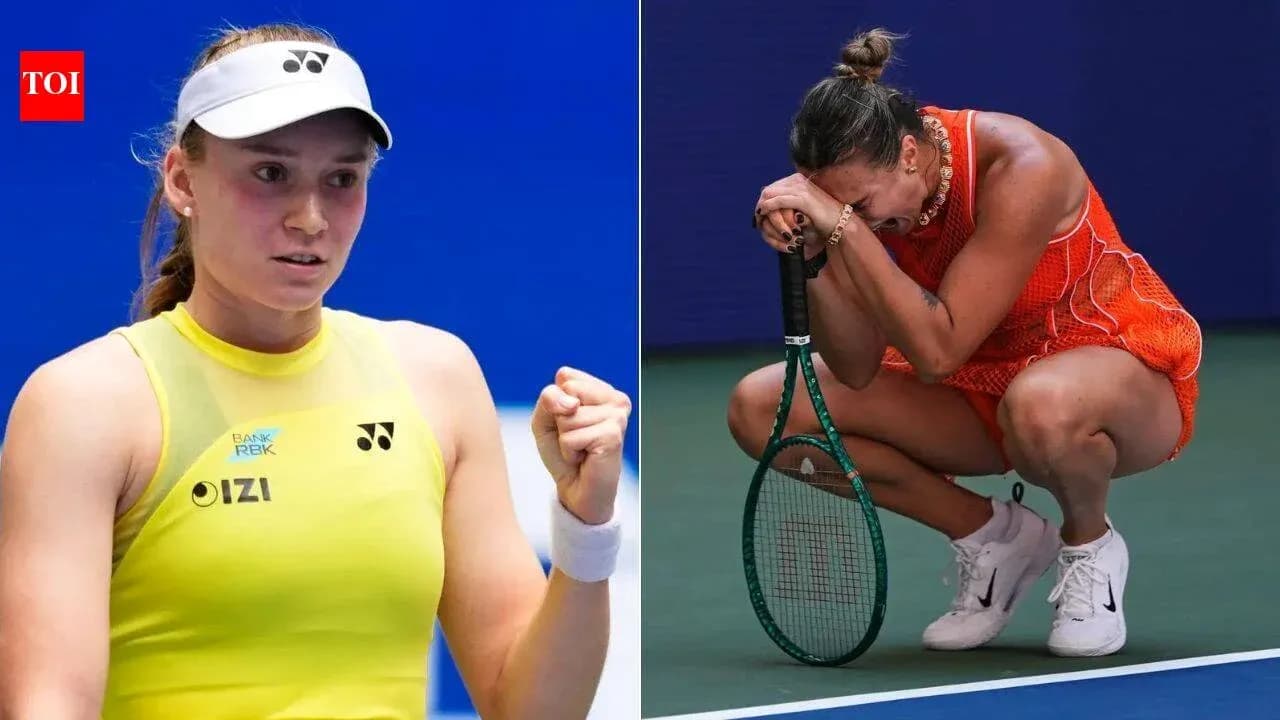
Elena Rybakina walked into Arthur Ashe Stadium on Wednesday as a contender. She walked out as the next world No. 1.
The Kazakh star overturned a slow start to defeat Zheng Qinwen 3-6, 6-1, 6-4 in the US Open quarterfinals, a victory that not only pushed her into the last four in New York but also sealed her place at the top of the WTA rankings for the first time in her career.
She will officially replace Aryna Sabalenka on Monday. The numbers behind that change tell their own story. Sabalenka’s reign ends at 99 consecutive weeks, 107 in total, the sixth-longest uninterrupted stay at No. 1 in WTA history. Since October 21, 2024, the ranking had belonged to her. Now it passes to the most persistent of her pursuers.
Rybakina becomes the first player from Kazakhstan, man or woman, to reach No. 1 in singles, and the 30th woman ever to sit on top of the WTA world.
From shaky start to statement win
For a set, Zheng Qinwen threatened to delay the coronation.
The Chinese star came out swinging, taking the ball early, attacking Rybakina’s second serve and racing through the opener 6-3. Rybakina’s timing was off, her feet a half-step slow, her power blunted by Zheng’s depth.
Then the match flipped.
Rybakina tightened her baseline game, found her first serve, and began to dictate. The 6-1 second set was ruthless: cleaner off the ground, heavier through the court, and suddenly in complete control of the exchanges. Zheng, who had been so bold early, started to feel the weight of every point.
The decider was closer, more tense, but the pattern held. Rybakina’s big-match experience showed in the key moments. She protected her serve, picked her spots to attack, and closed out the 6-4 set to book her place in the semifinals — and, with it, the No. 1 ranking, regardless of what happens the rest of the week.
Even if Sabalenka goes on to lift the US Open trophy, she cannot stop the change at the top.
A new No. 1 with bigger targets
For Rybakina, this is another milestone in a career that has gathered pace with remarkable consistency.
She already owns two Grand Slam titles — Wimbledon 2022 and the Australian Open earlier this year — and now stands two wins away from a third major. The ranking, she insisted, is not the end point.
"It's just a number right now. My goal is to win the tournaments which I play," the 27-year-old said after the match. She called it “an amazing achievement” but quickly pointed to the volatility of the sport, noting “how quickly everything can change in tennis ranking-wise.”
The message was clear: the top spot is a reward, not a finish line.
Gauff awaits in a blockbuster semifinal
Waiting for her in the semifinals is Coco Gauff, the former US Open champion and the face of American tennis in this generation. Gauff survived a dramatic escape of her own, saving two match points in a 2-6, 7-6 (9/7), 6-2 comeback win over 19-year-old French Open champion Mirra Andreeva.
That victory not only underlined Gauff’s resilience but also kept alive her own chase for the No. 1 ranking, at least in theory. Coming into New York, three women — Rybakina, Gauff, and Jessica Pegula — had a mathematical shot at overtaking Sabalenka. For Gauff and Pegula, the path was narrow: they needed the title and an early exit for Rybakina.
Rybakina’s run to the semifinals closed that door. The top spot is hers now, secured before a ball is struck in the last four.
Gauff knows exactly what she is walking into.
"Elena is the new world number one," she said. "It's going to be a tough match. These are the moments you live for."
It is the kind of semifinal that fits the occasion: the newly crowned No. 1 against the home favorite, one chasing a third Slam, the other chasing a second on home soil.
Sabalenka still in the fight
On the other side of the draw, Sabalenka is not done shaping this tournament. She faces Jessica Pegula in the other semifinal, a match loaded with its own tension.
Sabalenka may be losing her grip on the ranking, but she remains a looming force in the majors. Her 99-week streak at No. 1 speaks to dominance, not a brief flash. She has been the standard for nearly two years, and she will not quietly step aside in New York.
There is also a tantalizing possibility still alive: if both win their semifinals, Rybakina and Sabalenka will meet in the US Open final, a reprise of their three-set battle in this year’s Australian Open championship match, where Rybakina prevailed.
A new No. 1, a deposed champion still swinging, and a rising American star standing between them and Sunday.
The rankings have already changed. The question now is whether the balance of power at the Slams is about to shift with them.