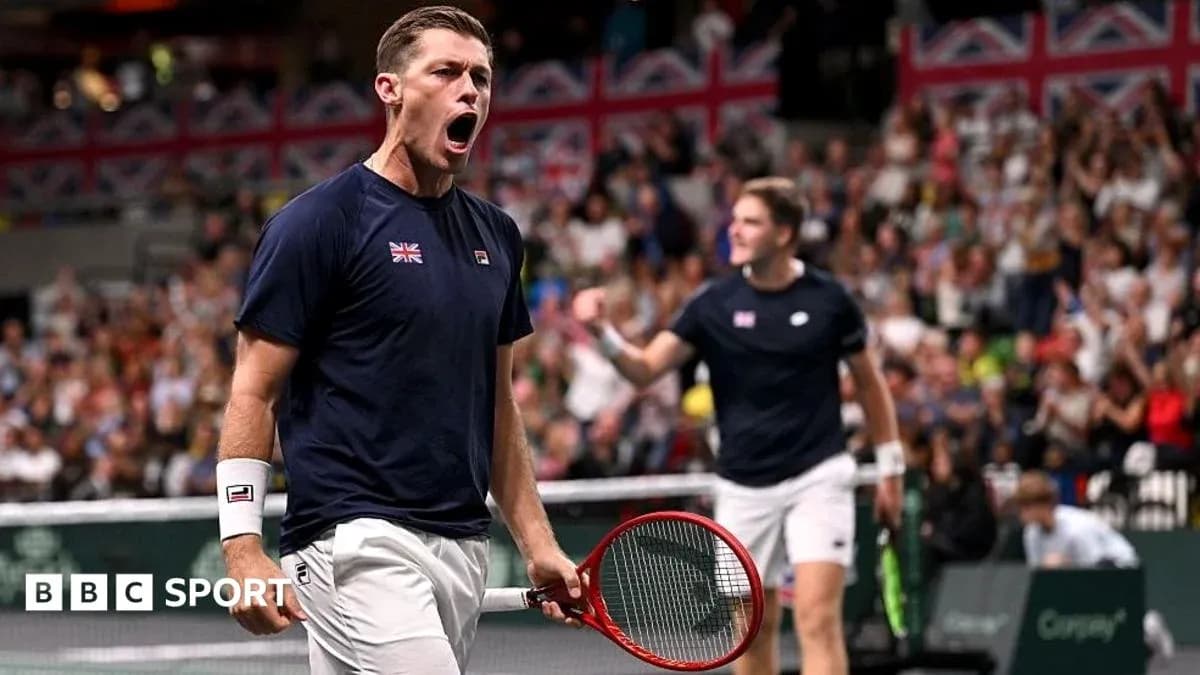
The Copper Box Arena came to its feet long before match point. By the time Henry Patten snapped away a final volley and Neal Skupski punched the air beside him, Great Britain’s passage to November’s Davis Cup Finals was already signed, sealed and loudly celebrated.
A 6-3 6-4 doubles win over Gonzalo Escobar and Diego Hidalgo on Sunday completed a 3-0 clean sweep over Ecuador and sent Leon Smith’s makeshift side through to the ‘Final Eight’ in Bologna. Job done at the earliest opportunity. Nerves, in the end, were for everyone else.
Patten and Skupski slam the door
With a 2-0 lead banked from Saturday’s singles, Britain needed just one more point. Patten and Skupski never looked like leaving the door ajar.
They broke early, served with authority and never once faced a break point. For a pair who do not play together on the ATP Tour, they looked like a long‑standing partnership: Patten’s heavy delivery and rangy presence at the net dovetailing with Skupski’s sharp hands and court craft.
“We’re feeling great,” Patten said on court, the noise still swirling around the Copper Box. He revealed how close this had come to being a very different weekend. “[Captain] Leon [Smith] was giving us the team talk and saying we needed to be ready for the singles so we’re very, very happy to get it done on the first match.”
The pressure finally told on Ecuador midway through each set. Britain broke once in the first, once in the second, and that was plenty. With Skupski, the new US Open champion in doubles, steering the ship and world number one Patten in his discipline alongside him, the gulf in class at key moments was stark.
For Skupski, this was a personal milestone too. At 36, making his 16th Davis Cup appearance, he cut a reflective figure as he soaked in the ovation.
“I made my debut in 2019 with all the other guys like Jamie Murray, Andy Murray, Evo [Dan Evans] and now I guess I am the oldest in the team,” he said. “It’s been amazing to be back with the team, it’s been a big 18 months and it’s such an honour to play for your country, especially in front of a home crowd like you guys coming out to support – it’s been amazing.”
A battered squad, an emphatic response
On paper, this tie should have been straightforward. In reality, Smith arrived in London juggling problems.
Jack Draper shut down his difficult season early. Jan Choinski and Jacob Fearnley were ruled out through injury. Then, on the eve of the tie, came the heaviest blow: British number two Cameron Norrie felt pain in his arm during practice on Friday and withdrew.
No Draper. No Norrie. No established singles spine. Smith, who had not guided Britain to the Davis Cup knockout stage since 2023, suddenly had to lean on rookies.
The response from those rookies changed the entire feel of the weekend.
Samuel’s fightback ignites the tie
First up on Saturday, Toby Samuel walked into a sold‑out Copper Box for his Davis Cup debut and looked, for a set, like a man feeling every decibel.
The 24‑year‑old, who began the season outside the world’s top 250 and has surged to 95 in the rankings, dropped the opener 4-6 to Andres Andrade. The tension in the arena thickened. An inexperienced squad, a partisan crowd, an underdog opponent swinging freely – it was a dangerous mix.
Samuel steadied. He trusted the game that had carried him to his first Grand Slam main‑draw win at the US Open only weeks ago. The forehand started to bite, the serve found its spots, the rallies tilted his way. He levelled the match 6-4, then ran away with the decider 6-1.
From a set down to a roar of relief and belief. Britain had its foothold.
Fery steps into the number one role
Arthur Fery then walked into a different kind of pressure. Listed as British number one for the tie, still only making his second Davis Cup appearance, he carried the responsibility of backing up Samuel’s comeback.
He did more than that. He imposed himself.
Against Alvaro Guillen Meza, Fery produced a measured, assured performance. He edged a tight first set 7-5, then slammed the door with a ruthless 6-0 second. No drama, no wobble. Just clean, controlled tennis from a player still at the start of his professional journey.
By Saturday night, what had begun as a test of Britain’s depth had turned into a showcase of it. Two debutants, two wins, a 2-0 lead. Ecuador were clinging on. Britain could smell Bologna.
From doubt to momentum
The narrative around this tie had been shaped by absences and uncertainty. Could Smith coax a run out of a patched‑up team? Could relative newcomers handle the weight of expectation at home?
Across two days in east London, those questions were answered with authority.
Samuel came of age in front of a home crowd. Fery wore the number one tag without blinking. Patten and Skupski, dropped into a partnership without ATP Tour experience together, looked as if they had been sharing a side of the net for years.
Great Britain are back in the Davis Cup Finals, their place among the last eight secured with room to spare. The squad that limped into this week will not be the same one that lands in Bologna.
The real intrigue now? Which of these new faces has just played their way into Smith’s long‑term plans.