Guy Sasson’s Grand Slam dream ended on a hot New York afternoon, not with a collapse, but with a tiebreak knife-edge that cut the other way.
One match. One set. One super tiebreak from perfection.
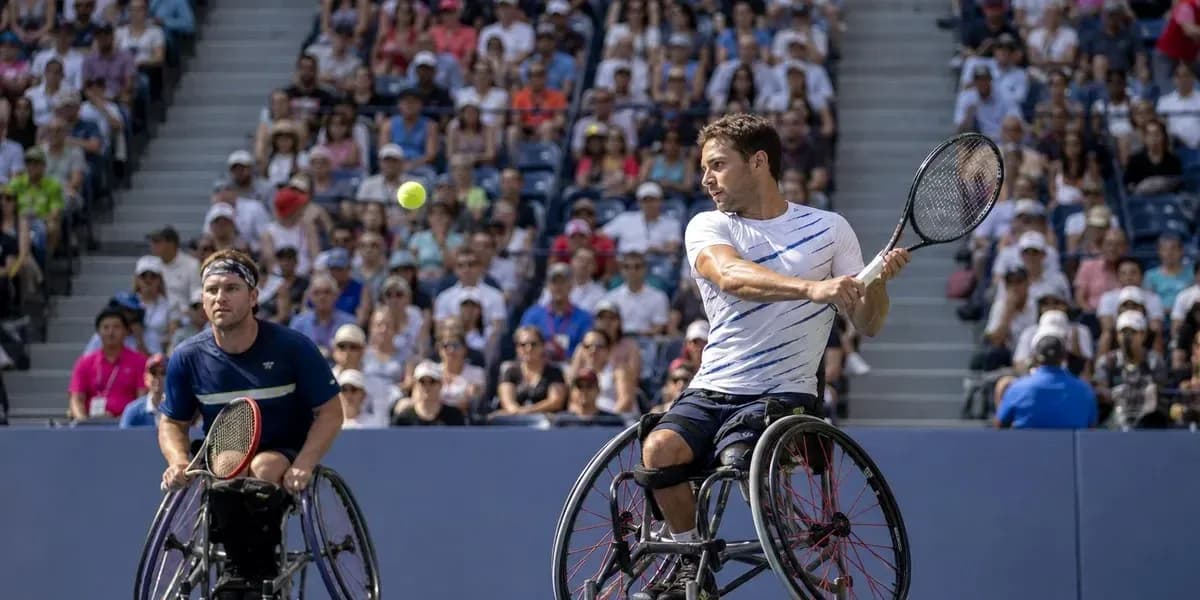
The Israeli quad wheelchair star and his Dutch partner Niels Vink walked into the US Open as the team to beat. They had already swept the Australian Open, Roland Garros and Wimbledon in doubles. Three majors in the bag. The calendar Grand Slam sitting there, just across the net.
Sam Schroder and Jin Woodman tore up the script.
The second seeds stunned the top-ranked pair 2–6, 6–3, 10–7 in the deciding match tiebreak, turning a match that had looked firmly under Sasson and Vink’s control into a late heist.
Sasson and Vink started like a team that knew exactly what was at stake and exactly how to handle it. They rolled through the opening set 6–2, their rhythm sharp, their patterns familiar, their aura of champions intact. The pressure, though, did not go away. It shifted.
Schroder, one of the most accomplished players in the division, and Woodman refused to fold. They tightened their returns, attacked second serves and wrestled back the baseline. The second set flipped 6–3, and suddenly the Grand Slam chase came down to a few points in a race to 10.
In the super tiebreak, the margins shrank to almost nothing. A missed first serve here, a bold return there, and the momentum tilted towards the Dutch-Australian pair. Sasson and Vink fought, as they have all year, but the final mini-battle went 10–7 against them. The dream stopped one step short.
Partner in one draw, roadblock in another
Sasson’s New York campaign carried its own layer of drama in singles.
Ranked world No. 3 and seeded third in the quad singles draw, he advanced to the semifinals, where the opponent across the net was all too familiar: his doubles partner, Vink.
The match quickly turned into a test of resilience. Sasson trailed 2–5 in the first set, seemingly on the brink of being swept aside. He clawed back to 5–5, dragging himself into rallies, refusing to let the set go quietly. For a few games, the dynamic changed; the partner became the hunted.
Vink, though, steadied. He closed out the first set 7–5, then shut the door 6–3 in the second. The Dutchman went on to lift the singles title, underscoring just how high the bar now sits at the top of the quad game.
“A long and difficult journey”
Back home, the significance of this season was not lost on the people who helped build it.
Israel ParaSport Center CEO Boaz Kramer hailed the work of Sasson and fellow Israeli player Sergei Lysov, framing their Grand Slam breakthroughs as the product of years, not weeks. Winning at that level, he noted, comes only after a long and difficult journey that demands unwavering commitment from both athletes and their teams.
Kramer underlined that the center will continue to back Sasson and Lysov, as well as their head coaches, Ofri Lankri and Damien Martinique, with LA28 already looming on the horizon. The message was clear: New York was not an endpoint. It was a checkpoint.
Lysov battles, Brand breaks through
Lysov, competing in the men’s wheelchair division at the US Open for the second time, endured a bruising campaign. His singles run ended in the opening round after a three-set battle. In doubles, he again went the distance, only to fall in a first-round match tiebreak. The scorelines showed how close he is; the exits showed how unforgiving this level remains.
If Lysov’s week was about narrow margins, Dan Brand’s was about a first taste of the big stage.
At just 17, Brand made his junior US Open debut and immediately announced himself. He won his opening singles match, a statement of belonging on one of the sport’s grandest platforms. The second round turned into a physical test as much as a tennis one. In the deciding set, severe cramps struck, and despite pushing it to three sets, he bowed out.
His doubles campaign, alongside Austrian partner Tilo Berman, carried its own promise. Seeded fifth, the pair reached the second round before losing to Yannick Alvarez of Puerto Rico and American Ryan Cozad. Another step, another lesson banked.
Brand’s schedule leaves no time to linger on what might have been in New York. After a brief stop in Israel to see his family, he will head to Japan for the J500 Osaka Mayor’s Cup World Super Junior Tennis Championships, running from September 21–27. A new continent, a new surface, another chance to build on what he started at Flushing Meadows.
Sasson’s near-miss at a calendar Grand Slam, Vink’s title run, Lysov’s tight defeats and Brand’s raw breakthrough all point in the same direction: Israeli wheelchair and junior tennis is not just showing up at the majors anymore. It is starting to shape them.
The question now is simple: how long before one of these runs ends not in a tiebreak heartbreak, but with the trophy held high on the final day?