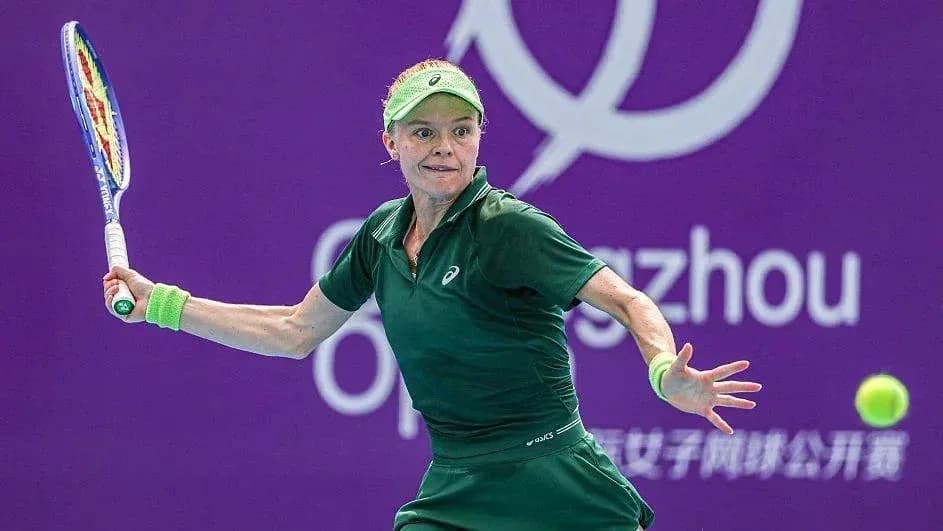
Harriet Dart wiped away tears in Guangzhou, finally standing where a decade of hard miles had been pointing her: a WTA Tour singles final.
The 30-year-old Briton clawed her way past 16-year-old Chinese wildcard Sun Xinran in a wild, punishing semi-final, winning 5-7 7-6 (7-1) 6-0 in just under two and a half hours to reach her first tour-level title match.
“It’s been a really long journey. I’ve wanted it so much, so badly – sometimes too much. To finally be here means the world,” Dart said, emotion etched all over her face.
A career spent on the fringes of the big stages, qualifying, grinding, flying under the radar, suddenly had a focal point. One more win on Sunday, against fourth seed Lilli Tagger or Kaitlin Quevedo, and she will not only have a trophy in her hands but a place back inside the world’s top 100. She has already jumped 14 spots to 101st in the live rankings.
A brutal start, a bigger response
For a while, it looked like the story might be another hard-luck chapter.
Dart opened nervously, double-faulting on break point in her first service game and slipping 3-0 down. Sun, the reigning US Open junior champion, fed off a partisan home crowd and settled faster, her ball striking clean, her movement sharp.
Dart, though, refused to fold. She reset, stepped up on the baseline and began to dictate the rallies, stringing together four straight games to turn 0-3 into 4-3, then 5-4. The qualifier was suddenly in charge, taking time away from Sun and dragging the teenager into longer, more physical exchanges.
Serving for the set, she tightened again. Two more double faults opened the door and she knew it. The frustration was instant and visible. Sun pounced, holding to 15, then breaking Dart for a third time to steal the opener 7-5 and flip the mood inside the stadium.
On the brink – and then the turnaround
The second set became a test of nerve as much as tennis.
Dart twice broke first, in the opening and fifth games, and twice Sun hit straight back. The pattern was cruel: Dart edging ahead, only to see the lead snatched away before she could settle into it.
The tension spilled beyond the lines. Dart repeatedly complained to the chair umpire about the noise from the crowd, trying to keep her focus while serving under pressure. Twice she had to hold just to stay in the match. Twice she did.
The pressure finally told – on Sun.
When the tie-break arrived, Dart played it like a veteran who had decided she was not leaving the court yet. She stormed through it 7-1, tightening her margins, picking her spots, and, in the process, quietening the same crowd that had been riding every Sun winner.
“I found it tough out there. It was a rollercoaster,” she admitted. “Playing in this part of the competition, more nerves and more feelings come out. I was really battling with myself. I’m proud of the second set and was able to turn it quickly.”
That breaker didn’t just level the match. It broke it open.
One-way traffic to history
From there, the contest changed completely.
Sun, who had carried so much energy through the first two sets, began to struggle both emotionally and physically. She took a medical timeout for treatment on her left leg, her movement clearly hampered, her shoulders sagging between points.
Dart, sensing the shift, showed no mercy.
She surged through the decider without dropping a game, winning 28 of the 41 points in the third set. The rallies shortened, the scoreboard raced. Every service game landed with authority, every return game applied more pressure. The match that had once been a scrap turned into a procession.
For a player who made her WTA Tour debut back in 2015 in Eastbourne and had reached only one previous tour-level semi-final – at the 2024 Transylvania Open – this was not just another win. It was a breakthrough, the kind that can redraw a career.
On Sunday in Guangzhou, Harriet Dart walks out not as a qualifier, not as a supporting act, but as a finalist with a ranking revival and a first WTA title within reach.