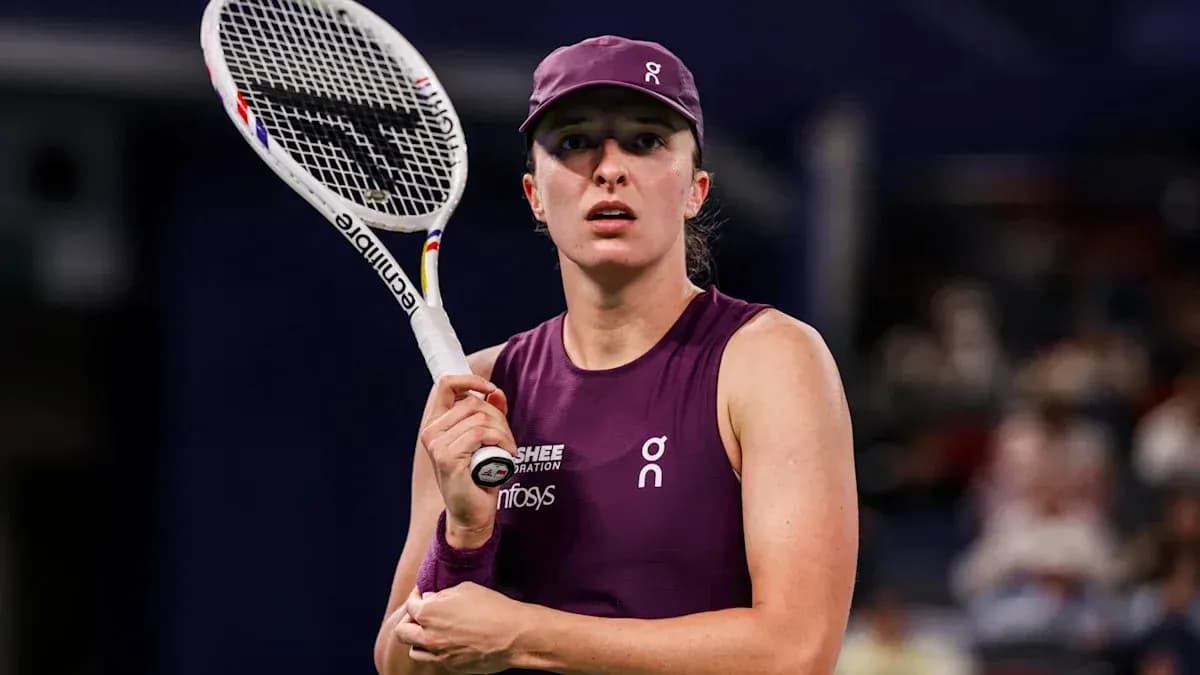
Iga Swiatek is used to closing seasons on the sport’s biggest stage. This year, she watched the WTA Finals from home.
For the first time in seven years, the Pole failed to qualify for the year-end showpiece, the clearest marker yet of a season that never quite caught fire when it mattered most. The ranking says No. 9. The story behind it is far more complicated.
A Champion Under the Microscope
Swiatek’s year frayed at the Grand Slams. Quarter-final exit in Melbourne. Fourth round in Paris and New York. Third round at Wimbledon, where she walked in as defending champion and walked out far earlier than anyone expected.
The reaction was swift and often unforgiving. Some fans went straight for her camp, questioning the impact of coach Francisco Roig. Others turned their attention to her long-time sports psychologist, Daria Abramowicz. Many skipped the nuance and blamed Swiatek herself.
She has heard all of it. And she has drawn a clear line between criticism she can live with and the kind that cuts deeper.
On the “What’s the Point” podcast, Swiatek admitted she understands why fans get frustrated when she loses early.
“If I was a fan of someone, I would also be disappointed if they lost early and I did not have a chance to watch them. I guess people, after so many great tournaments that I had, started booking tickets only for the finals and semi-finals, and they are not quite aware that tennis is tough to be consistent,” she said.
She knows she set a ferocious standard.
“I showed that I could be consistent maybe in 2022, 2023 and 2024, but it's not like every year that I would be able to do that. I guess the understanding of why they expect me to be in the finals, and being more rational about it, is enough for me to be fine with it.”
The bar she built is now the one she’s judged against.
Fans, Haters, and the Fine Line of Criticism
Swiatek doesn’t pretend social media is a safe space. She scrolls. She sees the comments. Some of them cross the line. She separates the noise from the intent.
“Honestly, most of the things that fans do or say, I am totally fine with it,” she said. “If I even read some comments on social media, obviously some of them are super hateful, and it's not acceptable, but if it's just being a bit judgy and them wanting to coach me, I can always just switch it around in my head and think that they care, so at least I had their support. Okay, maybe they don't understand everything, but it's okay.”
That’s the part she can reframe. Fans are emotional. Fans react. Fans vent. She gets it.
What she struggles to accept is when that tone comes from people paid to analyse her sport.
“The only thing that hurts me a bit more is when the journalists are being mean and judgy, and they are supposed to be experts, but they have never been on tour or been in a tennis tournament,” Swiatek said.
“This is quite painful because I know they create opinions that are then read by fans, and the fans may believe it. I can totally understand the negative comments from the fans, but from people who are supposed to know something about the sport, if they do too many mean things, this is not right for me.”
That is the tension of being a modern No. 1, or a former one. The same coverage that builds a star can quickly turn sharp when results dip.
A Season That Bent, Not Broke
On paper, missing the WTA Finals and dropping to No. 9 looks like a slide. Look closer and the second half of her year tells a different story.
The WTA 1000 events, often the best indicator of week-to-week level, started unevenly and finished with a surge.
Her 2026 run at that tier:
- Qatar Open – Quarter-final (lost to Maria Sakkari)
- Dubai Tennis Championships – Did not play
- Indian Wells – Quarter-final (lost to Elina Svitolina)
- Miami Open – Second round (lost to Magda Linette)
- Madrid Open – Third round (lost to Ann Li)
- Italian Open – Semi-final (lost to Elina Svitolina)
- Canadian Open – Champion
- Cincinnati Open – Semi-final (lost to Jessica Pegula)
- China Open – Quarter-final (lost to Elise Mertens)
- Wuhan Open – Semi-final (lost to Maja Chwalinska)
The pattern is clear. Early stumbles, then a steady climb. The title at the Canadian Open, deep runs in Rome, Cincinnati and Wuhan – these are not the numbers of a player lost in the wilderness. They are the markers of a champion recalibrating.
She just didn’t string it together at the Slams. In a sport where majors define narratives, that distinction matters.
A Different Road to the New Year
Normally, Swiatek’s year starts with the United Cup, where she helped Poland lift the trophy in 2026. This time, the route changes. She is expected to open her 2027 campaign in Brisbane, with the Brisbane International starting on January 3.
A new city. A different build-up. A chance to reset the story before the first ball is struck in Melbourne.
She arrives not as the untouchable force of her peak years, but as a former No. 1 with something to prove, a top-10 player stung by missing the WTA Finals and sharpened by the criticism that followed.
The question now is not whether Iga Swiatek can still reach the summit. Her late-season results already hinted at that answer.
The question is how quickly she intends to take it back.