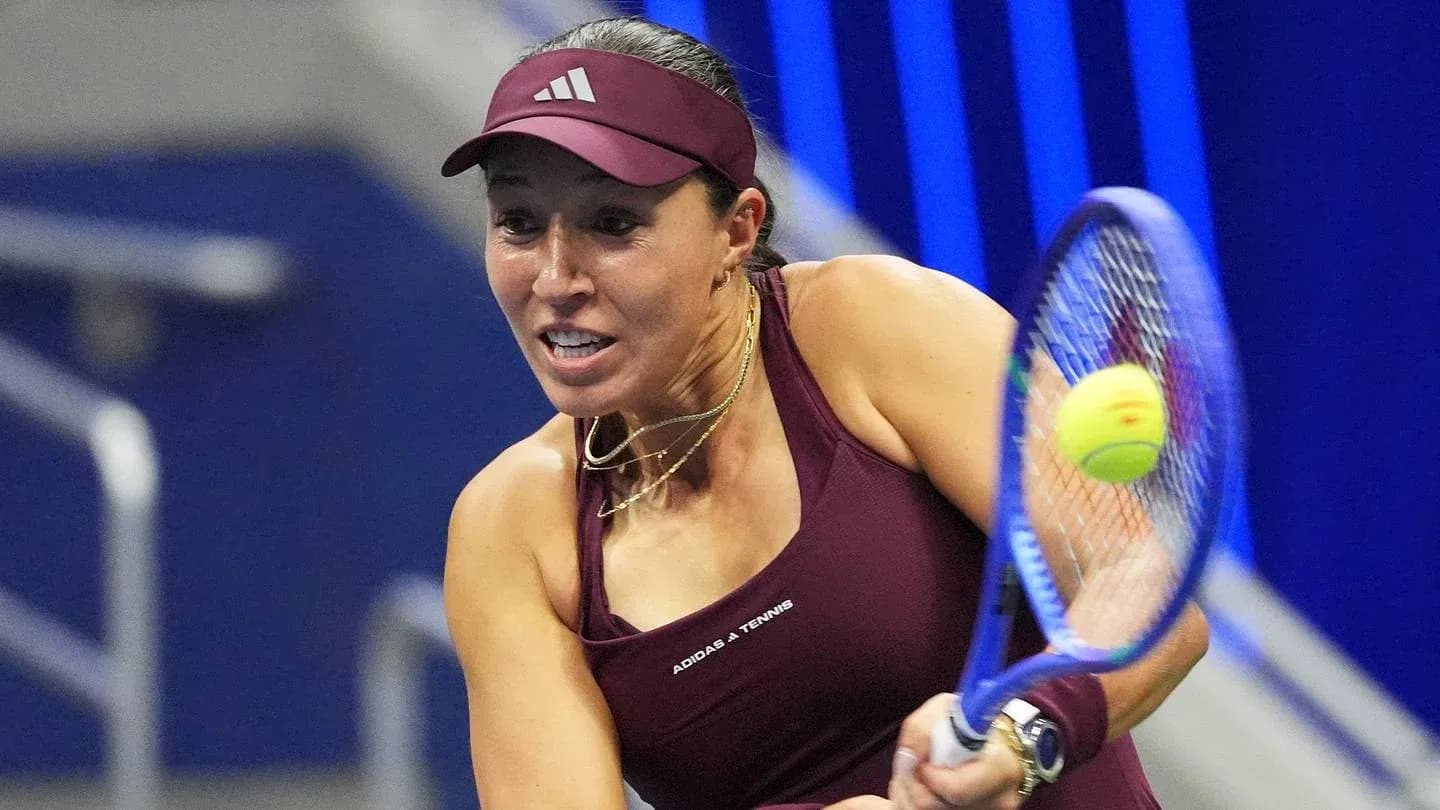
Jessica Pegula is running out of reasons to be overlooked.
On Wednesday in New York, the 32-year-old American quietly walked into tennis history, becoming the first player in the Open Era to reach her first four Grand Slam semifinals after turning 30. No prodigy, no teen sensation. Just years of rehab, restarts, and stubborn belief finally hardening into results on the sport’s biggest stages.
A Late Bloom That Refuses To Fade
Pegula’s breakthrough came late, and then all at once.
Her first major semifinal didn’t arrive until the 2024 US Open, a milestone that followed just months after her 30th birthday. She rode that run all the way to her maiden Grand Slam final, only to be stopped by Aryna Sabalenka in straight sets, 7-5, 7-5. It was close enough to sting, close enough to hint that this might not be a one-off.
Twelve months later she was back in the same city, at the same stage, staring across the net at the same opponent. Sabalenka again shut the door, this time 4-6, 6-3, 6-4. Pegula had pushed deeper into the match, but the ending felt hauntingly familiar: another step forward, another brick wall in the shape of the world No. 1.
Her third major semifinal came at the 2026 Australian Open, and again the margins were thin. Elena Rybakina edged her 6-3, 7-6(7) in an hour and 40 minutes, a tight contest that swung on a few points in the tiebreak. Pegula was in the mix with the very best, yet the sport’s biggest prize still hovered just out of reach.
This week in New York, she made sure the story didn’t flatten into a simple pattern of near-misses. Against fellow American Emma Navarro, Pegula looked in real trouble—down a set, then a break in the third. The clock, on the match and on her career, seemed to be ticking loudly.
She tore it all up.
Pegula clawed back to win 3-6, 6-4, 6-3, booking a record fourth Grand Slam semifinal after turning 30 and a third straight at the US Open. The comeback felt like a distillation of her entire career: behind early, written off more than once, still there at the end.
“I Just Need To Get There Again and Win the Match”
For Pegula, the weight of repetition has been impossible to ignore. Quarterfinal after quarterfinal, season after season, the question followed her into every press room.
“I’ve been [into major quarterfinals] so many friggin’ times,” she said earlier this year after finally cracking the last four in Melbourne. “I just kept losing, but to great players, I mean, to girls that went on and won the tournament... So I know everyone keeps asking me about it, but I don't know what else to do. I just need to get there again and win the match.”
She has done the first part, over and over. The second remains the missing line on an otherwise complete résumé.
Built on Scar Tissue
Pegula’s late surge looks even more remarkable when you trace the scars.
A serious knee injury wiped her out from late 2013 to early 2015 and required surgery. Just when she began to re-establish herself, a hip surgery in January 2017 cost her most of that season. While many of her peers were piling up second weeks at majors in their early and mid-20s, Pegula was fighting simply to stay on tour.
Those lost years pushed her prime into a window when most players are already thinking about the back half of their careers. Instead of peaking at 24 or 25, she has become one of the game’s most reliable forces in her thirties.
In 2024, she became the oldest American woman in the Open Era to reach her first major singles final. It was a quirky record at the time; now it looks like the first chapter of a broader redefinition of what “too late” really means in tennis.
A Season of Relentless Consistency
If this US Open run feels like a continuation of something, that’s because it is.
Pegula arrived in New York this year with a 50-12 match record and two titles already in the bag, in Dubai and Charleston. She had made finals in Washington and Cincinnati during the North American hard-court swing, stacking matches, building rhythm, refusing to drift out of contention.
This isn’t a veteran catching lightning in a bottle. It’s a top player repeatedly giving herself chances.
Even with another major title bid falling short, the body of work is undeniable. Week after week, surface after surface, Pegula has played like one of the most consistent threats on tour, regardless of the ranking list or the hype cycles swirling around younger names.
Sabalenka Again, and the Question of Time
Her fourth semifinal set up a familiar and brutal test: Sabalenka, again, at the same stage of the US Open for the third straight year. Pegula walked into that match with a 4-9 career record against the world No. 1, fully aware of the scale of the task and the stakes attached to it.
The result only sharpened the question that has been shadowing her for the past year: how long does she have left to turn all these deep runs into a Grand Slam title?
Pegula has never pretended she will play forever. On the Tennis Insider Club podcast, she made it clear that she doesn’t plan to stretch her career beyond 35 and has openly floated the 2028 Los Angeles Olympics as a possible final tournament. A home Games, a closing act, a full-circle finish.
That timeline leaves a narrow window. She is 32 now, with four semifinals, one major final, and no Slam trophy yet to her name. Every time she walks into the second week of a major, the stakes feel a little heavier. Every semifinal carries the weight of opportunity and the echo of the ones that slipped away.
But as long as she keeps coming back—down a set, down a break, down years to injury and doubt—the story stays alive.
The question is no longer whether Jessica Pegula belongs on this stage. It’s whether, before the clock finally catches her, she can find one perfect fortnight to walk away with the prize she has chased longer, and harder, than almost anyone in her generation.