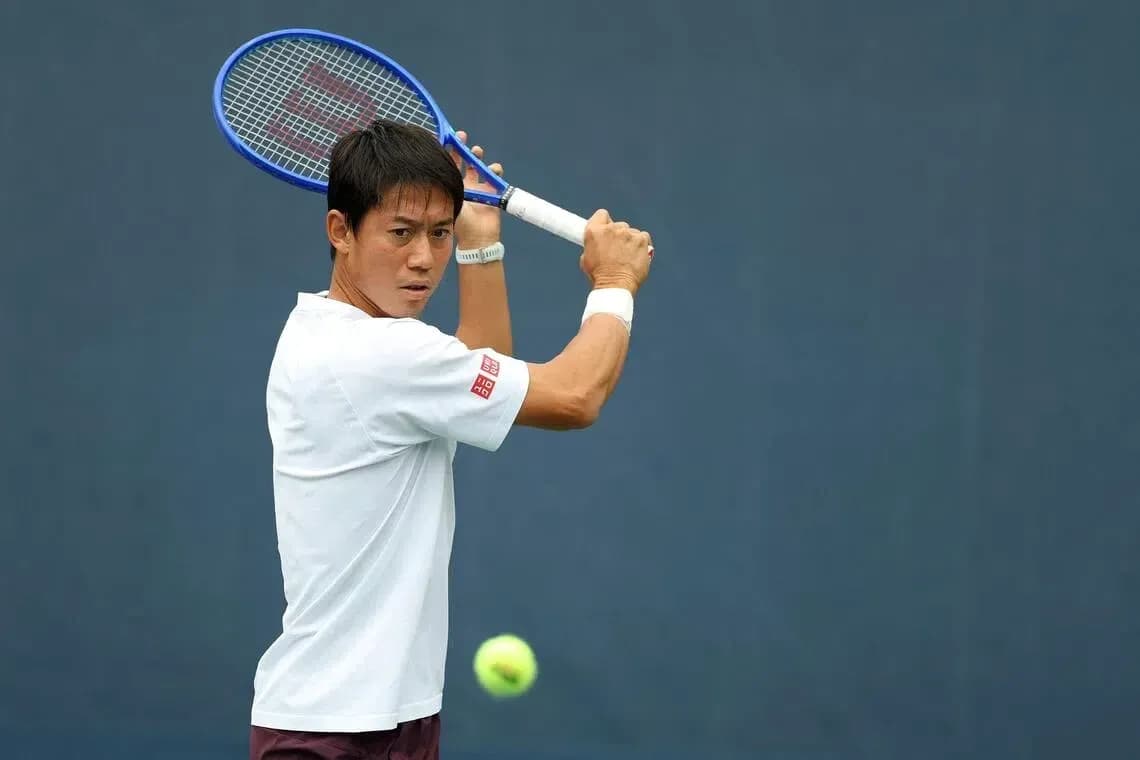
The end did not come under the lights of Arthur Ashe Stadium, nor deep in the second week of a Grand Slam. It came on an outside court in qualifying, with a 20-year-old compatriot firing down aces and refusing to blink.
Kei Nishikori’s last shot at a US Open main draw slipped away on Wednesday, the 36-year-old losing 6-4, 7-6 (7-3) to Rei Sakamoto in the third round of qualifying at Flushing Meadows. One win short of a farewell appearance at the major that defined his career, the former world No. 4 walked off to the quiet, heavy finality of a straight-sets defeat.
Sakamoto, ranked No. 157, played like a man in a hurry. He cracked 19 aces to Nishikori’s none, piling pressure on the veteran’s serve and dictating with 33 winners to 14. The gap in power was stark; the gap in time even starker.
Nishikori started with intent, breaking early and racing to a 2-0 lead. It felt, briefly, like one more familiar script: the clean ball-striking, the early aggression, the sense that he could still bend a match to his will.
Sakamoto tore that script up. He broke back immediately, then again, seizing the first set as his serve and forehand began to roar. From there, Nishikori chased. He stayed with Sakamoto in the second set, both men holding serve to force a tiebreak, but the younger man surged ahead 6-1 and never let him back in, closing it out in 1 hour 42 minutes.
On the other side of the net, the significance was not lost on the winner. Sakamoto called himself “happy” to reach the main draw, crediting his serve and aggression, and spoke openly of wanting to become a player “on par with Kei.” On this evidence, Japan’s next standard-bearer has little interest in waiting his turn.
For Nishikori, the emotions ran deeper. This was his last attempt to qualify for a Grand Slam before his planned retirement at the end of the season, having entered the 2026 US Open qualifying draw on a wild card.
“It’s a refreshing emotion, as if he totally blew out the last flame of a candle,” Nishikori said, searching for the right image to match the moment. He admitted he “wasn’t able to cope once the level went up slightly,” a blunt assessment from a player who once stood among the game’s very best.
He did not hide his disappointment, but he chose to point forward rather than back.
“Not happy to lose today, but I mean I’m happy for Rei, he’s the next Japanese top player so I hope he can make the top 10 soon. It was a great week for me. I was really enjoying it.”
That generosity has long been part of Nishikori’s appeal, but it was forged on hard courts like these. At this tournament in 2014, he became the first Asian man to reach a Grand Slam singles final, a trailblazing run that helped reshape expectations for Japanese tennis. He added a Rio 2016 Olympic bronze medal to his résumé, beat the sport’s giants on its biggest stages, and turned New York into a second home with a final, a semi-final and “many great matches,” as he put it.
“I really enjoyed my entire tennis life,” he said. “It was almost 20 years with the pros and especially here I had great memories, one time final, semis, many great matches I played here in New York so happy to play in the last moment.”
Those 20 years have taken a toll. Since left hip surgery in January 2022, Nishikori has been dogged by injuries, his comebacks repeatedly interrupted just as momentum seemed to build. The body that once carried him through five-set marathons now resists the demands of the tour.
That reality shaped this US Open, too. He had been slated to play mixed doubles with Naomi Osaka, a pairing that would have lit up the draw, but withdrew and focused on singles qualifying instead. Even that, in the end, proved a step too far.
Sakamoto did what the sport demands of its next generation: he attacked. His serve held up under pressure, his forehand punched holes in rallies, and when the tiebreak arrived, he played it on his terms. A 6-1 lead, a closing flurry, and a place in the main draw starting August 30 secured.
“My serves were really good, and I also managed to play aggressively,” Sakamoto said. “I hope to become a player on par with Kei.”
The baton, in many ways, passed right there.
Nishikori’s story is not quite over. He will not have the US Open main draw farewell many imagined, but he is scheduled to compete at the Japan Open in Tokyo in late September. One more home crowd. One more chance to swing freely. One more arena to decide how his final chapter really reads.