Paul Gallen has worn plenty in a long, unforgiving career. He has walked into heavy hands and hard nights and usually found a way to stay upright.
On Wednesday, he didn’t. And the way he went down left the boxing world cold.
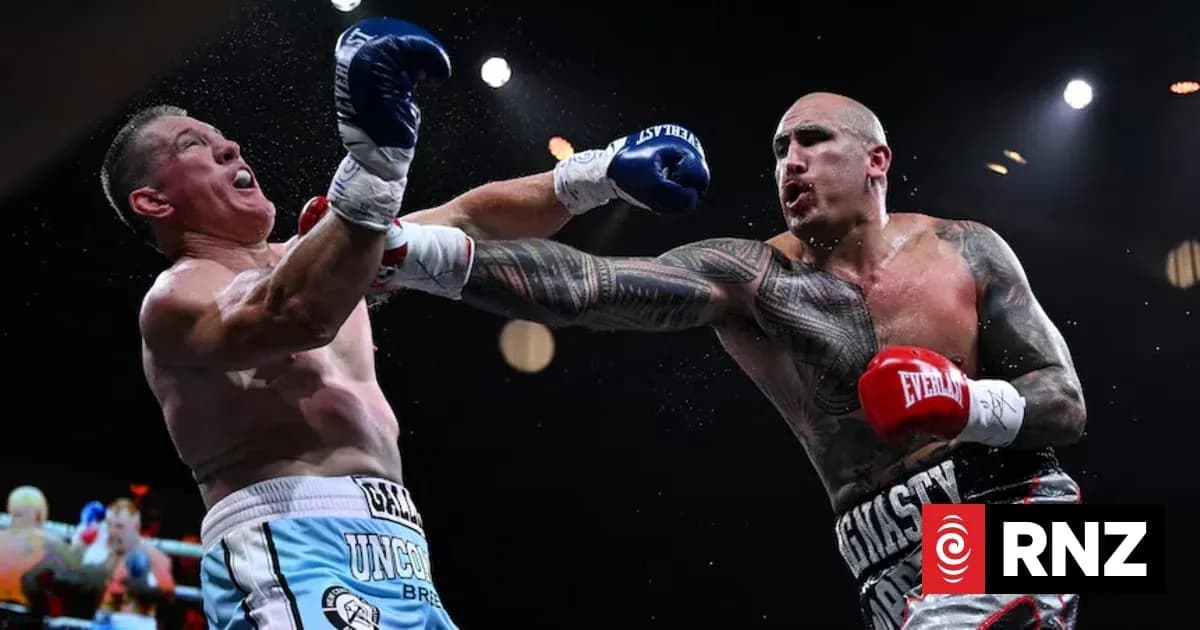
Nelson Asofa-Solomona’s knockout of the 45-year-old at the TikTok Entertainment Centre was brutal even by fight game standards. The replays told one story. The faces of those watching told another.
Michael Ennis, Gallen’s former Cronulla Sharks teammate, looked rattled on commentary, admitting he struggled to watch it back. Tim Tszyu called it “frightening”. The word didn’t feel excessive.
In real time, it was worse.
“Oh jeez, oh no!” gasped caller Ben Damon on Main Event as Asofa-Solomona’s right hand detonated on Gallen’s blank, unresponsive face. Ringside, Danny Green’s instinctive reaction cut through the noise.
“The last one was the worst one, boys,” he said, before repeating, “That was the one he didn’t need.”
Damon could only add, “That’s no good,” as Green again circled back. “The last one was a bad one.” Finally, a shaken Damon summed it up: “That’s hard to watch.”
The whole thing lasted just two minutes and 56 seconds. Not even a full round. In that short window, Asofa-Solomona showed he has the raw power to climb boxing’s Penrose stairs – that strange, endless ascent – and at the same time raised serious questions about whether he should.
The opening minute was measured. Gallen probed, Asofa-Solomona stalked. Then the fight flipped.
A thunderous right hand from the 208cm Melbourne Storm enforcer rocked Gallen backwards, his legs stiffening as he shuffled towards the ropes. A left-right combination crashed in and pinned him there, his body upright but his senses clearly scrambled.
Asofa-Solomona saw it. Gallen’s head snapped back, his arms flailed, his guard dissolved. The opening for the uppercut appeared and the big man didn’t hesitate.
He drove the shot through with hideous force. Gallen sagged, teetering on the edge of consciousness.
The next punch shoved him over that edge. A second uppercut, savage and clean, dumped him into the darkness.
But Asofa-Solomona kept firing.
As Gallen crumpled, a third uppercut skimmed his famously granite chin, the veteran collapsing into a seated heap, legs folded underneath him like a discarded marionette. His body was there. His awareness was not.
Still, Asofa-Solomona threw again.
Referee Chris Condon hurled himself between the fighters, a black-shirted barrier finally arriving to end punishment that had already gone on too long. Even as Condon intervened, another sickening blow arced toward the head of a man who was clearly finished.
Some will scoff at moral outrage in a sport built on sanctioned violence. This is boxing, after all.
Earlier on the same card, Paulo Aokuso had landed a perfectly timed left hand on Mobin Khahrazeh that had observers purring over its precision. The sport rewards exactly that – the punch that switches off the lights, the shot that scrambles a brain for the sake of spectacle.
Yes, the aim is to knock the other person out. Yes, the game is inherently dangerous.
But even inside this controlled barbarism, there are lines. They are written into rule books and etched into the unwritten code of the ring.
The Australian National Boxing Federation spells it out plainly:
“Some fouls for which a referee may penalise or disqualify a boxer are: (a) Hitting an opponent who is down or is rising from a knockdown.”
There are nuances. From the first of those crushing uppercuts to Condon’s stoppage, only eight seconds elapsed. The four uppercuts themselves landed in roughly two-and-a-half horrific seconds. That is barely enough time for anyone to process what they are seeing, let alone a fired-up novice swinging for his sporting future.
But Gallen was down. More importantly, he was out.
Across generations, fighters have learned to recognise that moment – the instant when the man in front of you is no longer a rival but a defenceless human being. The greats pull their punches then. The rest at least try.
Hitting an unconscious opponent crosses an invisible line. It shreds the thin veil of honour that allows two people to punch each other in the head and still talk about respect and brotherhood when they touch gloves.
On Wednesday, Asofa-Solomona tore straight through that line.
His adrenaline didn’t fade with the stoppage either. Moments later, he launched himself towards the crowd, vaulting the ropes in a wild dash at a spectator. The scene added another layer of chaos to an already unsettling finish.
There was context, as Asofa-Solomona explained at the post-fight press conference.
He told reporters that he had been subjected to a racist taunt from the stands.
“Someone was doing an ape gesture. I stood on the ropes and it looked like someone threw something at me,” he was reported as saying.
“If I had my time back, I would, because that’s not on. But what that guy did to me, in terms of that gesture, is not on either.”
Racist abuse is indefensible. Nobody should ever be forced to swallow that kind of foul, vindictive, uneducated garbage. Nobody has the right to dictate exactly how a person should react when it’s hurled at them.
But the ring is different. In there, responsibility cuts both ways.
Nelson Asofa-Solomona has raw, terrifying power and the kind of presence that can move a crowd. If he keeps boxing, those qualities will bring more big nights, more knockouts, more attention.
The next time he lands a finishing punch, he will need something else too – the cold, disciplined instinct to stop before his sport’s darkest risks become his burden to carry.