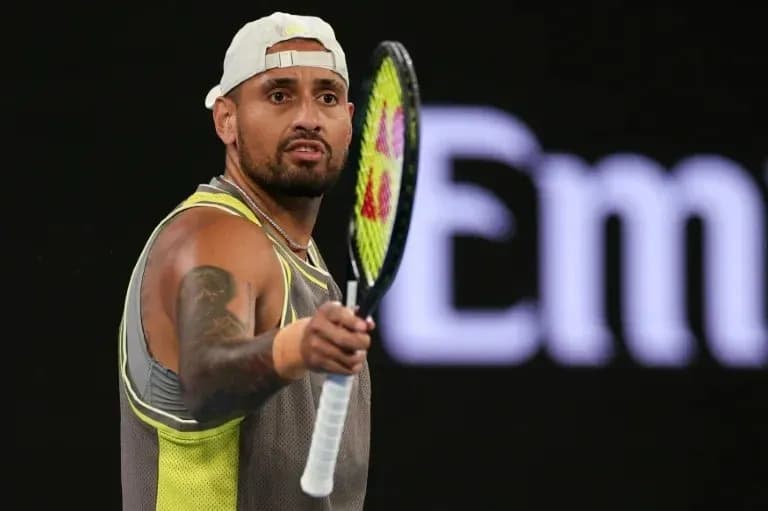
Nick Kyrgios has been cleared to return to tennis after accepting a one‑month ban for cocaine use and enrolling in a treatment programme, drawing a stark new line in one of the sport’s most turbulent careers.
The 31-year-old Australian, a Wimbledon finalist in 2022, failed a doping test at the ATP event in Mallorca on June 22 and was provisionally suspended on August 4 by the International Tennis Integrity Agency (ITIA). He admitted then he had made “a huge mistake”.
On Friday, the ITIA confirmed that mistake will not end his career.
Cocaine use ruled out of competition
Kyrgios told investigators his cocaine use happened socially during a night out before he was due to play in Mallorca, not as part of any attempt to enhance performance. The ITIA turned to an independent scientific expert at a World Anti-Doping Agency (WADA)-accredited laboratory, who concluded that his account matched the level of cocaine detected in his sample.
That detail proved crucial.
“As a result, the ITIA accepted that Kyrgios’ use of cocaine was outside of competition,” the agency said.
Under WADA rules, a violation of this kind carries a standard three-month suspension. That ban can be cut to one month if the player commits to a recognised treatment programme. Kyrgios has done exactly that.
The ITIA confirmed he has entered treatment and set the formal end of his suspension as September 3, 2026, contingent on him completing the programme. Any prize money and ranking points earned in Mallorca will be wiped from his record.
A career of brilliance and bruises
Kyrgios’ story has never been straightforward. Armed with a huge serve, explosive groundstrokes and a showman’s instinct, he climbed to No. 13 in the world in 2016 and collected seven ATP singles titles. At his peak, he looked capable of beating anyone, anywhere, on his own terms.
Wimbledon 2022 was his masterpiece. He surged through the draw on grass that seemed made for his game, only to fall in four sets to Novak Djokovic in the final. It remains the high point of his career.
The years since have been dominated less by box-office tennis and more by medical reports. A string of injuries have carved into his schedule, culminating in a full reconstruction of his right wrist in 2024. His ranking has collapsed to 918, a number that barely fits the scale of his talent but reflects how little he has been able to compete.
His last appearance on tour came as a wildcard in the men’s doubles at Wimbledon this July, partnering Alexander Bublik. They went out in the first round, another brief, flickering glimpse rather than a sustained return.
Public remorse and a fragile reset
When news of the failed test broke last month, Kyrgios did not try to hide.
“I recently failed a drug test in Mallorca after testing positive for cocaine,” he wrote on Instagram. “I made a huge mistake and I take full responsibility for it.
“I’m sorry to my fans, my family, my sponsors and everyone close to me. Above all, I’m sorry to the kids who follow me. I know the example this sets and I’m deeply disappointed in myself.”
Those words now sit alongside the ITIA’s ruling as the official record of this episode: a confession, a sanction, and a conditional second chance.
Kyrgios is free to step back onto a court once his short suspension and obligations are met, but the terms are clear. The ban ends on September 3, 2026, only if he completes the treatment programme. His slate from Mallorca is wiped clean. His reputation is not.
For a player who has always walked the tightrope between genius and self-destruction, the next chapter will not just be about whether his body can hold up, or whether that serve still cracks like thunder.
It will be about whether he can finally keep his career from tearing itself apart.