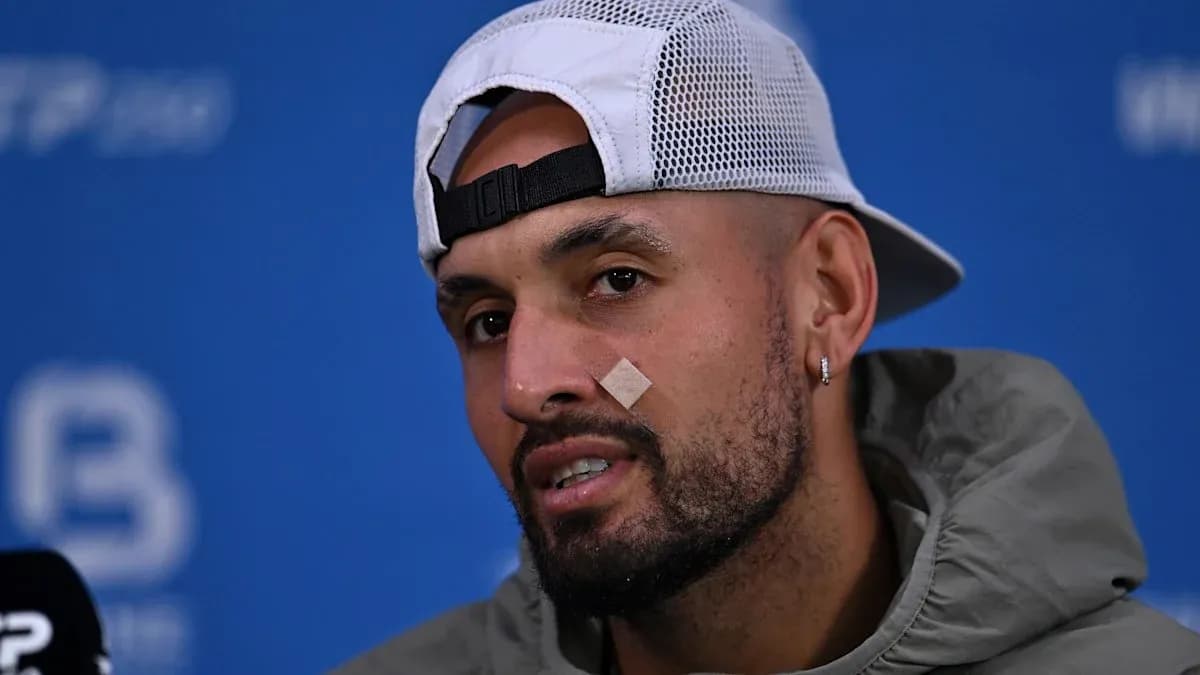
Nick Kyrgios has been cleared to return to professional tennis after accepting a one‑month ban for testing positive to cocaine, a suspension backdated to early August and now officially served.
The International Tennis Integrity Agency (ITIA) confirmed on Friday that the Australian’s provisional suspension, imposed on August 4, expired on Thursday, opening the door for the 31-year-old to compete again — if his body allows it.
Kyrgios tested positive for a metabolite of cocaine during an ATP Tour event in Mallorca in June. He told ITIA investigators he had taken the drug while out partying on a night before the tournament began, not during competition.
ITIA officials consulted World Anti-Doping Agency (WADA) scientists, who assessed that the level detected in his sample matched his account of out‑of‑competition use. On that basis, the integrity body accepted that Kyrgios had not used cocaine in a way that might have directly influenced his performance on court, a key distinction under the code.
That nuance mattered.
Under WADA rules, the default sanction for this type of violation is three months. It can be cut to one month if the player agrees to undertake a recognised treatment program. Kyrgios accepted the reduced penalty and has committed to completing that program, with the threat that his ban could be reinstated if he fails to follow through.
When the positive test became public last month, Kyrgios moved quickly to address it. On social media, he called it “a huge mistake” and said he took “full responsibility,” before opening a rare window into his mindset as his career fades from the heights it once reached.
“My body hasn’t been able to do what my mind expects it to do... Coming to terms with being near the end of my career has been harder than I ever imagined,” he wrote.
If the statement was contrite, the reaction inside the locker room was anything but forgiving.
Kyrgios has long positioned himself as an outspoken critic of fellow professionals who fall foul of anti-doping rules. That history came back at him. Sympathy was in short supply.
Former world No.1 Simona Halep, herself dragged through a high-profile doping saga, was among those who publicly took aim at the Australian. At the US Open this week, Stefanos Tsitsipas went further, suggesting Kyrgios’ drug use was widely known among people on tour. Tsitsipas and Karen Khachanov both made it clear they felt no urge to offer support to a player who had rarely extended that courtesy to others.
It is a stark contrast to the way Kyrgios once lit up the sport.
At his peak, he climbed to No.13 in the world rankings and, in 2022, rode a wave of form and theatre all the way to the Wimbledon final, where only Novak Djokovic stopped him. That run felt like a belated realisation of the raw talent that had teased tennis for a decade.
Since then, his body has broken down repeatedly. Injuries have stripped away his explosiveness, his schedule, and eventually his ranking. He now sits at No.918, a number that underlines how far he has drifted from the game’s sharp end.
The ban is over. The treatment program awaits.
The real question is whether Kyrgios has either the physical resilience or the appetite to fight his way back from the margins, or whether this latest chapter is simply another sign that his turbulent career is winding towards its final act.