NEW YORK — On a court he has ruled for a generation, Novak Djokovic finally looked mortal.
The king of the opening round, unbeaten in his last 77 first matches at Grand Slams, walked out of Arthur Ashe Stadium late Sunday night beaten, bent and bewildered. The man who almost never loses early lost in a way he never has before — in five sets, in visible agony, to a player who has never stood among the game’s giants.
Mariano Navone, a clay-court grinder from Argentina ranked inside the top 50 but outside the sport’s pantheon, sent Djokovic out of the U.S. Open, 7-6(5), 5-7, 4-6, 6-2, 6-1, in four hours and 36 minutes that felt less like an upset and more like a reckoning.
A streak ends, and something more
Djokovic had not lost a first-round match at a major since the 2006 Australian Open, back when he was world No. 76 and still figuring out who he might become. Since then, he has treated opening rounds as formalities, the first pages of another deep-run script.
Sunday shredded that script. It wasn’t just the result. It was the way the night unfolded, the way the 39-year-old body that has so often seemed bionic suddenly looked like everyone else’s.
He started like the old Djokovic, ripping three aces in his first two service games, racing to a 3-0 lead, dictating rallies. Then the match lengthened. Navone dug in. The points stretched. And Djokovic’s night began to unravel.
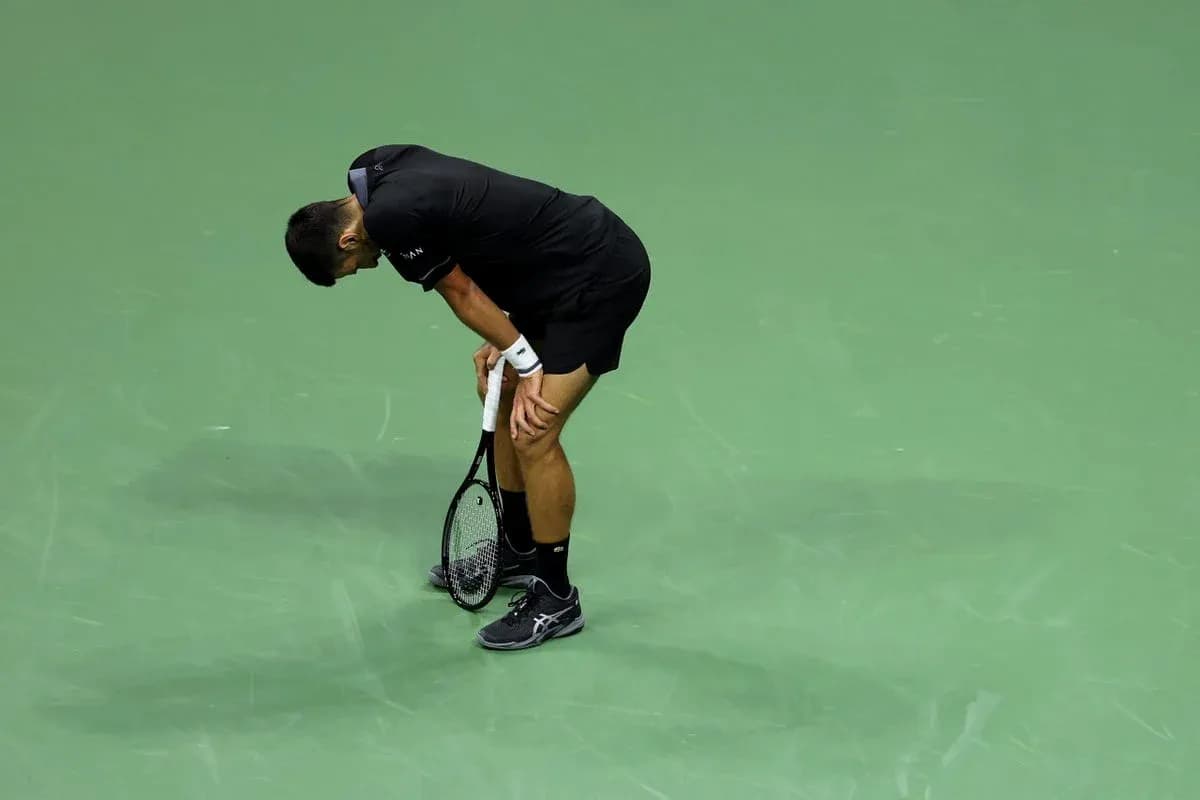
The roof closed after early rain, the air conditioning kicked in, and the weather ceased to matter. The physical struggle did not. By the middle of the first set, Djokovic’s movement dulled. He bent over between points. He gave back the early break. The match stopped looking like a routine night session on Ashe and started to resemble a test of endurance he no longer seemed equipped to pass.
Navone took the opening-set tiebreak — the kind of moment Djokovic has owned for years — and the unease in the stadium deepened.
A body betrays its owner
The numbers told one story. The visuals told another.
Djokovic still owned the short points. When rallies ended in four shots or fewer, he held the advantage, as always. When they went longer, Navone took control, dragging him side to side, forcing him to hit one ball too many on a dank, humid night that was not especially hot but felt suffocating for one man.
In the seventh game of the third set, Djokovic leaned over a courtside bin and vomited mid-game. Later came the cramping, the limping, the grimaces, the visible sag in his shoulders after each punishing exchange.
“An awful feeling on the court for me,” he said afterward outside the locker room, drained and hollow-eyed. He spoke of vomiting, of his body “start[ing] to collapse,” of cramping and pain, of his back and shoulder “giv[ing] up” as he tried to finish a match he had once seemed to control.
He said the struggle had started as early as the fourth game. He also tried to keep a sliver of the spotlight on Navone, calling him “a nice guy, a fighter.”
The larger question hung over everything: can he fix what is happening to his body?
“I’m trying, man, I’m trying,” he said. “Let’s, let’s see.”
A familiar court, an unfamiliar script
This was Djokovic’s house. Navone had barely visited.
Djokovic has played almost all of his U.S. Open matches on Ashe for 15 years, winning the title four times and imposing his will on countless nights like this, especially under the lights and indoors, where he has long been nearly untouchable.
He owns 101 career titles, trailing only Jimmy Connors and Roger Federer. Navone? One ATP title, on clay, the surface that feeds his game and his ranking. This was just his third main-draw appearance at the U.S. Open and his first match on Ashe. Before Sunday, he had won a single match at this tournament.
If Djokovic could have drawn up a first-round opponent to ease into the fortnight, Navone might have made the list.
Yet it was Navone who refused to blink. He stole the first-set breaker. He survived two break points early in the third set. He withstood the moment in the fourth when Djokovic, up a break and seemingly steering the match toward its expected conclusion, tried to suffocate him with experience and guile.
Djokovic broke to start that fourth set, coaxing errors, shortening points, bringing the finish line into view. The stadium sensed the familiar turn. The champion had steadied. The challenger had had his moment.
Navone ripped that script apart. He broke back immediately, then again a game later as Djokovic’s body sagged and the match swung decisively.
The fifth set and the fall
Djokovic took a medical timeout before the decider. A trainer worked on his lower back, one more attempt to patch together a frame that once seemed indestructible.
It wasn’t enough.
In the second game of the fifth, Navone drove the final wedge between past and present. He pushed Djokovic corner to corner, then lured him forward. As Djokovic advanced, Navone threaded a backhand down the line. Djokovic lunged, tried to half-volley, and failed. The next steps were a stagger, then a limp. The roar of Ashe turned into a kind of hush, the noise of a crowd watching a great athlete age in real time.
By the fifth game of that set, tears slipped from Djokovic’s eyes. His wife, Jelena, and their children, Stefan and Tara, sat courtside, their expressions darkening with every changeover, every lost point, every wince.
He tried to fight. He always does. But the scoreline — 6-2, 6-1 in the final two sets — told the story of a player whose tank had emptied long before the handshake.
The weight of recent years
This was not an isolated bad night. It felt like the culmination of whispers that have grown louder over the past two seasons.
Djokovic has spoken often about how demanding best-of-five tennis has become. He talks of limited hours in his body, of the cost of long early matches that leave him depleted in the second week, when the opposition hardens and the margins shrink.
Even if he had survived Navone, his 2026 U.S. Open already looked compromised midway through the third set, when the grimaces grew sharper and the rallies shorter.
The signs had been there. After a vintage five-set win over Félix Auger-Aliassime en route to the Wimbledon semifinals, he was routed in straight sets by Jannik Sinner, the world No. 1 and a one-time protege. Late in that match, when a fan tried to reassure him he could still hang with Sinner, Djokovic’s reply cut through the noise: “Maybe 10 years ago.”
He went on vacation after that defeat, retreating into family life. He hit with Jelena, with Stefan and Tara, but did not grind through the usual hard-court preparation.
When he returned at the Cincinnati Open this month, he looked miles from ready, losing his first match to Thiago Tirante and wilting in the heat and humidity. He alluded to a medical condition he has been managing for a couple of years but declined to offer details.
In New York, during his pre-tournament news conference, he insisted he had used the extra time to train.
“Two weeks, to really train and get my body and mind into the right state, prepared for what’s coming up,” he said. “If you ask me if I’m prepared, I feel like I am, you know, as best as I can be, but it’s different training and then getting out on the Arthur Ashe Stadium and playing best of five.”
He also acknowledged how treacherous opening rounds had become.
“Hopefully I can overcome, you know, the first hurdle and build from there,” he said.
On Sunday, that first hurdle became a wall.
A champion and the unknown
By the end, the match had stopped being about Navone’s night — though he earned every inch of it — and turned into something larger: a portrait of a legend wrestling with his own limits.
Djokovic apologized for not performing as he wanted, echoing the scene five years ago when, one match away from a calendar Grand Slam, he played one of his worst matches of the season in the U.S. Open final. That day, the New York crowd rallied to him in a way it never had, and he wept on his bench.
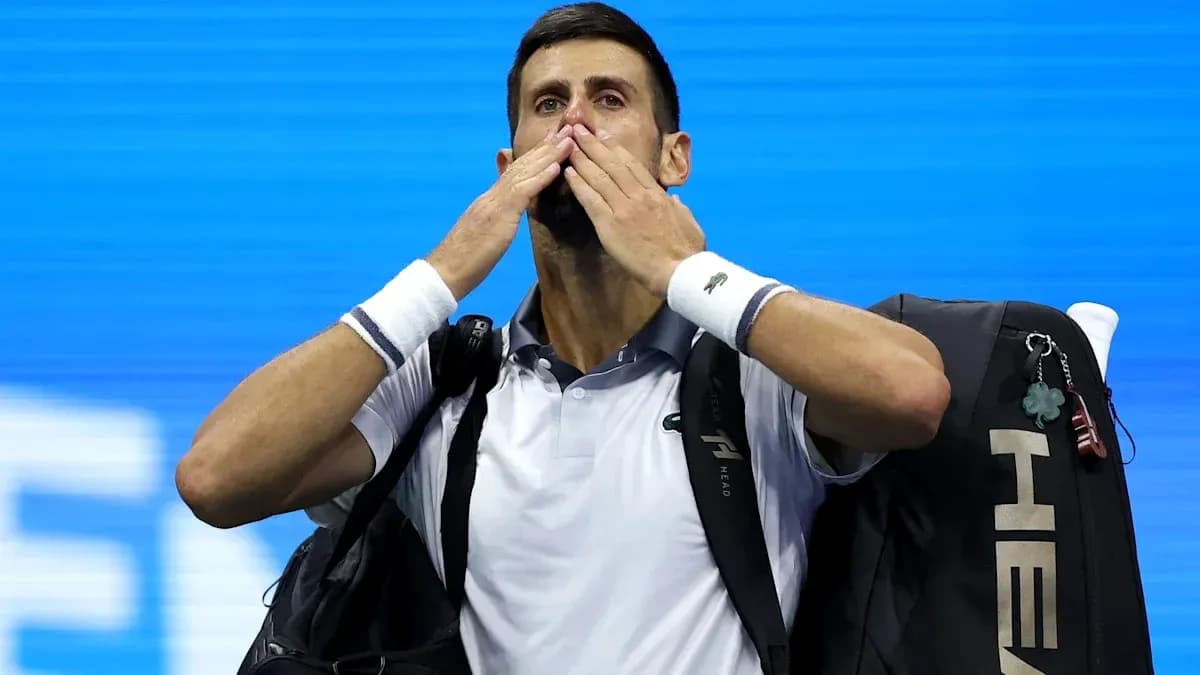
This time, as he walked off Ashe, he turned to each side of the stadium and formed a heart with his fingers, a small, familiar gesture that felt heavier than usual.
Earlier this summer, he had released a documentary titled “The Wolf in Winter,” a declaration of his refusal to bow to the end of one of the sport’s greatest careers.
On this night in New York, under the closed roof and the bright lights of a court he has owned, the winter he has long tried to outrun felt closer than ever.