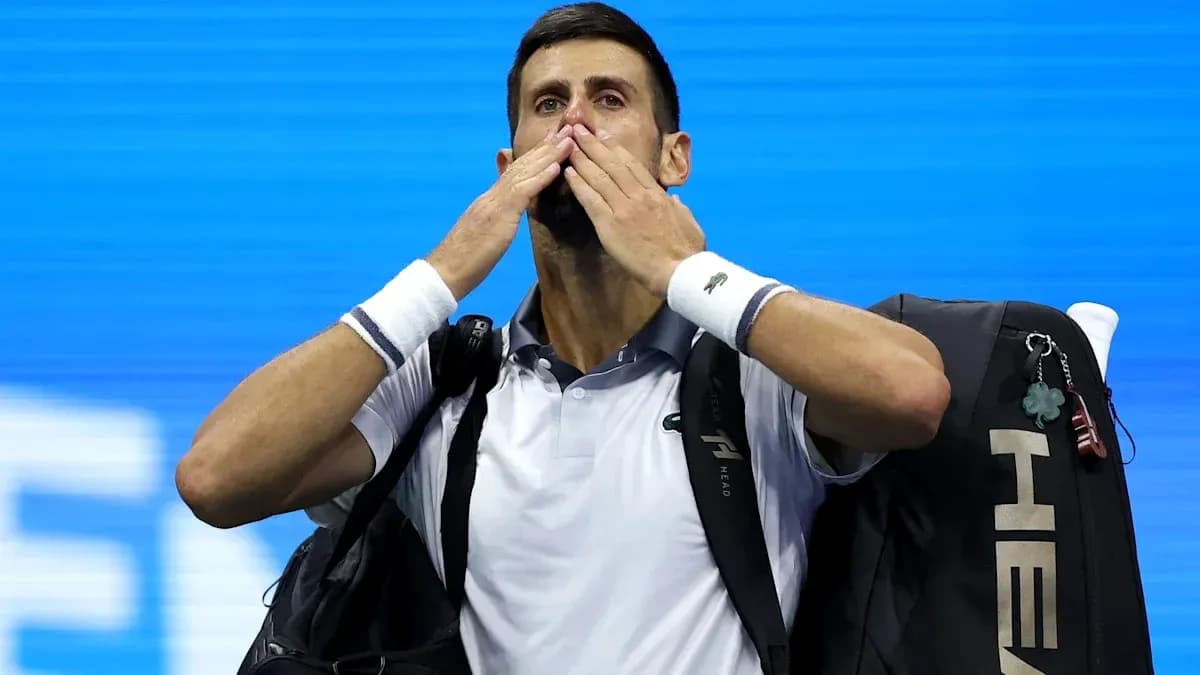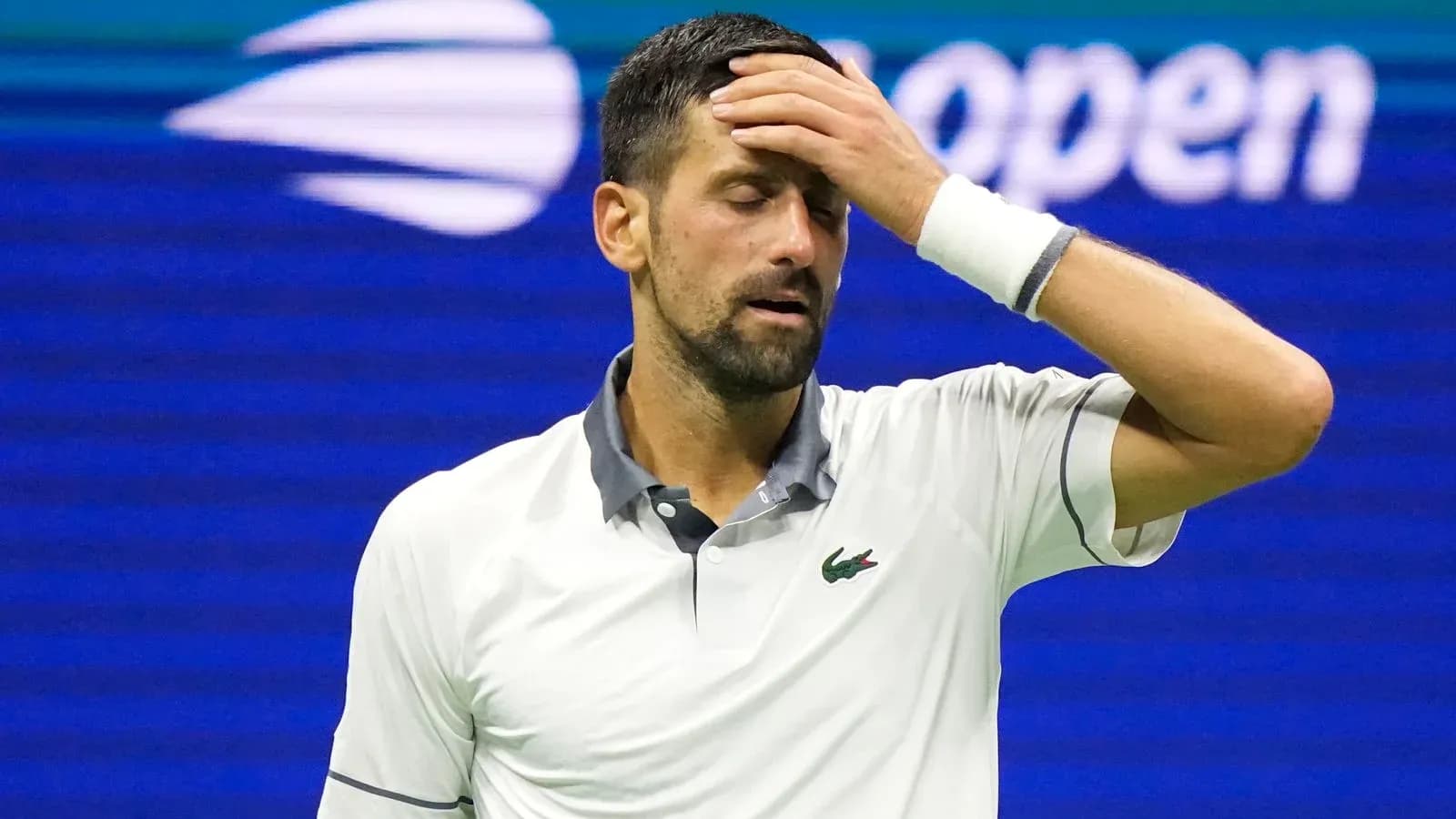
Novak Djokovic walked into Arthur Ashe Stadium chasing history. He left it bent over a courtside towel box, emptied out by the heat, his body, and a 25-year-old Argentine who refused to blink.
On a sticky New York night, Djokovic’s bid for a record 25th Grand Slam title and a fifth US Open crown was ripped up in the first round by world No 49 Mariano Navone, who stunned the 39-year-old 7-6 (7-5) 5-7 4-6 6-2 6-1 in four hours and 36 minutes.
It was the longest opening match of Djokovic’s Grand Slam career. It was also his earliest exit at a major since the 2006 Australian Open. The numbers alone tell you this was no routine upset. The images told you more.
A champion unravels
Djokovic has built a career on dragging opponents into deep water and surviving longer than anyone thought possible. He came into the night with a 42-12 record in five-set matches. Navone? 0-4.
The script felt familiar when Djokovic surged 3-0 ahead in the first set. Then the air thickened, the rallies lengthened, and the world No 2’s face turned a worrying shade of red. His hair was soaked, his shirt clinging to him. The lead vanished. Navone held his nerve in the tie-break, and the tone of the night changed.
Djokovic had already asked for the roof to be closed to ease the conditions. It didn’t help. He battled, of course he did. With his wife Jelena and their children watching on, he clawed back the second set, breaking for 6-5 after vomiting by the towel box, then serving it out.
He was sick again in the third, even with the air conditioning on. Still he found a way, snatching the single break he needed and moving within a set of the second round. This is the Djokovic tennis has known for two decades: hurting, but hunting down the finish line.
Then his body called time.
“I didn't enjoy myself,” he admitted afterwards. “I think it was obvious that it was an awful feeling on the court for me.
“It's something that I've been carrying, unfortunately, pretty much every match this year. Vomiting, throwing up, a serious issue there. Then my whole body started to collapse, basically cramping and pain.
“The back just gave up in the end and shoulder, and I couldn't close it out.
“I was a break up in the fourth, but just struggled all the way since the fourth game of the match.
“I don't want to take too much out of his win. Congrats to him. He's a nice guy, a fighter. But I didn't enjoy myself.”
The body breaks, the underdog rises
The warning signs had been there. Two weeks earlier in Cincinnati, Djokovic ended his match against Thiago Tirante on his knees, sick into a towel, later revealing he has a long-standing health issue that flares in heat and humidity.
New York was warm, but nowhere near the brutal levels of Cincinnati. Still, by the middle of the first set his body looked under siege. By the start of the fourth, it was in open revolt.
Djokovic vomited again, then somehow broke for 2-1. For a fleeting moment, it looked like another grimly familiar tale: the great survivor, patched up and prowling towards the line.
Navone refused to play his part.
The Argentine, who won his first ATP singles title earlier this year, kept swinging, kept running, kept believing. When Djokovic fired a shot wide in the fourth set, landed awkwardly and dropped his racket, the shift was obvious. The Serb looked like a man whose resources had finally run dry.
Navone levelled the match, then ran away with the decider as Djokovic cramped and laboured, barely able to move. The final set was brutal in its simplicity: 6-1 to the underdog, the favourite winning just one more game as his 70 unforced errors piled up.
By the time it ended, minutes before midnight, Djokovic was a shadow of the player who has dominated this sport. He will now fall out of the ATP top 10 for the first time in eight years.
Across the net, Navone stood in the spotlight he had once only imagined.
“It was very tough for me because you are playing with the ‘GOAT’ on this court,” he said, having grown up idolising Djokovic.
“For sure it's the best thing I've had on court. This is an amazing court and the biggest stage. It's amazing, the way we play. I mean, five sets. I'm very happy. I don't know. What can I say?”
A night that felt bigger than one defeat
This was not just a first-round shock. It felt like a line in the sand.
Djokovic’s greatness has always rested on two pillars: an iron mind and a body that could withstand almost anything. The mind still snarled and fought on Ashe. The body did not. It buckled under heat he once devoured, under a workload he once relished.
He spoke of a “serious issue” that has dogged him for years, one that leaves him vomiting and drained in these conditions. On this night, it turned a player who has so often looked ageless into one who suddenly seemed every bit of his 39 years.
The question now hangs over Flushing Meadows and the sport beyond it: was this just a brutal, isolated night in New York, or the beginning of the end of Djokovic at the very top of the Grand Slam mountain?
For the first time in a long time, even he does not seem to have the answer.