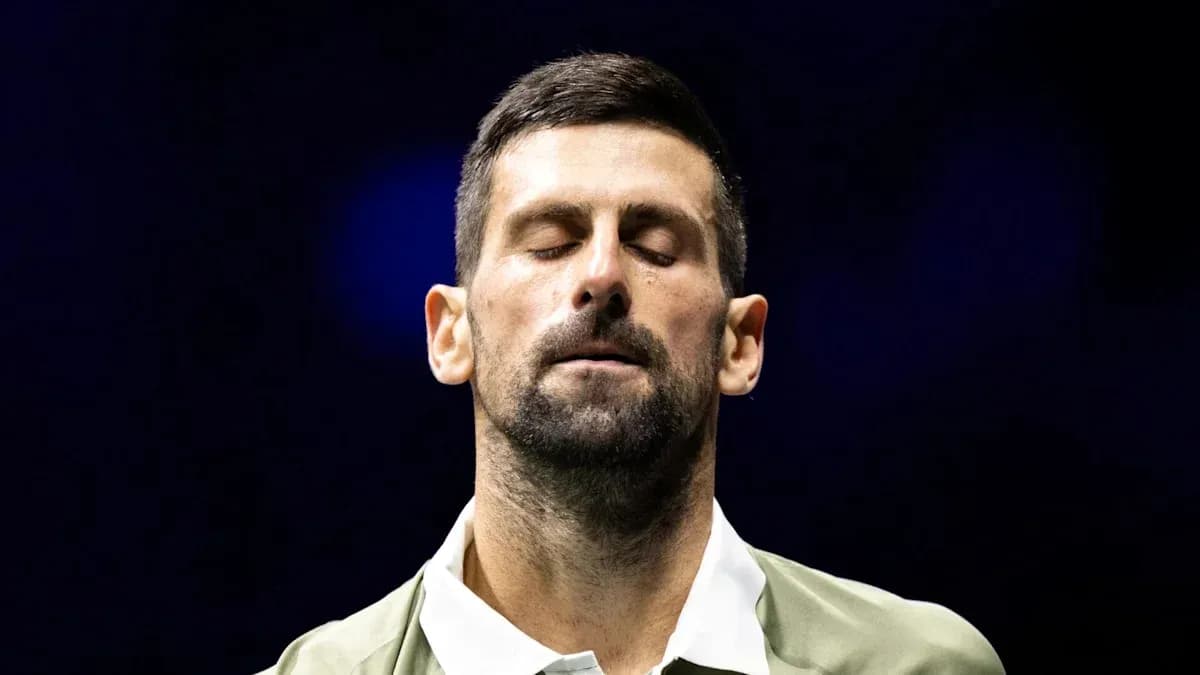
Novak Djokovic has called time on his 2026 season, and not on his own terms. The decision comes after a bruising second-round exit to Rinky Hijikata at the Paris Masters, a result that shut the door on his hopes of reaching the ATP Finals and underlined just how different this year has been for the 24-time Grand Slam champion.
For the first time in 21 years, Djokovic has gone through a season without reaching a Masters 1000 quarter-final. He played Indian Wells, the Italian Open, the Shanghai Masters and Paris. None of them yielded a last-eight berth. For a man who built a career on owning these stages, that statistic alone tells the story.
Hijikata was the 10th different player to beat Djokovic in 2026 – and the lowest-ranked of them. Ten defeats in a single season. It is an ordinary number for most, a jarring one for him.
A Year That Promised a Different Script
The season did not begin like a farewell tour or a slow fade. Djokovic opened 2026 by tearing through the draw at the Australian Open, dismantling two-time defending champion Jannik Sinner to reach his first Grand Slam final since Wimbledon 2024. Melbourne looked ready to crown his 25th major.
He even led Carlos Alcaraz in that final, taking the first set and standing within two sets of history. Then the match flipped. Alcaraz surged, Djokovic faltered, and the Spaniard handed the Serbian his first defeat of the year. What could have been a coronation instead became a warning that the balance of power at the top might be shifting for good.
Djokovic then disappeared from competition until Indian Wells. When he resurfaced in the Californian desert, he battled into the fourth round but fell in a thriller to Jack Draper – one of only eight wins the Brit would collect all year. It was the kind of upset that once felt almost unthinkable in a Masters event involving Djokovic. Now it was a sign of things to come.
Clay Brings No Comfort
Clay used to be the surface where Djokovic proved he could chase down even Rafael Nadal’s shadow. This year, it exposed him.
He opened his clay campaign at the Italian Open and crashed out early to Croatian qualifier Dino Prizmic. Not a rising superstar, not a seasoned rival – a qualifier. Rome, once a fortress, suddenly looked fragile.
Roland Garros offered no reprieve. Djokovic suffered his earliest exit there in 17 years, beaten by another young talent, Joao Fonseca. The defeat did more than end a tournament; it broke one of the longest-running habits in men’s tennis: Djokovic going deep at the majors almost by default.
Wimbledon Revival, Then Hard-Court Collapse
Just when the whispers about decline grew louder, Wimbledon arrived – and with it, a familiar version of Djokovic. On the lawns he knows better than almost anyone, he pieced his game back together, navigating his way to a semi-final for the eighth consecutive time at the Championships.
Waiting for him there was Sinner again. The Italian, no longer the apprentice, sent Djokovic out and underlined the generational handover that has hovered over the sport for the last few seasons.
From there, the North American hard courts should have offered Djokovic a chance to reset. Instead, they became a nightmare. He did not win a single match at either the Cincinnati Open or the US Open.
In Cincinnati, Thiago Agustin Tirante stunned him. At the US Open, Djokovic lost in the first round of a Grand Slam for the first time in 20 years. Two decades of always being a factor at the majors, gone in a single evening.
A Lone Title in Beijing
The response came in Asia. In Beijing, Djokovic reminded everyone that he still knows how to dominate a field. He tore through the China Open, beating Alexander Zverev, Daniil Medvedev and Alex de Minaur, and maintained his perfect record in the Chinese capital. It was his only title of 2026, a bright, sharp spike on an otherwise uneven graph.
That run pushed him into a strong position to qualify for the ATP Finals, a clear goal he had set for himself. The path looked open. His résumé suggested he would walk it.
Then the losses returned.
In Shanghai, Hubert Hurkacz stopped him. In Basel at the Swiss Indoors, Jan-Lennard Struff did the same. In Paris, Hijikata completed the trio. Three players he had never lost to before, three more reminders that the aura which once smothered opponents now flickers rather than blazes.
With the defeat in Paris, Djokovic’s chase for Turin is over. So is his season.
Outside the Top 10, Eyes Still on 25
The highest ranking Djokovic managed in 2026 was world No. 3. By the end of this punishing campaign, the 39-year-old has dropped outside the top 10 – a place in the standings that used to feel like his permanent address.
Yet he is not walking away.
Djokovic has been clear: he intends to keep playing next year, still hunting that elusive 25th Grand Slam title that would push his record even further out of reach. The body has been tested, the results have wobbled, the calendar has taken its toll.
But the question that will follow him into 2027 is simple and unforgiving: after a year like this, can he still bend the sport to his will one more time?