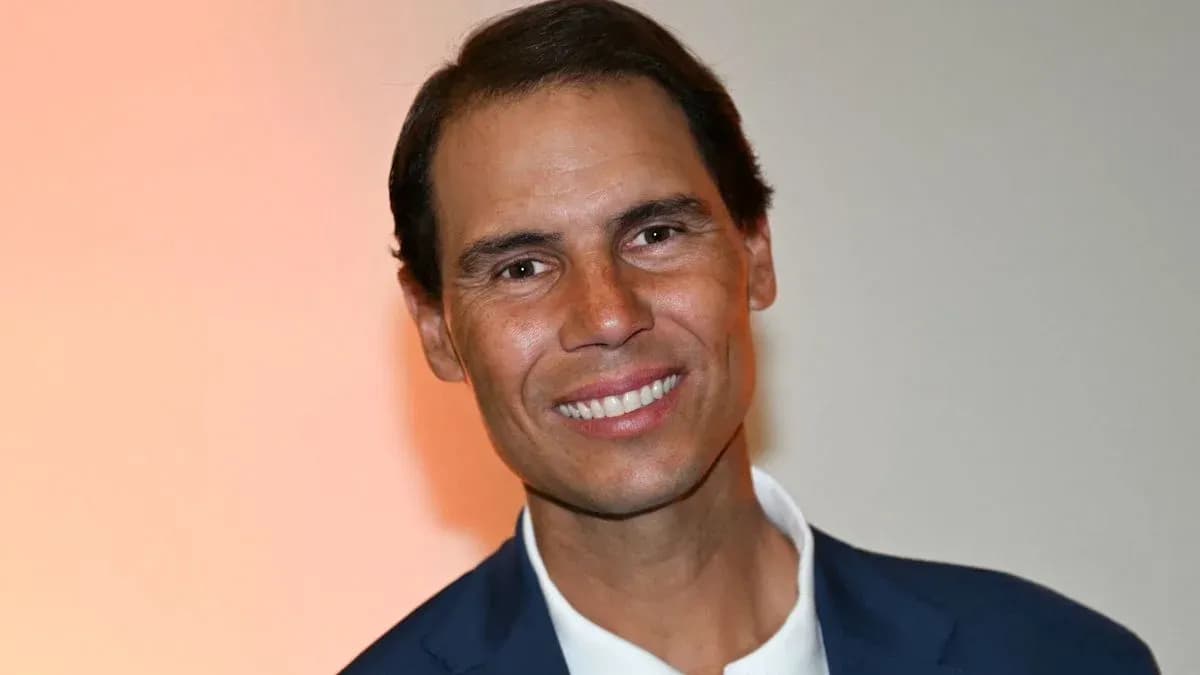
Rafa Nadal’s summer looked nothing like Centre Court.
No roaring crowds, no taped ankles, no desperate lunges at the baseline. Instead, the 22-time Grand Slam champion opened a rare window into his private life, sharing a series of photos that show him not as a global icon, but as a husband, son, brother, and—most of all—a father.
The post begins with a simple family snapshot. Nadal, his wife Mery Perelló, and their eldest son, little Rafa, beam at the camera. Behind them, a toy Jeep and a dinosaur loom into view, props of a childhood adventure at what appears to be Dinopark Funtana in Croatia. The scene feels a long way from Wimbledon or Roland Garros, yet it carries the same warmth that has defined Nadal’s relationship with fans for two decades.
Then the circle widens.
Other images bring in the pillars of his life: his children, Rafael and Miquel, Mery by his side, his mother Ana Maria, his father Sebastian, his sister Maribel, and his uncle Miguel Ángel. The Nadal clan appears at beaches, by waterfalls, and at busy tourist spots, the kind of family holiday that millions of people take each year—only this one belongs to one of the most recognizable athletes on the planet.
“Summer 2026 in family,” Nadal wrote as a caption, adding a smiley emoji. Four words, one symbol, and a clear message: this is where his energy is going now.
For those who have followed his career closely, none of this feels out of character. Nadal has long framed his success around the strength of his family. His parents, his sister, his wife, his children—they have all featured prominently in the way he talks about happiness, stability, and perspective. His uncle Toni, who coached him through much of his career, is often credited as one of the architects of his competitive edge and mental toughness.
That bond with family stretches beyond his own home. It shaped the way he reacted to one of the summer’s most emotional stories in sport: Lionel Messi losing his father, Jorge.
As news broke of Jorge Messi’s passing, Nadal didn’t stay silent. He posted a heartfelt message, stripped of any formality, speaking directly to a fellow great who suddenly found himself facing something far bigger than football.
“Dear Leo Messi, I can't imagine the pain you're going through. I'm sending you all my love and all of my condolences to you and your family in these challenging times. Rest in peace, Jorge,” Nadal wrote.
No analysis. No platitudes. Just one champion reaching out to another, united by something that ignores medals, trophies, and Ballon d’Ors.
Messi’s own story has always been tied tightly to his father. Jorge Messi wasn’t just a parent; he was his son’s agent and constant companion through the turbulence of a career that began with a transatlantic leap from Rosario to Barcelona. Their partnership shaped one of the greatest football journeys ever seen.
The depth of that relationship came through years ago in a 2007 radio interview, when Messi spoke candidly—then in Spanish—about what they endured together as he tried to make it in Europe.
“My old man was always by my side. We went through a lot of ugly things together,” Messi said. “Sometimes, I would shut myself in my room to cry alone, or he'd do the same, without me seeing him. We'd pretend we were both OK, but we weren't. My old man asked me, 'What do you want to do? Do you want to keep going or should we go back home?' I wanted to keep going, and he stayed with me.”
It is that version of Messi—vulnerable, young, on the edge of giving up—that gives Nadal’s message extra weight. One family man speaking to another who built his career on the quiet sacrifices of a father who stayed.
Scroll back to Nadal’s holiday photos and they take on a different tone. The beaches, the waterfalls, the crowded tourist spots are not just postcard scenery. They are moments he has earned after a life on the road, in hotels, on planes, and under the unforgiving lights of the biggest courts in the world.
He has spoken before about how those years of living out of suitcases pushed him toward new business ventures and projects that feel more rooted, more permanent. Yet nothing appears more grounding than these images: children on his shoulders, parents at his side, the man who once devoured clay courts now content to simply watch waves break on the shore.
Two giants of sport. One enjoying a quiet summer with his family, the other grieving the loss of the man who walked every step of his career with him.
Different paths, same truth: when the trophies are polished and the careers are weighed, it is the people around them—the ones in those family photos and the ones behind those old radio confessions—who define what all of it really meant.